





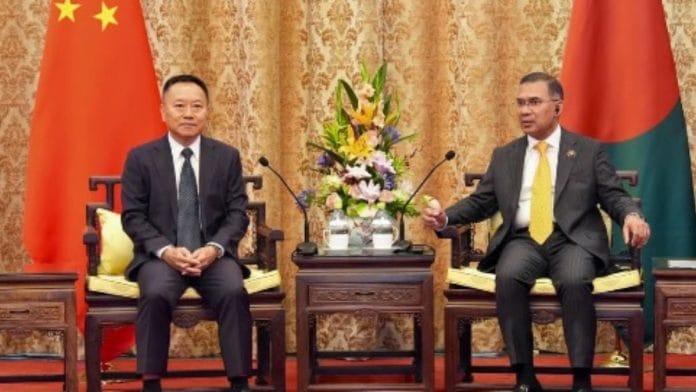


New Delhi: Bangladesh Prime Minister Tarique Rahman sought the Chinese government’s support for the long-delayed Teesta management project during his first official visit to China Thursday, deepening cooperation with China on a politically sensitive issue that has long complicated relations between Bangladesh and India.
During talks in Beijing, Rahman met with China’s minister of water resources, Li Guoying, and called for greater Chinese involvement in Bangladesh’s efforts to manage its rivers, reduce flooding and improve irrigation and navigation systems.
Central to those discussions was the Teesta River Comprehensive Management and Restoration Project, a Chinese-backed initiative that Bangladesh views as critical to the economic future of its northern districts.
According to Bangladesh’s Prime Minister’s Office (PMO), Li responded positively, promising broad cooperation on water-resource management and technical assistance for the Teesta project.
“The Prime Minister in the meeting seeks the support of the Chinese government in Bangladesh’s water resources management by citing the ongoing river excavation programme in the country aimed at tackling flood risk, environmental protection and proper management of water resources. The Prime Minister expects technical support from the China government in Bangladesh’s Teesta management project,” the Bangladesh PMO said in a statement in Bangla on social media.
China’s water resources minister responded positively and assured Bangladesh of comprehensive cooperation with the Bangladesh government’s water resources management initiatives, the statement added.
India’s caution
For years, India has viewed China’s growing role in the Teesta basin with caution. The river flows from the Himalayan region of Sikkim through India’s West Bengal state before entering Bangladesh, making it both a shared water resource and a strategic concern.
Particularly sensitive for India is the river’s proximity to the Siliguri Corridor, a narrow stretch of land often referred to as the “Chicken’s Neck”, which connects India’s northeastern states to the rest of the country.
Bangladesh and India share 54 transboundary rivers, and disagreements over water allocation have periodically strained relations between the two countries.
The Teesta dispute itself predates China’s involvement by decades. Negotiations over the Teesta have remained unresolved for more than 40 years despite repeated attempts to reach a formal water-sharing agreement.
A temporary arrangement reached in 1983 never evolved into a permanent treaty. In 2011, an interim agreement was about to take place during a visit by then Prime Minister Manmohan Singh to Dhaka.
The deal ultimately collapsed after opposition from Mamata Banerjee, then the chief minister of West Bengal, who argued that insufficient water remained in the river during the dry season to permit the proposed sharing formula.
Successive governments in Bangladesh have continued to press for a resolution. But with negotiations stalled and domestic demand for irrigation increasing, officials in Dhaka have increasingly signalled that they are unwilling to wait indefinitely.
“Bangladesh cannot just sit idle. We have our own work to do,” Foreign Minister Khalilur Rahman said in May before departing for Beijing, a day after the West Bengal election results were declared in India.
His comments reflected a growing sentiment within Bangladesh’s political establishment that development of the Teesta region must proceed regardless of the pace of negotiations with India.
China’s involvement in Teesta
China first became involved in the project in 2016, when the state-owned engineering agency PowerChina signed an agreement with Bangladesh’s Water Development Board to conduct technical studies along the river.
The resulting Teesta River Comprehensive Management and Restoration Project, formalised in 2019, envisions extensive river training works, embankment construction, land reclamation and water-storage facilities designed to improve dry-season water availability. In 2020, Beijing offered nearly $1 billion in financing for the initiative.
The project has gained renewed momentum amid shifting political dynamics in Bangladesh.
Chinese Ambassador Yao Wen visited the Teesta project area alongside Bangladeshi officials in January before the Bangladesh elections, describing the initiative as a priority for bilateral cooperation.
Bangladesh’s water resources interim adviser, Syeda Rizwana Hasan, said at the time that both governments remained committed to implementing what has become known locally as the “Teesta Mega Plan”.
Chinese officials have consistently framed the project as a technical and developmental undertaking rather than a geopolitical one.
During his visit to the river basin, Yao rejected suggestions that external political pressure was influencing the project and pledged to expedite ongoing feasibility studies.
For Bangladesh, the stakes are largely economic.
The Teesta irrigates some of the country’s most agriculturally important northern districts, including Nilphamari, Kurigram, Lalmonirhat, Gaibandha and Rangpur. Farmers there depend heavily on irrigation during the dry season, when river flows decline sharply.
Bangladesh maintains that water diversions at India’s Gazaldoba Barrage in West Bengal reduce downstream flows between December and May, contributing to agricultural losses and water shortages.
(Edited by Sugita Katyal)