



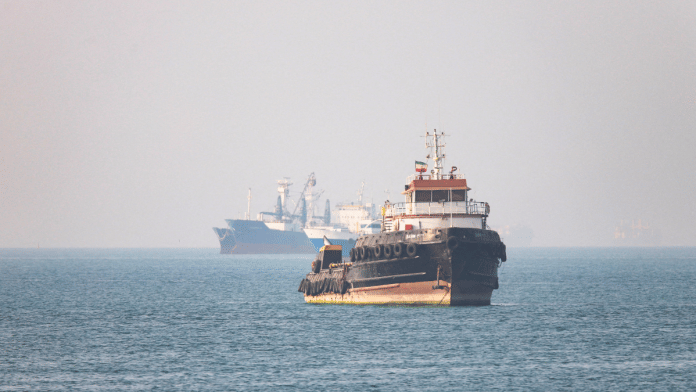
New Delhi: India Tuesday lodged a strong protest with Iran over the continued attacks against merchant vessels, after an attack against two oil tankers in the Strait of Hormuz left one Indian seafarer dead, and eight sailors injured.
Mohammad Javed Hosseini, the Iranian Deputy Chief of Mission at the embassy in New Delhi, was summoned by the Ministry of External Affairs (MEA) Tuesday morning.
Anand Prakash, the joint secretary leading the Pakistan, Afghanistan and Iran section (PAI), lodged a strong protest over the incident.
The summoning lasted a little over 10 minutes. Iran’s Ambassador to India Mohammad Fathali is currently travelling. The summoning was done in full public view, as India’s ire over the repeated attacks on merchant vessels have grown.
#WATCH | Delhi: Iranian diplomats including Deputy Chief of Mission (DCM) Mohammad Javad Hosseini, summoned by Ministry of External Affairs, over recent attack on merchant vessels in the region pic.twitter.com/OpwOFHOhf8
— ANI (@ANI) July 14, 2026
On Tuesday morning, the United Arab Emirates (UAE) Ministry of Defence in a statement said that two oil tankers – the Mombasa and Al Bahiyah – both Emirati-flagged vessels were targeted by Iranian cruise missiles, while transiting through Omani territorial waters in the Strait of Hormuz.
“The attack resulted in the death of one Indian crew member aboard the Mombasa tanker and the injury of eight others, including four who sustained serious injuries. The injured comprise six Indian nationals and two Ukrainian nationals,” the Emirati Ministry of Defence statement said.
“The UAE reserves its full right to respond to this escalation and to take all necessary measures to protect its territory, its citizens and residents, in a manner that safeguards its sovereignty, security, and stability, and protects its national interests.”
تعلن وزارة الدفاع عن تعرض الناقلتين الوطنيتين (ممباسا) و (الباهية) للاستهداف بصاروخين جوالين إيرانيين في الممر الجنوبي لمضيق هرمز بالمياه الإقليمية العمانية.
وقد أسفر الاستهداف عن مقتل أحد أفراد طاقم الناقلة (ممباسا) من الجنسية الهندية، وإصابة 8 من بينهم 4 إصابات بليغة. (6 من… pic.twitter.com/KVz3qDu6kf
— وزارة الدفاع |MOD UAE (@modgovae) July 13, 2026
The latest attack on merchant vessels came days after an Iranian attack on the Cyprus-flagged container ship GFS Galaxy left one Indian seafarer missing. Over 13 Indians, many of them seafarers, have died since the conflict in West Asia began at the end of February.
The US and Israel jointly launched strikes on Iran, and killed its Supreme Leader Ayatollah Ali Khamenei. The US and Iran had arrived at a fragile ceasefire on 8 April, which had then extended into an interim agreement that had led to the cessation of hostilities for 60 days. The interim deal was announced last month and was mediated by Pakistan.
However, in recent days the interim deal has seemingly fallen through, with US President Donald Trump declaring that the “ceasefire is over” over the weekend. The US President ordered the reinstatement of the blockade against Iran Monday, and announced American tolls for the transit of vessels through the Strait of Hormuz.
The new tolls to be imposed by the US is a significant change in position, as Washington has previously labelled such fees as illegal under international law. The US has conducted strikes for three consecutive days against Iran on Monday. Trump’s consistent changing positions on Iran has narrowed the path to peace.
For India, any disruption to the Strait of Hormuz is set to have a negative impact on its energy security. The Gulf countries account for a large portion of India’s imports of crude oil and liquefied natural gas (LNG).
New Delhi has called on both the US and Iran to return to the path of “dialogue and diplomacy” as tensions have continued to increase. Any further disruption in the flow of energy would impact the Indian economy harder.
As is, India’s imports of crude oil has significantly increased during the first quarter of the 2026-2027 financial year to $60 billion, largely due to price spikes. During the first quarter of 2025-2026, India had imported a little over $45 billion worth of crude oil.
(Edited by Tony Rai)
Also Read: Qatar, UAE explored deals with Tehran to shield territory from Iranian strikes, say reports