





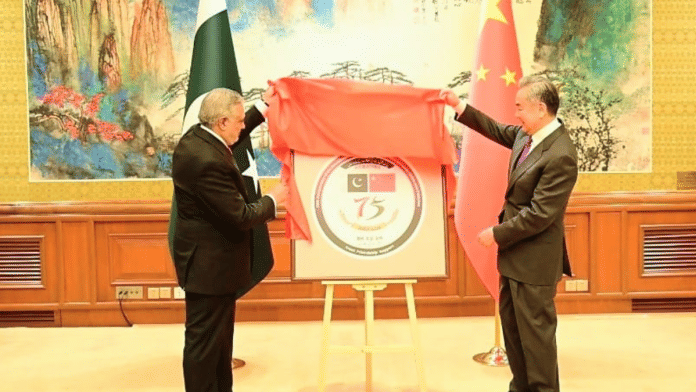



New Delhi: China and Pakistan Monday used a joint communiqué warning against what they described as “hegemonism”, “bullying behaviours” and the formation of “small circles”, a statement that appeared to be aimed at India and its growing partnerships with the West.
The statement came after the seventh round of the Pakistan-China Foreign Ministers’ Strategic Dialogue, held in Beijing between Chinese Foreign Minister Wang Yi and Pakistani Deputy Prime Minister and Foreign Minister Ishaq Dar.
Though the statement didn’t name any country, it was widely seen as being directed at India and particularly the Quad grouping, which includes India, US, Japan and Australia.
“The two sides reaffirmed their commitment to the purposes and principles of the UN Charter, their support for multilateralism and free trade, and their opposition to hegemonism, bullying behaviours violating national sovereignty of other countries, the forming of ‘small circles’ and bloc confrontation,” the statement read.
This joint statement comes even as China itself faces persistent accusations of coercion from several of its neighbours, including Vietnam, the Philippines and Bhutan, over territorial claims, economic pressure and military posturing.
Earlier, Pakistan’s Ishaq Dar used similar language in his year-end press conference, when he said that “big powers” had “bought” into the narrative of India being the net security provider in the Indian Ocean Region (IOR) and that this perception apparently shifted after Operation Sindoor and assumptions about India’s military dominance had been challenged.
“The biggest success that Allah has given Pakistan in South Asia was the performance of Pakistan’s armed forces in the four-day conflict. The world received a strong message, because India claimed that they are the hegemon, they are the net security provider in this region. Some big powers might have bought it,” Dar claimed.
Washington has in recent years publicly endorsed India’s role as a stabilising force in IOR, part of a broader strategy to counter China’s growing influence. A joint US-India statement earlier this year reaffirmed American support for that role.
Focus on trilaterals excluding India
Ironically, the communiqué also highlighted Beijing and Islamabad’s intent to expand regional diplomatic frameworks that exclude India.
“The two sides expressed readiness to continue leveraging the China-Afghanistan-Pakistan Trilateral Foreign Ministers’ Dialogue and the China-Bangladesh-Pakistan cooperation mechanism to deliver new outcomes,” it said.
Counterterrorism also featured in the talks, with both sides calling on the international community to avoid what they described as selective approaches.
“Calling on the international community to strengthen counter-terrorism cooperation, the two sides expressed their firm opposition to double standards on counterterrorism,” the statement said.
China went further, explicitly endorsing Pakistan’s record of what it called counter-terrorism efforts. “China fully recognised the significant contributions and huge sacrifices that Pakistan made in combating terrorism over the years,” the communiqué noted.
India has long accused Pakistan of tolerating or supporting militant groups targeting India.
On Afghanistan & ‘ironclad’ ties
In a pointed reference to Afghanistan, the two sides called for action against militant sanctuaries, urging “more visible and verifiable actions to dismantle and eliminate all terrorist organisations based in Afghanistan which continue to pose serious threats to regional and global security”.
The statement also called for efforts to prevent Afghan territory from being used “for terrorism against any other country”.
“The two sides reiterated that China and Pakistan will further promote their ironclad ties, deepen mutually beneficial cooperation, and continue to strengthen their strategic cooperation to break new ground and set new goals in their All-weather Strategic Cooperative Partnership,” the statement concluded.
(Edited by Sugita Katyal)