



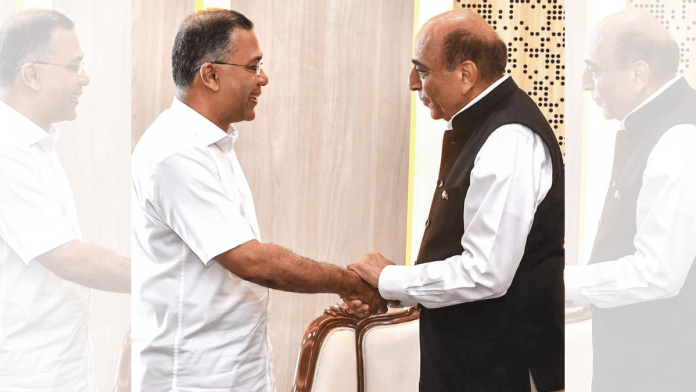
Dhaka: Sheikh Hasina’s flight to India was unexpected, was not arranged by the Indian military, and she arrived as the prime minister of Bangladesh, Indian High Commissioner to Bangladesh Dinesh Trivedi said Saturday, talking about the ousted leader’s arrival in New Delhi two years ago.
He was speaking at the Bay of Bengal Conversation in Bangladesh, organised by local think tank Centre for Governance Studies in Dhaka. India, Trivedi said, was “not prepared” for her sudden arrival, and had few choices.
“Hasinaji was not brought to India by the Indian Air Force or the Indian Army,” he said in response to a question on demands for her extradition. “It so happened because of the tragic circumstances in Bangladesh during that time. We hope and pray that should never happen, where innocent people get killed, doesn’t matter in which part of the world.”
He added, “The military aircraft came to India… India was not prepared. I was watching on television, and the scroll was coming that she was going to some other country. At that point, Hasinaji was still the prime minister of Bangladesh. We had hardly any choice on that. It was our duty as a neighbour to accept the reality of life. Because situations are such that at times you are not prepared for such.”
“What was our [India’s] choice?” Trivedi went on to ask, adding that if India did not give Hasina “landing permission”, the situation could have been very different. The Indian High Commissioner said India and Bangladesh are vibrant democracies, adding that the “legal system” is looking into the issue of her extradition.
The issue of Sheikh Hasina’s continued stay in India remains an irritant in ties between the two countries. The former prime minister fled Dhaka for New Delhi on 5 August 2024, following large-scale demonstrations led by students across Bangladesh. Her government’s actions, including unleashing violence against the demonstrators, left hundreds of people dead, and many more injured.
India-Bangladesh ties cratered following her ouster. In December 2024, the then interim government in Dhaka made a request for Hasina’s extradition. India has consistently maintained that it has received the request, and that the processes outlined in the bilateral extradition treaty are currently underway.
Also read: Why diplomacy alone won’t work anymore for India-Bangladesh ties
Chill in ties
The request for her extradition was repeated by the Tarique Rahman administration after it came to power following the February 2026 general elections. Bangladesh’s Foreign Minister Khalilur Rahman reiterated the request during his meeting with External Affairs Minister S. Jaishankar earlier this year, while Prime Minister Rahman highlighted the need for Hasina’s extradition when Trivedi called on him in August.
Hasina’s repeated media appearances, including a press conference on 5 August 2026 in New Delhi, further set back ties. The two countries had started a process of stabilising the relationship following Rahman’s ascent to power.
India had extended two invitations for a visit by Rahman: one as a bilateral state visit, and the other to attend the BRICS Leaders’ Summit in New Delhi last month (on account of to Bangladesh’s role as chair of Bay of Bengal Initiative for Multisectoral Technical and Economic Cooperation or BIMSTEC). However, the press conference led to a strong response from Dhaka, which said that unless Hasina is extradited and a “conducive environment” created, a visit by Rahman to New Delhi is unlikely to happen.
Discussions for the bilateral visit failed to concretise, and Rahman also skipped the BRICS Summit, not sending a Bangladeshi delegation for it either.
Even so, the two countries have moved to activate various engagement mechanisms with varying degrees of success. A joint working group on trade is expected to meet soon, while technical discussions of the Joint River Commission are ongoing. New Delhi and Dhaka are yet to hold a consular dialogue, which is a key mechanism to discuss the issue of migration, which remains an area of key concern for India.
Hasina in recent weeks has made it clear that she plans to return to Bangladesh sometime in December and continue her fight against the Bangladesh Nationalist Party (BNP) government led by Rahman.
However, the former prime minister was in November 2025 sentenced to death by the International Crimes Tribunal of Bangladesh (ICT-B) for the actions of her government in attempting to violently suppress the student demonstrations in 2024. Hasina has rejected the sentence.
(Edited by Ajeet Tiwari)
Also read: Bangladesh’s Bay of Bengal pitch: Turn shared geography into shared prosperity, says Tarique Rahman