



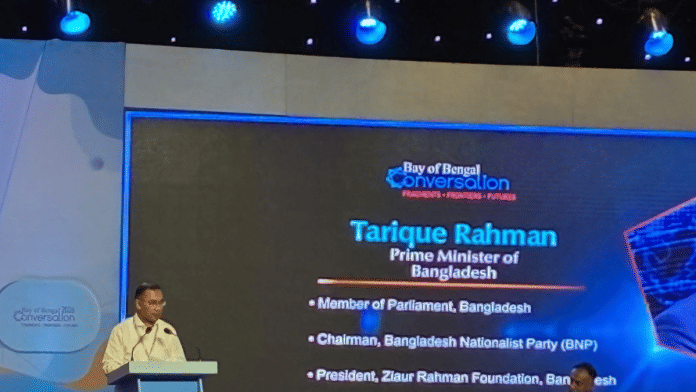
Dhaka: Bangladesh’s shared geography across the Bay of Bengal must become “shared prosperity” underlined Prime Minister Tarique Rahman Saturday, highlighting Dhaka’s keen interest in ensuring “dialogue and partnership” based on “mutual respect”.
Speaking at the Bay of Bengal Conversation in Dhaka, Rahman highlighted that under his government, Bangladesh is keen to work with “all its partners” with a focus on ensuring justice and mutual interest. Rahman inaugurated the conference, organised by Bangladesh’s Centre for Governance Studies, which will run from 3 to 5 October.
“The Bay of Bengal shapes our fate generation after generation… Shared geography should become shared prosperity and we must work together through bilateral and multilateral forums,” said Rahman.
The Prime Minister of Bangladesh added: “Geography has brought us together. Bangladesh’s policy remains based on dialogue, partnership and mutual respect. We will work with all our partners.”
The comment on the shared geography of the Bay of Bengal is noteworthy, as Bangladesh and India share over a 4,000 kilometre boundary and both have access to the bay for maritime trade. Rahman did not directly mention India in his address.
The stress on the importance of the Bay of Bengal is even more significant given that Bangladesh is the current chair of BIMSTEC—the Bay of Bengal Initiative for Multi-Sectoral Technical and Economic Cooperation—which includes India as a member along with five other states.
BIMSTEC, which was originally founded in 1997, has had an uneven history, with the last leaders summit hosted in April 2025. Rahman was invited as the chair of BIMSTEC for the BRICS Leaders Summit in New Delhi at the last minute, but chose to not attend the summit or send a delegation to the Indian capital.
Ties between India and Bangladesh cratered in 2024, following the ouster of former Prime Minister Sheikh Hasina from power, due to student-led demonstrations.
Hasina fled Dhaka to New Delhi and remains in the Indian national capital. Ever since Rahman assumed power in February 2026, the two governments have taken multiple steps to stabilise ties.
However, the calibrated stabilisation has hit a number of roadblocks, including negotiations over a state visit by Rahman. The Bangladesh Prime Minister missing BRICS was another sign that all is not well in the ties.
Rahman in his address at the Bay of Bengal Conversation also highlighted the “global responsibility” that Bangladesh has undertaken as the home of 1.3 million Rohingya refugees. He called on the global community to find a solution to the refugee crisis, which ensures their safe return to Myanmar.
Bangladesh has also been pushing for the revival of the South Asia Association for Regional Cooperation (SAARC), the regional organisation which includes both India and Pakistan as members.
New Delhi has maintained that Islamabad has been the main roadblock for the revival of SAARC. BIMSTEC as a regional organisation has barely featured in discussions between New Delhi and Dhaka.
However, BIMSTEC’s various mechanisms remain a forum where the two countries continue to interact.
(Edited by Viny Mishra)
Also read: Why diplomacy alone won’t work anymore for India-Bangladesh ties