


New Delhi: Former Bangladesh Prime Minister Sheikh Hasina has welcomed the International Court of Justice’s (ICJ) judgment holding Myanmar responsible for genocide against the Rohingya minority, describing the ruling as an “important step forward for international justice and the return of the Rohingya to their homes in Rakhine State” and urging all United Nations member states to ensure its implementation.
In a statement, Hasina said the judgment in the case brought by The Gambia against Myanmar was an important milestone in the pursuit of accountability for the atrocities committed against the Rohingya in northern Rakhine State during the military’s 2017 clearance operations.
“I call upon all UN member states to uphold this judgment and ensure that it is respected by Myanmar,” she said.
Recalling Bangladesh’s response to the crisis, Hasina said that, as prime minister, she had welcomed nearly one million Rohingya refugees who crossed into Bangladesh in 2017 after fleeing what she described as ethnic cleansing.
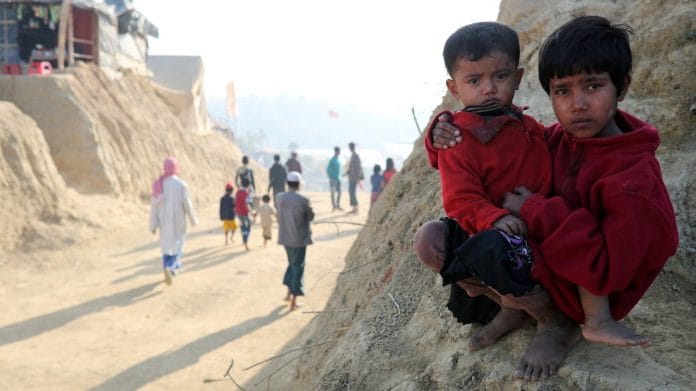
Cox’s Bazar, a coastal district in southeastern Bangladesh near the Myanmar border, today hosts the world’s largest Rohingya refugee settlement. Most refugees live in congested settlements—including Kutupalong and Nayapara—across the Ukhiya and Teknaf sub-districts of Cox’s Bazar.
According to UNHCR, more than 7,23,000 Rohingya fled to Bangladesh following the military crackdown that began on 25 August 2017.
Because Cox’s Bazar borders Rakhine State, older local communities in Cox’s Bazar and Chittagong share cultural and linguistic parallels with cross-border populations despite different national histories.
Hasina used her statement to contrast Bangladesh’s earlier role in supporting the Rohingya with what she described as the country’s current political and human rights situation. “It is unfortunate that from its position of leadership on these issues, Bangladesh today is mired in human rights abuses and political persecution, chaos and decline,” she said.
Hasina has been living in New Delhi since 5 August 2024, when she fled Bangladesh following weeks of student-led protests against a government job quota system that escalated into a broader uprising against her government.
She credited her government with playing a central role in efforts to pursue international accountability, including supporting The Gambia’s case before the ICJ through diplomatic and financial assistance within the Organisation of Islamic Cooperation (OIC).
Hasina said she had also instructed her counsel, Professor Payam Akhavan, to pursue the matter before the International Criminal Court (ICC), invoking Bangladesh’s jurisdiction. She also referred to an arrest warrant issued in 2024 in connection with crimes against humanity.
Bangladesh, she added, had contributed to investigations and the collection of crucial evidence, including testimony from Rohingya survivors and witnesses living in refugee camps. “Those efforts have now come to a successful conclusion,” she said, describing the judgment as a proud moment for Bangladesh.
Addressing the 73rd United Nations General Assembly in September 2018, then Prime Minister Sheikh Hasina said Bangladesh was hosting around 1.1 million Rohingya refugees. The World Bank announced nearly $500 million in assistance in 2018 to support refugees with healthcare, education, sanitation and other essential services.
On 19 November, the International Court of Justice (ICJ) ruled that Myanmar committed genocide against the Rohingya Muslim minority during its 2017 military crackdown in northern Rakhine State
The case, formally known as The Gambia v. Myanmar, was filed in November 2019 by The Gambia, with the backing of the 57-member OIC, accusing Myanmar of violating its obligations under the Genocide Convention.
Although The Gambia was not directly affected by the alleged crimes, it brought the case under Article 9 of the convention, which allows disputes concerning state responsibility for genocide to be referred to the ICJ.
(Edited by Viny Mishra)
Also read Explainer: Rohingya crisis remains unresolved as ICJ rules on Myanmar