





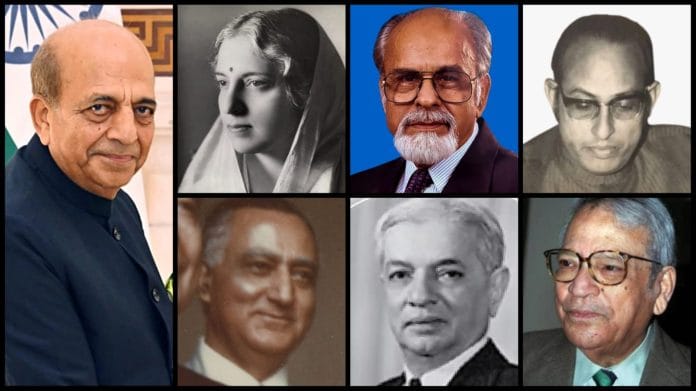


New Delhi: The elevation of an Indian High Commissioner to the rank and protocol status of a Union Cabinet Minister, while rare, is not unprecedented. Indian High Commissioner to Bangladesh Dinesh Trivedi is the latest in a long line of political appointees to be accorded the rank of Ambassador or High Commissioner (for Commonwealth countries) with cabinet minister status—a distinction that signals their direct access to the prime minister.
Elevation to the rank of cabinet minister also indicates the seriousness of the government of the day to focus on the relationship with that specific country, which in the latest case is Bangladesh.
In the past, a number of Indian ambassadors and high commissioners to the US, UK and USSR (Soviet Union) have all enjoyed the status that Trivedi has been elevated to.
Among the earliest ambassadors of India to have enjoyed cabinet status was Vijaya Lakshmi Pandit, who first served as the Indian envoy to the Soviet Union (1947-1949) and later ambassador to the US and Mexico (1949-1951). Pandit was also India’s High Commissioner to the UK from 1954 till 1961, while concurrently serving as ambassador to Ireland and the first woman president of the United Nations General Assembly (1953).
Pandit, a freedom fighter, carried political heft as the first Indian woman to hold a cabinet position in pre-independence India. She was also key to New Delhi’s establishment of ties with a number of countries immediately after independence.
Ambassador G.L. Mehta, India’s envoy to the US between 1952 and 1958, also enjoyed cabinet rank status. The other envoys who enjoyed the rank of cabinet minister include former PM I.K. Gujral, T.N. Kaul, Karan Singh, L.M. Singhvi and Siddhartha Shankar Ray.
ThePrint looks at the careers of those who held the position of ambassador with cabinet rank.
Gaganvihari Lallubhai Mehta
Gaganvihari Lallubhai Mehta was born in 1900 to the wealthy aristocrat Lallubhai Samaldas in Ahmedabad. A graduate of Elphinstone College, Mehta was President of FICCI between 1939 and 1940 and again between 1942 and 1943.
He was appointed to the first Planning Commission of India in 1950, and served on the commission till 1952. Following that, he was appointed as India’s ambassador to the US and Mexico, a role he held for six years. For two of those years, he was also Minister Plenipotentiary to Cuba.
During his tenure in the US (1952-1958), Mehta enjoyed cabinet rank, and received direct cables from then PM Jawaharlal Nehru. Mehta also faced racial segregation in the US when, in August 1955, he and his secretary were moved into a special dining room at the Houston airport in Texas after restaurant supervisor Mary Alley believed they were African Americans.
Mehta and secretary B.A. Rajagopalan was asked to move from the public dining room due to America’s segregation practices at the time. The US later officially apologised to India for the move, with then Secretary of State John Foster Dulles calling Mehta to express regret. The policy of segregation led to worries within the US State Department of its impact on foreign relations.
Inder Kumar Gujral
I.K Gujral was sworn in as the 12th PM of India in 1997. Before taking the chair, Gujral served as India’s Minister for External Affairs twice. Between 1967 and 1976, he held a number of ministerial positions in the cabinet of then PM Indira Gandhi.
In 1976, Gujral was appointed as India’s envoy to the USSR (1976-1980) with cabinet rank. His appointment came just after the untimely death of the previous Indian ambassador to the country Durga Prasad Dhar (D.P. Dhar). Dhar was one of the main architects of the Indo-Soviet Union Treaty of Peace, Friendship and Cooperation of 1971, and was serving for the second time as ambassador to the USSR.
Gujral’s long parliamentary and political career aided in boosting ties between the USSR and India at the highest levels.
Triloki Nath Kaul
T.N. Kaul was one of India’s foremost diplomats in the early years. A civil service officer, Kaul served as India’s ambassador to the USSR between 1962 and 1966. He eventually became foreign secretary between 1968 and 1972 and was appointed India’s ambassador to the US in 1973 until 1976.
It was during his second tenure as ambassador to the USSR between 1986 and 1989, which was post-retirement, that he enjoyed the rank of a cabinet minister.
Kaul also served as India’s deputy high commissioner in London, as well as ambassador to Iran from 1958 to 1960.
Siddhartha Shankar Ray
Ray, a senior Congress politician, was chief minister of West Bengal (1972-1977) and held a number of cabinet positions throughout his long tenure in politics. In 1992, he was appointed as India’s ambassador to the US till 1996, despite never visiting the country or having any prior diplomatic experience.
As a politician, while his record was mixed, he was considered an important troubleshooter for the Congress, and had at one point even discussed with then PM Indira Gandhi the Emergency powers underlined within the Constitution of India.
His appointment came with the protocol of a cabinet minister. It was Ray’s tenure that saw a thaw in ties between India and the US, before the Pokhran nuclear tests in 1998 halted the growing engagement between New Delhi and Washington.
Then PM Narasimha Rao travelled to the US in 1994, while Ray was envoy, and the visit was considered successful.
Laxmi Mall Singhvi
L.M. Singhvi was India’s second longest serving High Commissioner to the UK, a post he held between 1991 and 1997. Before being appointed as a diplomat, Singhvi was a jurist and parliamentarian.
During his tenure as high commissioner, he enjoyed the rank of cabinet minister. His only son, Abhishek Manu Singhvi, is a senior advocate and member of the Rajya Sabha, representing the state of Telangana for the Congress.
(Edited by Nida Fatima Siddiqui)
Also Read: The anti-India rants that got Bangladesh PM aide on immigration watchlist & stopped at Delhi airport