



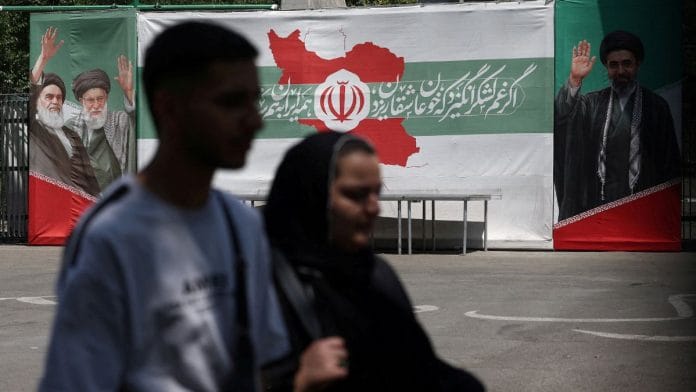

A 14-point Memorandum of Understanding (MoU) between the US and Iran has been signed. The fun part—or the great irony—is that it was signed at the Palace of Versailles, sometimes called the venue for bad treaties. Let’s try and understand the portents and prognoses of this much-awaited deal-in-progress.
Palace of illusions? This palace was the home of French politics and diplomacy between 1682 and 1789. But history now, at least from our generation onward, will remember Versailles for the so-called Treaty of Versailles that ended the Great War, signed on 28 June 1919. The US-Iran deal has thus been signed practically on the 107th anniversary of the failed Treaty of Versailles.
It failed because it was too tough on Germany: it humiliated them, they lost swathes of territory, areas with iron, coal, etc.. They lost colonies, becoming almost a sub-sovereign state. That was never going to be sustainable.
Then again, the treaty was not strong enough to prevent German resurgence. Has something like that happened in this 14-point MOU as well? Why did Trump sign it at Versailles? He doesn’t care much about history; he just thinks it’s a nice, beautiful palace.
Dazzled by things European, Trump may have missed the irony. It could be that people in his team didn’t want to remind him of it, or that French President Emmanuel Macron was playing a cruel joke on him. Nevertheless, that’s where Trump signed this 14-point MoU.
Signs of the times: It’s also quite likely that Trump thinks that this is an Iranian document of surrender, that the Iranians have been humiliated, and they are surrendering.
Far from it. Nobody, including those who support Trump or those on the US Right, are calling it a great American success. Some on the Trumpian Right are quiet, and that shows that even they are a little embarrassed or uncertain about what has happened.
Trump has been going on and on that he’ll bomb the Iranians again if they don’t behave or keep their promises. At the same time, Iran Speaker Mohammad Bagher Ghalibaf, effectively the most prominent face of the Iranian regime, has said that they hope the enemy understands the language of logic or a return to the language of power will happen.
Meanwhile, Trump’s finger stays on the trigger.
Pakistan Prime Minister Shehbaz Sharif signed the document too, as a mediator, or witness, leading to celebrations in Pakistan.
Here’s our Top 10 about the MoU:
- Casus belli: Trump joined the war out of FOMO, or ‘fear of missing out’. Trump thought Netanyahu was the only one hitting Iran, which is easy to do. He also probably bought into that idea from Netanyahu: we’ll declare a quick victory, have regime change, etc.
As ThePrint’s 50-word edit says: ‘Trump joined the war out of FOMO. He capitulated with minimal gain because of buyer’s remorse. Then the epiphany. Why not use Iran as a balancing power and put America’s spoiled friends in their place? That’s how he buried the hatchet with Iran in the back of the Gulf Arabs and Israel.’
- Strait deal: Trump came in, figuring this fight would last a week, maybe two. But as it went on, Trump realised he was in a quagmire. Iran has a population of nearly nine-and-a-half crore. They are very nationalistic, and will hang together, whatever their problems with their regime. Plus, Iranians showed him their incredible ability to take attrition.
Their leadership was wiped out, but they were still standing. That is not what Trump was prepared for. That’s why from about the second week onwards, he was desperate to declare victory. This was the same as Operation Midnight Hammer last year, when stealth bombers attacked Iran’s nuclear sites, and Trump declared victory, saying Iran’s uranium and nuclear facilities have been obliterated. He wanted something like that now.
He did not want a land invasion. He did not want to take Kharg Island because that would have sent a bunch of body bags home. His base did not want him to fight any more. That’s why he wanted out. The Iranians figured that that was his compulsion, so they played with that. They thought that they had found a way of giving him trouble, a lever in the Strait of Hormuz. Sending global oil prices up, and giving Trump a domestic gas problem was something Iran could prolong as long as. That is just what Trump was not prepared for.
- Vox Dei: Democracies essentially are much stronger than dictatorships when it comes to either protecting themselves directly or protecting their direct interest. Not so much, however, when it comes to going and fighting for an ideology or a coalition or for some ally someplace, because then public opinion matters. Public opinion in Iran does not matter as long as the regime is strong. Public opinion in China does not matter as long as Xi Jinping is totally in control. Public opinion in Russia does not matter as long as Putin is fully in control. Public opinion in Saudi Arabia does not matter as long as the royal family is fully in control, and similarly in Jordan and Sisi-run Egypt.
In democracies, public opinion can turn against a war unless they think it is for self defence, survival, or supreme national interest. In that sense, democracies are the hardest states. Nobody can then defeat a democracy in any such war where a democracy fights to protect its own direct interest, its territory or existence. A democracy or a set of democracies always wins.
In extraneous wars, however, democracies face internal pressures. That’s what happened with the Americans in Vietnam. That’s how they were timed out. That’s what happened in Afghanistan, where they decided to do nation-building. They were timed out.
They decided to do nation building in Iraq; that did not fail as badly as in Afghanistan, but it did not work out because the people in power are not the ones Americans would have liked to see there. Iran understood that the US failed in Afghanistan and Iraq, much smaller nations.
Even in the Second World War, Americans were very reluctant to get involved on behalf of the Europeans, their own friends and allies. It’s only after the Japanese attack on Pearl Harbour of 7 December 1941 that they got directly involved.
In this case, Trump saw no percentage for himself. Also, at this point, Israel is not so popular in America, even within Trump’s base, because of Gaza, because of what’s happening in the West Bank, because of the settler violence. And a lot of people, even on the American Right, Trumpians included, have been saying that Israel exercises too much influence on US policy.
Combine all this with domestic issues like gas prices, inflation and likely casualties if the fighting went on, and Trump decided to call it a day.
It’s not a question of who surrendered where, rather it’s quite evident that both sides wanted the fighting to end. Politically, Trump’s sense of urgency was stronger, and that’s also why the choice of Versailles is probably more an irony for him than for the Iranians.
- Eff grade: Trump saw it as Israel’s war. Israel has been under attack from Iran, sometimes directly, but otherwise through the many Iranian proxies: Hamas, Hezbollah, Houthis, Palestinian Islamic Jihad, groups in Iraq. Sometimes Iran also attacks Israel directly in support of the proxies.
The US came into this to aid Israel. But did they want to fight Israel’s war to the finish? Obviously, Trump did not. And that is just what he showed in his repeated irritation with Netanyahu. In fact, in that interview with Barack Ravid of Axios, he used the word effing several times for Netanyahu. Using “Bibi,” Netanyahu’s nickname, he said, “Bibi has no effing judgement.”
In later interviews, Ravid said the F word was used several times. So Trump was really irritated because he had been dragged into a war that Israel wanted to fight till the end of Iran or its regime. That’s not what Trump had signed up for, the tail wagging the dog.
- MWAGA: Trump is using this as an opportunity to reshape West Asia or the Middle East. He wants to shift the balance of power, or to reset it.
What was the balance of power? There are a whole bunch of Gulf Arab countries rich in oil and gas. All are American protectorates, essentially Qatar, Kuwait, Bahrain, UAE, and Saudi Arabia. And then there is Iran, opposed to everybody, and larger than everybody in terms of population and fighting ability.
And then there’s Israel, an ally of the West, particularly the US. Israelis would not like to be seen as protected by America. In fact, one of the issues the coalition against Netanyahu is raising for the Israeli elections is that Netanyahu has made Israeli security too dependent on Washington. From Trump’s point of view, Israel and all these Arab countries are his protectorates. And everybody is enemies with Iran.
If Iran is willing to settle and some kind of modus vivendi can be arranged between all of them, then why should Trump try to shift this balance of power by destroying Iran? That is simply not worth it. In fact, in his first term, Trump brought legitimacy for Israel in the Arab with the Abraham Accords.
That was towards the end of his tenure. The Abraham Accords were signed in 2020 by the UAE, Bahrain, Morocco, Sudan and the US, besides Israel. All these Arab countries recognised Israel. That was Phase I of Trump’s reshaping the Middle East.
The larger Muslim neighbours of Israel, Egypt, Turkey and Jordan, had already recognised it. Under the Abraham Accords, Israel had gained legitimacy in a large part of the Arab Muslim-West Asia region. Turkey is also a North Atlantic Treaty Organization (NATO) member.
In Phase II, with this MoU, Trump is reminding the Arabs that a permanent war with Iran is not sustainable, that their Islamic ideological issues are not America’s problem. America can have good relations with either side, as it did with Iran until the 1979 revolution.
It’s the Gulf Arabs, then, who need to find their own modus vivendi with Iran. Their armies cannot fight, they know, and now the world knows that Gulf Arab armies cannot fight, except the honourable UAE, which despite having just a 1.3-million native population tried to fight back. None of the others did, despite their fancy armies.
Most Gulf Arab countries are too rich, too small, and too unwilling to fight. They have no stomach for any attrition. From Trump’s point of view, look at Iran. Look at the amount of damage they took and kept fighting.
The footnote to this is that this is exactly what happens when a nation or a set of nations outsource security. That is just what the Europeans are facing right now, with Trump getting estranged from NATO and basically telling the Europeans to fight for themselves. That’s also the message going out to Japan, South Korea, Australia, and most importantly, in that region, Taiwan.
Pay no attention to the comments Trump made in the presence of Prime Minister Narendra Modi, saying that I will come to your defence if you are under attack. He does not mean that he will come to India’s defence if India is attacked by China or somebody.
He is saying that as long as this man is there, I will come (to help). If somebody else is there, I may not. This is just Trump talking Trump.
- Fund and games: Trump is also rubbing Gulf Arab noses into the ground, telling them that Iran needs $300 billion worth of reconstruction. You raise this money, he’s saying to them, which means they will then have a vested interest in Iranian stability. And because Iran would have borrowed this money, it will be more responsible.
That will change Iran’s conduct. Trump may not have thought that far, but has clearly said that America will pay no such money. All of this will come from Gulf Arab countries.
Effectively, Trump is telling them that if you want your security, I am there, but you also have to pay rent, to me, to Iran. Or maybe what you do in Iran is actually a rent to me because I don’t want to spend any money in Iran.
- Beautiful people: Ever since the talks started, Trump has been very kind to the Iranians. He’s only used positive adjectives about them. These are different people. They are strong people. They are nationalists, etc. It is very clear that going ahead, he will only use military force against Iran if there is an obvious threat to America’s own assets or its direct protectorates. Obviously, if Iran again starts attacking Israel or Saudi Arabia or Qatar—the latter is most unlikely—the Americans will carry out tit-for-tat attacks, maybe four per tat, but they will not come into the war.
The fate of the Iranian nuclear programme and uranium will be a protracted technical negotiation, and the Iranians will try to drag it out for as long as possible.
- The big rethink: All this will force the Gulf Arabs to rethink life as they have known it. In Sudan, Yemen, and Libya, Gulf Arabs are fighting each other. The UAE and Saudi Arabia are fighting each other in these countries. An enormous number of Arab Muslims are being killed, fighting as proxies for Saudi Arabia versus the UAE’s proxies.
Can they afford this? Someone like Trump would be very bored with this, and he would think that these guys are just distracting the whole world. At the same time, all these war zones are too far to be of any concern to Trump unless they breed terror, which is also the leverage of Pakistan.
- Fuel for thought: This MOU brings us to a very important question. What is West Asia’s leverage with the rest of the world? There are just about 15 crore people, or fewer, in the region. Their only leverage with the rest of the world is energy. But they are too unruly. They are fighting among themselves too much of the time, taking too much global attention, and too much attention and investment from the sole superpower. This strengthens the other superpower.
If these countries did not have this storehouse of oil and gas, who would bother? So the lesson of this MoU is that everybody has a stake in this oil. The Iranians also have a lot of oil. More is being found all the time.
It’s not as if they invented oil and patented it. Oil is available elsewhere; West Asia countries will have to learn to behave like responsible states, or go fight their own battles.
- Bibi in trouble: Netanyahu has been left greatly weakened. In fact, Israeli opinion polls now, in election year, show the coalition against him leading 58 to 51. Israel has a very complex electoral system. Generally speaking, it is based on proportionate representation. To get a seat in parliament, one needs a minimum of 3.25 per cent of the vote.
It is a supreme irony that Netanyahu’s hard-right religious coalition, the Likud coalition, is trailing in the polls. Against him are Naftali Bennett and Yair Lapid, both former prime ministers in their Together Party. And there’s Benny Gantz, who has a party of his own, the Blue and White Party. But the coalition that’s leading the opinion polls right now is led by Gadi Eisenkot, with his Yashar Party. Yashar means straight. None of them are as religious or right-wing as Netanyahu but all accuse him of being weak, having become too dependent on Washington, and having achieved too little with this war against Iran.
Netanyahu hasn’t lost the war but he is probably paying the price for this. Nothing will happen to the Iranian regime. Nothing will happen to the Iranian Revolutionary Guard Corps leadership. But this will greatly influence the outcome of Israeli elections this year.
Two of the challengers against Netanyahu are former army chiefs. Eisenkot started out as an infantryman in the famous Golani Brigade, becoming the 21st Chief of Staff of the Israeli Defence Forces from 2015 to 2019. General Benny Gantz was the 20th IDF chief from 2011 to 2015. They were also members of a national security cabinet that they left because they just could not stand Netanyahu.
(Edited by Nardeep Singh Dahiya)
Also Read: Iran-US truce: Gains & concerns for India, weakened US, Netanyahu’s setback, Pakistan’s role