



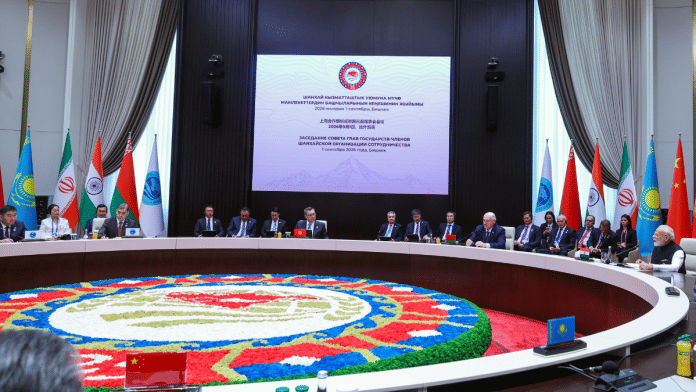
New Delhi: Days after trading barbs at the United Nations General Assembly (UNGA) in New York, India and Pakistan are once again sharing a conference room, this time in Islamabad, to begin planning next year’s Shanghai Cooperation Organisation (SCO) Summit to be held in the Pakistani capital.
India’s delegation at the first meeting of the bloc’s Council of National Coordinators is led by the Ministry of External Affairs Joint Secretary (Multilateral Economic Relations) division Alok Dimri. He is also India’s National Coordinator for the SCO.
The Indian delegation landed in Islamabad earlier on Monday for the three-day meeting.
The three-day meeting, which runs through Wednesday, is the opening act of Pakistan’s 2026-27 chairship of the organisation. Pakistan assumed the chair from Kyrgyzstan on 1 September.
The coordinators’ meeting lays the groundwork for the main event: a Summit of the bloc’s Heads of State, which Pakistan is scheduled to host in August 2027. Pakistan’s Foreign Office has said invitations will go to all member leaders, including Prime Minister Narendra Modi, according to news reports.
Pakistan has chosen “Turning Vision into Action: Connectivity, Innovation and Shared Prosperity. as the theme of the Summit.
The 2025 Summit adopted the Tianjin resolution, which condemned the 2025 Pahalgam terrorist attack. PM Modi had attended the Summit, and thanked member countries for their solidarity, adding that there should be “no double standards in dealing with terrorism and urged the group to hold countries who perpetrate and support cross-border terrorism accountable.”
India and Pakistan have not held substantive bilateral talks in roughly a decade. The last attempt at bilateral talks occurred during then External Affairs Minister Sushma Swaraj’s visit to Islamabad in December 2015, where the two countries attempted to revive the “Comprehensive Bilateral Dialogue”.
That process, however, was derailed by the January 2016 terrorist attack on the Pathankot airbase.
Pakistan currently also heads the organisation’s Regional Anti-Terrorist Structure, known as RATS, a body India has long viewed with some skepticism amid Delhi’s longstanding accusations that Islamabad harbours terrorists who target India.
Since both countries became full members in 2017, Indian officials and military personnel have regularly attended meetings of the bloc’s border security forces.
In July 2026 this year, for example, India attended the 12th meeting of the heads of border services of the Shanghai Cooperation Organisation (SCO) hosted in Islamabad.
In October 2024, EAM S. Jaishankar visited Islamabad to represent India at the SCO heads of government Summit, the first trip to Pakistan by an Indian foreign minister in nearly nine years. In July this year, an Indian delegation attended a meeting of the bloc’s border service chiefs in the Pakistani capital.
India and Pakistan joined the SCO in 2017.
This year, the main summit of the SCO Heads of State was held in Bishkek, the capital city of the Kyrgyz Republic in August. PM Modi attended the meet.
Last year, PM Modi travelled to the Chinese city of Tianjin to attend the SCO Summit, and also held a bilateral meeting with President Xi Jinping on the margins of the Summit.
The Shanghai Cooperation Organisation was founded in Shanghai on 15 June 2001, by China, Russia, Kazakhstan, Kyrgyzstan, Tajikistan and Uzbekistan. It was created largely to promote regional stability and to combat what its members call the “three evils” of terrorism, separatism and extremism.
India joined as an observer in 2005 and became a full member in 2017, at a summit in Astana, Kazakhstan, alongside Pakistan. The group has since grown to 10 permanent members, including Iran and Belarus.
It spans roughly 60 percent of Eurasia and more than 40 percent of the world’s population, and is often described by some analysts as a counterweight to NATO, with an agenda covering security, trade, and economic and cultural cooperation.
The SCO is headquartered in Beijing, while the RATS operates from the Uzbek capital of Tashkent. At the Tianjin summit in 2025, the SCO also agreed to establish a universal centre for countering security challenges and threats, as well as an anti-drug centre.
(Edited by Ajeet Tiwari)
Also read: Shehbaz to address UNGA. How Pakistan used forum to rake up Kashmir, from Zulfikar to Nawaz, Imran