



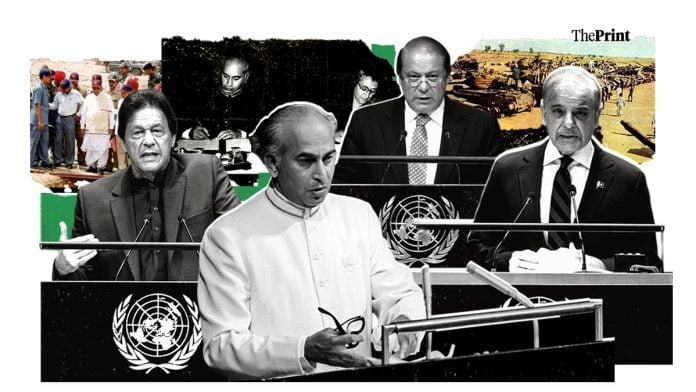
New Delhi: As Pakistan Prime Minister Shehbaz Sharif is due to speak at the 81st UN General Assembly (UNGA) on 25 September, a year-old excerpt from his speech at the 80th UNGA has resurfaced, specifically his reference to Pakistan’s sacrifices towards combating terrorism. “Had these terrorists not been encountered by us, they would have been roaming on the streets of New York and London and God knows far East,” he said.
Addressing the UNGA for the third time as Prime Minister of Pakistan, Sharif had also mentioned the May 2025 four-day war that followed India’s Operation Sindoor, saying, “We have won the war and now we seek to win peace in our part of the world.” He then, in an apparent reference to Kashmir, offered a “composite, comprehensive, result-oriented dialogue with India on all outstanding issues”.
This was part of a pattern. For decades, Pakistan has used the UN’s global stage to advance its narrative on Kashmir vis-a-vis India. It virtually follows this order: invoke Kashmir’s self-determination citing UN resolutions and historical incidents, indict India for ‘mistreating’ Kashmiris, and then extend a dialogue or peace offer.
This string runs through UNGA speeches by Pakistani leaders—from Zulfikar Ali Bhutto’s 1965 address to Imran Khan’s controversial speech in 2019, and Shehbaz Sharif’s speech last year in the aftermath of Operation Sindoor.
Sharif, referring to the four-day war, said Pakistan sent India “back in humiliation, delivering a bloody nose.” Despite being in a position of strength, Pakistan agreed to a ceasefire facilitated by Donald Trump, he claimed, hailing the US President as a “man of peace”.
“Had he (Trump) not intervened timely and decisively, the consequences of a full fledged war would have been catastrophic. Who would have lived to tell what happened, and therefore, in recognition of President Trump’s wonderful and outstanding contribution to promote peace in our part of the world, Pakistan nominated him for Nobel Peace Prize,” said the Prime Minister of Pakistan.
Sharif thanked China, Qatar, Turkey, Iran, Saudi Arabia, Azerbaijan, the UAE, and the UN Secretary-General for extending diplomatic support to Pakistan at a crucial time.
From Zulfikar Ali Bhutto’s UNGA address in 1965 to Nawaz Sharif’s in 2015 and 2016, ThePrint looks at all the times Pakistan used UNGA to rake up Kashmir on the global stage, and how India responded.
Also Read: Fire Imran Khan or the speech writer? People ask after Pakistan PM’s mujahideen claim at UNGA
Imran Khan at UNGA in 2019
Then Prime Minister Imran Khan’s speech in September 2019 remains among the more significant UNGA addresses by a Pakistani leader in recent history. That year saw the Pulwama terror attack, the Balakot strikes that followed; as well as the abrogation of Article 370 just over a month before the UNGA session.
Against the standard allotted time of 15 minutes, Imran took roughly 50 minutes. While he opened with climate change, his real intention was something else. Kashmir is “the reason why I specially came here,” Khan said.
He added that, when his party came to power in Pakistan, he had reached out to Modi, saying, “we have similar problems, climate change, poverty…let’s build our relationship through trade…”
Modi’s response, in his narration, was that “there were terrorist attacks (against India) from Pakistan”. Imran said he countered it by saying that Pakistan has the same grievance. Referencing the capture of retired Indian naval officer Kulbhushan Jadhav, he accused India of instigating terrorist attacks in Balochistan.
On the Pulwama terror attack, Khan said it was a 20-year old Kashmiri boy, “whose father said was radicalised by security forces,” who blew himself up near a convoy of paramilitary forces, killing 40 CRPF personnel, but India blamed Pakistan.
“If you give us any iota of proof, we will immediately take action…Rather than sending us any proof, they sent their jets and bombed us. We retaliated…two of the planes were shot down, one pilot bailed out in Pakistan, we immediately returned the pilot saying that we do not want any escalation,” said Imran, referring to the capture and subsequent release of IAF fighter pilot Abhinandan Varthaman.
Imran continued: Rather than taking the pilot’s release as a peace gesture, almost the entire election campaign of Modi was how he had taught Pakistan a lesson, and how their jets had killed 350 terrorists. “Complete lie. They had just killed about 10 trees of ours, which was quite painful given that we are growing all these trees,” he added.
On the abrogation of Article 370, Imran argued that India defied UN Security Council resolutions establishing Kashmir as a disputed territory deserving self-determination, breached bilateral commitments of the Simla Agreement, and disregarded its own Constitution. Imran continued his tirade about the life of people living in Kashmir under curfew and warned of a “bloodbath” once India would lift the restrictions. “There will be another Pulwama and guess what, India will again blame us,” he said.
Nawaz Sharif at UNGA in 2015, 2016
Speaking at the UNGA in September 2016, then Prime Minister Nawaz Sharif said, “Confrontation should not be our destiny in South Asia. Pakistan wants peace with India. I have gone the extra mile to achieve this.”
Addressing the UNGA less than two weeks after the Uri terror attack, Sharif also broached Kashmir, speaking of an “indigenous uprising” in Kashmir. He called for an independent inquiry into alleged extra-judicial killings and a UN fact finding mission to investigate the role of “Indian occupying forces”.
He echoed the typical Pakistani narrative on Kashmir and expressed his desire for dialogue with India in the same breath. From the rostrum, he reiterated an offer to India, urging New Delhi “to enter into a serious and sustained dialogue for the peaceful resolution of all outstanding disputes, especially Jammu and Kashmir”.
At the same 71st UNGA, India in its own address countered the accusation of human rights violations Pakistan alleged. The then External Affairs Minister, Sushma Swaraj, said in her speech, “I can only say that those accusing others of human rights violations would do well to introspect and see what egregious abuses they are perpetrating in their own country, including in Balochistan.”
“The Prime Minister of Pakistan also said that India has placed pre-conditions for talks which are not acceptable to him. What pre-conditions? Did we impose any pre-condition before extending an invitation for the oath-taking ceremony of our Government?…Did we impose any pre-condition when Prime Minister Modi travelled from Kabul to Lahore?…We took the initiative to resolve issues not on the basis of conditions, but on the basis of friendship,” added Swaraj, emphasising that Pakistan responded to peace efforts by aiding terror attacks inside India.
A year earlier, at the 2015 UNGA, Nawaz Sharif, just like Imran Khan in 2019, had talked about reaching out to India the moment he took office. “When I assumed office of the Prime Minister in June 2013, for the third time, one of my first priorities was to normalize relations with India,” he said.
He also laid out a four-step new peace initiative.
“One, we propose that Pakistan and India formalize and respect the 2003 understanding for a complete ceasefire on the Line of Control in Kashmir…Two, we propose, that Pakistan and India reaffirm that they will not resort to the use or the threat of use of force under any circumstances.
“…Three, steps be taken to demilitarise Kashmir. Four, agree to an unconditional mutual withdrawal from Siachen Glacier, the world’s highest battleground,” said Sharif.
This plan did not materialise, because a year later, Uri happened, and Sharif’s next UNGA speech registered the difference.
While he did bring up Kashmir, Sharif in 2015 had a more reconciliatory tone. Three months after that speech, in December 2015, Prime Minister Narendra Modi made a surprise, unofficial stopover in Lahore to attend the wedding of Nawaz Sharif’s granddaughter. It was the first visit by an Indian Prime Minister to Pakistan in more than 10 years, and Sharif received him personally at the airport with a warm embrace.
Also Read: Why Britain wanted Nehru to take Kashmir issue to UN—Palestine, Zionism & oil
Nuclear debate at UNGA
Another address by Nawaz Sharif at the UNGA dates back to September 1998, months after India and Pakistan had gone nuclear. “This year the nuclear cloud has cast its dark shadow over South Asia,” Sharif began.
Further adding that, “Our neighbour, India, has always perceived nuclear weapons as the key to great power status and a permanent seat on the Security Council. Thirty years ago, we warned the world that India would develop nuclear weapons. Our warnings were ignored.” Sharif said Pakistan had conducted nuclear tests and established nuclear deterrence in self-defence.
Notably, when then Indian Prime Minister Atal Bihari Vajpayee addressed the UNGA a day later, he talked about India’s commitment to nuclear disarmament, but did not mention Pakistan or its tests at all. Where both parties did converge was their willingness to sign the Comprehensive Test Ban Treaty (CTBT) by September 1999. This commitment, though, never materialised, and then came the Kargil war in 1999.
Two foreign ministers, one war and the UNGA
By the time the 20th UNGA commenced in September 1965 and the leaders of India and Pakistan gave their respective addresses, the ink on the UN-mandated ceasefire that ended the 1965 war was barely dry. Zulfikar Ali Bhutto, then foreign minister, led the Pakistani delegation. India was represented by its external affairs minister, Swaran Singh.
Bhutto told the UN General Assembly: “The war with India is not of our seeking. It is a war of self-defence…”
He went ahead to express gratitude for the moral and material support provided to Pakistan during the war by Iran, Turkey, and “the great bloc of Arab countries stretching from the great ocean of Asia and Africa to the Atlantic Ocean, to which Pakistan is linked, let me say, not merely by ties of religion and of common culture but by common adherence to the idea of justice and peace”. He thanked China for “full moral support” and delivered a special note of thanks to Indonesia.
Towards the end, Bhutto proposed that both countries withdraw their forces from Jammu and Kashmir. “Let the United Nations send a force consisting of contingents from African, Asian and Latin American countries, countries which have no interest in the outcome of the plebiscite in Kashmir and which are not involved in the exigencies of international power politics,” he said.
He finished by saying this was the UN’s last chance to settle the Kashmir issue.
Putting forth India’s position on the 1965 war, Swaran Singh said, “The rulers of Rawalpindi engaged in a plan to subjugate our people and grab our territory in Kashmir.”
Adding, “I want to inform this Assembly of the anatomy of the second aggression of Pakistan against India…The whole country, all my countrymen, of all faith, stood as one man in the defence of the motherland.
“This was the biggest disappointment and defeat to Pakistan, which had pinned its hopes on the emergence of the forces of discord and disintegration in India.”
UN’s role on Kashmir
The UN has, on multiple occasions, helped enforce ceasefires between India and Pakistan. Most prominently, the UNSC passed Resolution 47 on April 21, 1948.
This resolution lays out a detailed plan for cessation of hostilities and creating conditions for a free and impartial plebiscite to decide whether Jammu and Kashmir should accede to India or Pakistan.
However, Resolution 47 was practically superseded by the Simla Agreement of July 1972, which explicitly provides for ‘bilateral’ negotiations of all disputes without any third-party mediation.
(Edited by Amrtansh Arora)
Also Read: These Indian women diplomats have given fiery responses to Pakistan at UN in last 5 years