


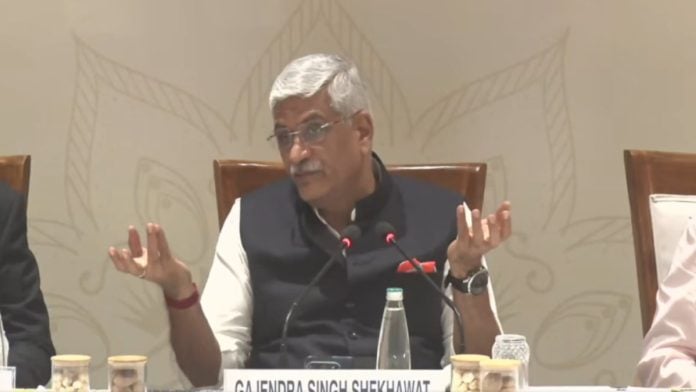
New Delhi: China has accepted India’s invitation to the first Shanghai Cooperation Organisation (SCO) Civilisational Dialogue Forum, Union Minister of Culture and Tourism Gajendra Singh Shekhawat said Friday. He said he is hopeful Pakistan will also attend, but the decision ultimately rests with Islamabad.
“We have extended the invite, hopefully they will attend but ultimately their decision,” said Shekhawat.
The forum will be held at Purana Qila in Delhi from 20 to 22 November.
India has invited all 10 permanent SCO members, including Pakistan. Pakistan’s Minister for National Heritage and Culture, Aurangzeb Khan Khichi, is among those invited. Islamabad has yet to confirm its participation. On 6 November, Pakistan Foreign Office spokesperson Sajjad Haider Khan said Pakistan had received the invitation and would take a final decision after consultations among “relevant institutions”.
If Khichi attends, he will be the first Pakistani minister to visit India since then foreign minister Bilawal Bhutto Zardari’s visit to Goa for the SCO foreign ministers’ meeting in May 2023. It would also be the first such visit since the four-day military conflict between the two countries in May 2025. That conflict followed the Pahalgam terror attack, in which 26 people were killed.
Shekhawat confirmed China’s response while speaking to the media at Bharat Mandapam along with Culture Secretary Vivek Aggarwal. He said representatives of more than 15 countries would take part. The Ministry of Culture and the Ministry of External Affairs (MEA) are organising the forum together, and Prime Minister Narendra Modi is expected to inaugurate it. Last month, MEA spokesperson Randhir Jaiswal said India had invited “all SCO members”, along with dialogue partners and one observer, “as per established practice”.
Live: Press Conference on 1st SCO Civilisational Dialogue Forum https://t.co/VrKYxcZscF
— Gajendra Singh Shekhawat (@gssjodhpur) November 13, 2026
India, China, Russia, Pakistan, Iran, Belarus, Kazakhstan, Kyrgyzstan, Tajikistan and Uzbekistan are permanent members of the SCO. The grouping also has 15 dialogue partners and two observers, Afghanistan and Mongolia.
Modi proposed the Civilisational Dialogue Forum at the SCO summit in Tianjin, China, in September 2025. Shekhawat said member states accepted the proposal unanimously. At the SCO leaders’ meeting in Moscow in November 2025, they also accepted India’s offer to host the first edition. Defence Minister Rajnath Singh announced the dates at the SCO Council of Heads of Government meeting in Dushanbe on 20 October this year.
Shekhawat said Modi has long held that ties between countries should not be limited to bilateral, strategic or economic relations. “Relations between countries should also be built through shared history, cultural heritage, knowledge traditions and people-to-people ties,” he said.
The forum will have four sessions. The first is on civilisational and cultural expressions, including dress, food, traditional games and music. The second is on art and architecture, covering monuments, sculpture, frescoes, coins and building traditions. The third is on language, literature, scripts and manuscripts, including the role of centres of learning such as Nalanda, Takshashila and Vallabhi. The fourth is on monastic, religious and philosophical traditions, including Buddhism, Islam, Confucianism, Taoism, Zoroastrianism and Sikhism.
“It is not an academic platform,” Shekhawat said. He said there would also be exhibitions and cultural performances on India’s heritage.
The minister said the forum would look at possible joint nominations to UNESCO’s Intangible Cultural Heritage lists and its Memory of the World Register. He said UNESCO allows a country to nominate one cultural element a year, but multinational nominations do not have this limit. He cited mehendi as an example of a shared heritage nomination.
“The world is passing through what is perhaps its most challenging period since the World War,” Shekhawat said. Because of this, he said, dialogue between civilisations has become more relevant.
In response to a question, Shekhawat said India would look at what SCO countries have in common rather than at their differences. He named Iran, Kyrgyzstan and Kazakhstan, and said centuries of exchange through scholars and trade had left them influenced by one another. He pointed to the wider acceptance of yoga, Sanskrit and Ayurveda across the world. “Dialogue leads to recognition, and recognition leads to influence. This happens naturally,” he said.
The SCO was set up in Shanghai on 15 June, 2001. It grew out of the “Shanghai Five” grouping formed in 1996. India and Pakistan became members at the Astana summit in 2017.
Pakistan holds the SCO chair for 2026-27 and will host the leaders’ summit in August 2027. India has yet to state at what level it will attend. In September, India sent its SCO National Coordinator, Alok Dimri, to Islamabad for a meeting ahead of Pakistan’s presidency.
(Edited by Amrtansh Arora)
Also Read: Pakistan envoy joins SCO diplomats for MEA luncheon ahead of bloc’s Delhi forum