



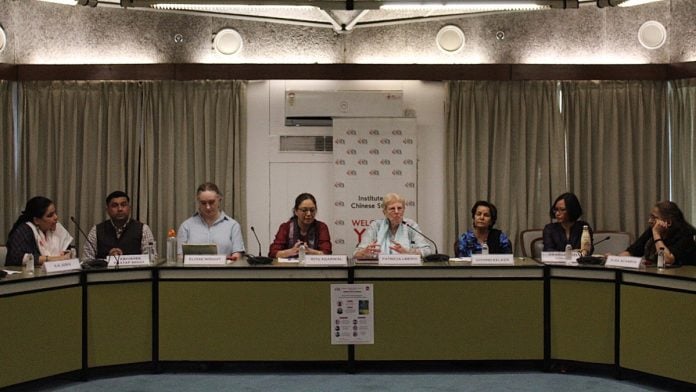
New Delhi: How does a border province move beyond the way it has traditionally been perceived? And what does it take to build an identity around its own geography, economy and culture? These questions formed a central thread in a discussion on The Border Province Reimagined: Yunnan’s Economic and Cultural Ties to Asia at the India International Centre in New Delhi, hosted by the Institute of Chinese Studies (ICS).
The book is centred around Yunnan, the Chinese province associated with cross-border economic trade but also viewed through a preconceived notion of underdevelopment. The discussion on 17 October brought together its editor, contributors and others to examine how the province is understood, how it has sought to shape its identity and whether its experience offers lessons for other border regions.
The session was chaired by Patricia Uberoi, Emeritus Fellow at the Institute of Chinese Studies (ICS), New Delhi. The book was edited by Ritu Agarwal, associate professor at the Centre for East Asian Studies, Jawaharlal Nehru University, and honorary fellow at ICS.
The contributors were Eloise Wright, assistant professor in the Department of History and member of the Ashoka Centre for China Studies at Ashoka University; Abhishek Pratap Singh, assistant professor at Deshbandhu College, University of Delhi; and Ila Joshi, assistant professor in the Department of Humanities and Social Sciences at Jaypee Institute of Information Technology, Noida.
Part of the panel discussion were Govind Kelkar, visiting professor at the Council for Social Development and the Institute for Human Development, New Delhi; Swargajyoti Gohain, associate professor in the Department of Sociology and Anthropology at Ashoka University; and Alka Acharya, director of the Institute of Chinese Studies.
‘Looking at Yunnan from within’
Opening the session, Uberoi recalled her first visit to Yunnan and described the province as “home to one of China’s matrimonial or matriarchal societies”.
She said the papers in the book were almost like memories of an archive of Yunnan, bringing together different accounts of the province.
Agarwal explained how the book had evolved, describing it as an attempt to look at Yunnan from within. She said the province had often been looked down upon as an ethnic region. “Kunming, located in Yunnan and associated with cross-border economic trade, also carried a preconceived notion of being underdeveloped,” Agarwal said.
How borders shape identity
Wright’s contribution examined two concepts: border construction and border crossing. She said administrative geography should never be taken for granted.
China is often described as a “great land of borders”, Wright noted, highlighting the different layers of administration within a province.
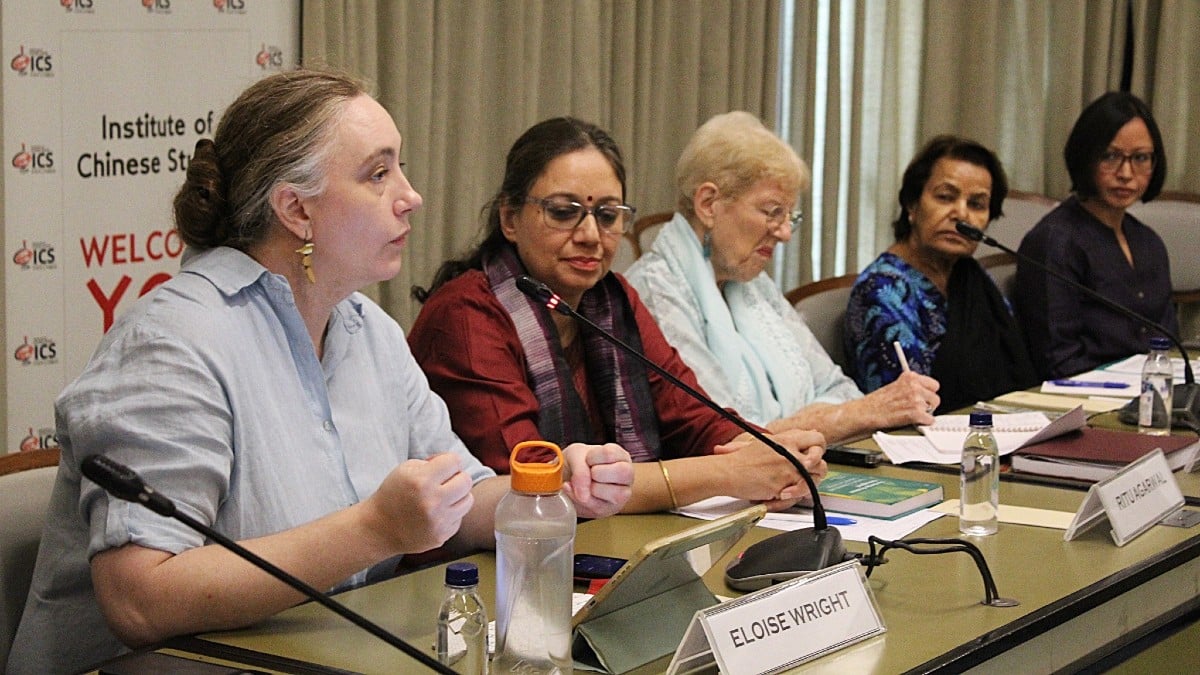
The discussion on borders connected with the book’s larger focus on Yunnan’s identity. Its position as a border province is central to understanding its economic and cultural ties, but the way that geography is administered also shapes how the region is viewed.
Cultural tourism and ‘Yunnan model’
Singh discussed the Yunnan model, focusing on cultural tourism, ecological preservation and the relationship between state and national initiatives.
He described cultural tourism as a distinctive feature of the model and said it reflected a partnership between the state and the national government. He also spoke about ecological preservation, the adaptive nature of state laws and the need to improve social safety.
These themes raised a broader question about how a province can harness its cultural and geographical characteristics to further itself on the path to development.
However, the panellists questioned whether the book had sufficiently documented the economic changes behind Yunnan’s changing identity.
They called for a clearer historical account of its growth and transition. They also suggested including maps to make the chapters easier to understand, particularly because geography is central to the book’s argument.
The questions pointed to a gap between examining how Yunnan is being reimagined and documenting the changes that have shaped the province over time.
Yunnan: ‘Bridge head of Chinese policy’
Joshi brought another dimension to the discussion by examining digital diplomacy and the role of border regions in wider policy conversations.
She raised the question of what happens to the edges when discussions tend to focus on the centre and the states.
Yunnan was described as the “bridge head of Chinese policy”. Joshi explained how digital tools had been used to promote the province’s culture, including livestreaming festivals and offering virtual tours.
She said these initiatives were a way to put Chinese culture on the radar.
Can Yunnan model work for Arunachal?
The discussion then turned to whether Yunnan’s experience could offer lessons for India, particularly Arunachal Pradesh. The participants asked why a model that emphasised the importance of geography and location could not be considered for an Indian state. They also raised the possibility of drawing comparisons between the border provinces of China and India.
Responding to a question by ThePrint, Abhishek Pratap Singh said that adopting a development model for a particular state required a framework coordinated with national policy. He said state initiatives needed to emerge more strongly within that framework to uplift a state.
The comparison raised questions about how far the experience of one border province could be applied to another. It also brought the discussion back to the relationship between geography, local initiatives and the wider national policy framework.
Why ‘reimagined’?
There was also a discussion on the use of the word “reimagined”.
Agarwal explained that the title referred to how local leaders had imagined Yunnan’s growth beyond its existing position.
The question of reimagining Yunnan was, therefore, also a question of documenting its transition. The panellists said the book needed to establish more clearly how the province had changed over time, supported by a stronger historical account of its economic development.
For a book examining Yunnan’s economic and cultural ties to Asia, the discussion underscored the importance of connecting the province’s changing identity with the history of its development.
ThePrint is a digital partner of ICS.