



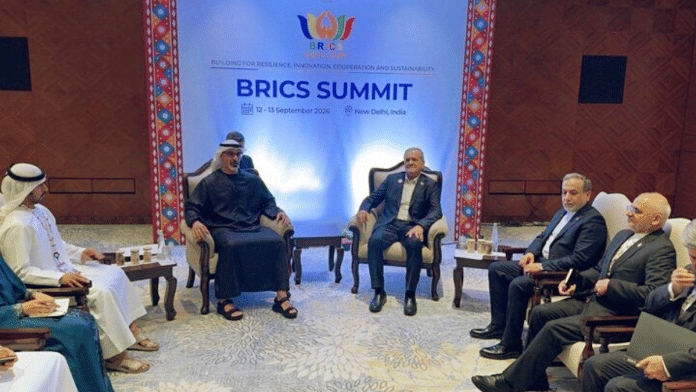

New Delhi: As the two countries remain at odds over the West Asia war, the presidents of Iran and the United Arab Emirates met face to face Saturday in New Delhi, in a rare diplomatic encounter on the sidelines of the BRICS summit.
Iranian President Masoud Pezeshkian met Sheikh Khaled Mohamed bin Zayed Al Nahyan, the United Arab Emirates Crown prince, according to the Iranian Embassy in India, marking their first known face-to-face meeting since the conflict in West Asia began in February.
In an interview with an Indian media outlet, Pezeshkian later said Iran has no issues with UAE but is against US bases in the region being used to attack Iran.
The two leaders discussed regional and international issues of mutual interest and stressed on the need to ease tensions, promote de-escalation and strengthen regional stability, according to the Abu Dhabi media office. They also discussed opportunities for peace and development in the region, the office said.
The meeting came against the backdrop of a conflict that has exposed divisions within the increasingly diverse BRICS grouping.
The West Asia war strained Iran’s already complicated relationship with Abu Dhabi. The United Arab Emirates subsequently suspended trade and financial exchanges with Iran in August, amid multiple missile and drone attacks.
The disagreement earlier also complicated the bloc’s attempts to formulate a common position on the conflict. In May, BRICS foreign ministers failed to issue a joint statement, with New Delhi attributing the impasse to “differing views among some members” over the situation in West Asia.
Prime Minister Narendra Modi has repeatedly used India’s growing diplomatic engagement with countries involved in the conflict to press for dialogue, de-escalation and a negotiated path toward peace.
His meeting with Pezeshkian Friday was their second meeting in less than two weeks, following talks on the sidelines of the Shanghai Cooperation Organisation summit in Bishkek in August.
Modi told the Iranian president that India supported efforts toward lasting peace and stability in West Asia while stressing on the importance of freedom of navigation, uninterrupted commerce and the safety of seafarers.
The New Delhi summit offered India an opportunity to demonstrate what an expanded BRICS can accomplish despite the sharply divergent interests of its members.
The grouping now brings together Iran and the United Arab Emirates alongside China, Russia, India and other major emerging economies. The encounter between the Iranian and Emirati leaders was therefore important less for any immediate breakthrough than for what it represented. The two governments remain deeply divided, and there was no indication that their meeting would resolve the broader conflict. But they were willing to meet.
(Edited by Viny Mishra)
Also read: BRICS is bigger and more powerful. But what does the grouping actually want?