



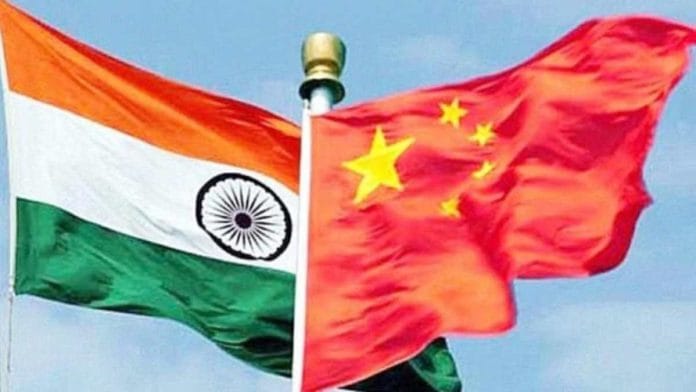
New Delhi: Amid stabilising ties between India and China, the Union Ministry of External Affairs has flagged concerns over the former’s widening trade deficit with the latter in its latest annual report.
The report, made public recently, flags the deficit twice, even as it describes the activities the two countries undertook in the last year to recalibrate ties that had cratered following the clashes in Eastern Ladakh during the summer months of 2020.
“Total bilateral trade stood at USD 96.46 billion up to November, though a trade deficit of USD 75.05 billion remained a concern that both leaders acknowledged needed to be addressed,” the report said.
The report—which looks at India’s engagement with the world over the last year, as well as the functioning of the ministry—highlights in roughly two pages the “intensification” of high-level exchanges between the two neighbouring countries in 2025 and the early months of 2026. It also notes the establishment of four new territorial divisions as the ministry refines its territorial mandates.
It notes that Prime Minister Narendra Modi travelled to the Chinese city of Tianjin at the end of August last year for the Shanghai Cooperation Organisation (SCO) Heads of States Summit, and held a bilateral meeting with President Xi Jinping on the sidelines.
“The run-up to the SCO Summit saw visits to China by National Security Adviser (NSA) in June, Raksha Mantri in June and EAM in July for meetings under the SCO framework and meetings with Chinese Ministerial counterparts on the sidelines. Foreign Secretary held meetings with Vice Foreign Minister Sun Weidong on two occasions in 2025, during his visit to Beijing (January) and subsequently during the latter’s visit to New Delhi (June),” the report added.
“Talks between the two sides under the Special Representative (SR) Mechanism on the Boundary Question have continued, with NSA visiting Beijing for the 23rd round on 18 December 2024, and the subsequent visit of Politburo member and Foreign Minister Wang Yi to New Delhi for the 24th round on 19 August 2025.”
Other high-level meetings include External Affairs Minister S. Jaishankar’s meeting with counterpart Wang Yi in New Delhi last August, as well as on the margins of the BRICS meetings in Johannesburg last February.
The MEA annual report further pivots to the trade deficit, underlining that Modi and Xi called for the “need to proceed from a political and strategic direction to expand bilateral trade and investment ties and reduce trade deficit”.
The trade deficit between India and China has been widening in recent years, especially due to large imports of electronic goods by Indian manufacturers. The deficit is more structural in nature than cyclical. India’s trade deficit for electronic goods alone has doubled since 2018-2019 to stand at around $43 billion in the last fiscal. India’s exports of goods to China have continued to grow year-on-year, albeit remain much smaller than its merchandise imports.
The two countries have undertaken certain confidence-building measures to stabilise ties, including resumption of direct flights and the Kailash Mansarovar pilgrimage. China has now had two summers hosting the pilgrimage.
President Xi travelled to Delhi last week for the BRICS Summit, marking his first visit to the country in seven years.
MEA’s expanding footprint
Internally, the MEA has established four new territorial divisions in the last year: Central America (CA), South America (SA), Northern Europe (NE) and Southern Europe (SE).
These were created from the bifurcation of two earlier divisions—Latin America and Caribbean (LAC) and Central Europe (CE).
The year also saw a number of new missions and posts established by MEA in foreign countries. A new embassy was set up in Quito, Ecuador, while seven consulate generals were opened across the globe.
The new posts were opened in Manchester and Belfast (UK), Fukuoka (Japan), Yekaterinburg and Kazan (Russia), and Boston and Los Angeles in the US.
(Edited by Mannat Chugh)
Also Read: India rejects Pakistan-China’s ‘so-called’ boundary commission—‘no boundary between them’