





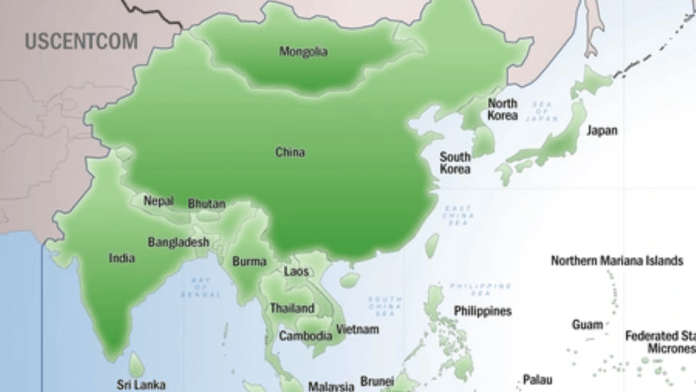


New Delhi: Amid the uproar over the US Pacific Command, or USPACOM, reinstating its previous name, an incorrect map used by the military command responsible for the Indo-Pacific region is back in the spotlight.
The Pentagon Wednesday announced the restoration of the name United States Pacific Command, or USPACOM, reversing President Donald Trump’s 2018 move to name it US Indo-Pacific Command to reflect increasing connectivity between the Indian and Pacific oceans and to show how the command stretched from ‘Bollywood to Hollywood’.
What, however, drew more discussion Wednesday was the “Area of Responsibility Map” accompanying the announcement as it misrepresented India’s territorial boundaries.
The map excludes the northern and western portions of Jammu and Kashmir, that are illegally occupied by Pakistan from India’s outline, and appears to place them within Pakistan’s borders.
Aksai Chin, claimed by India, is also shown outside India’s territorial contours. In addition, a dark line cuts across the subcontinent, demarcating the boundaries of American military command jurisdictions, including those of US Central Command and Pacific Command.
India maintains that the entirety of Jammu and Kashmir, including territories occupied by Pakistan and China, is an integral part of India. Successive Indian governments have rejected any map that appears to legitimise competing territorial claims by Islamabad or Beijing.
This is a controversy that makes a comeback every few months. In February this year, the Office of the United States Trade Representative used a correct map on X that depicted Aksai Chin and the whole of Jammu and Kashmir, including Pakistan-occupied areas, as part of India.
Department of War Restores U.S. Pacific Command Designation.
CAMP H.M. SMITH, Hawaii — The Department of War announced today that the U.S. Indo-Pacific Command (USINDOPACOM) will officially restore its name to the U.S. Pacific Command (USPACOM).
Originally established on… pic.twitter.com/ZL0EL3q6Ph
— U.S. Pacific Command (@INDOPACOM) June 16, 2026
The image accompanied a post celebrating gains for American manufacturers and farmers under an interim trade agreement announced with India on 2 February. Days later, however, the tweet with the correct map disappeared after Pakistan lodged objections with Washington.
The removal was notable because US government agencies have traditionally attempted to maintain a neutral cartographic position on Kashmir by marking the Line of Control with dotted lines rather than assigning sovereignty to either side.
New Delhi’s objections to American depictions of Kashmir go back to decades and have surfaced repeatedly across different American governments.
in 2011, when the U.S. State Department’s website displayed a map that showed Pakistan-occupied Kashmir as part of Pakistan, India lodged a formal protest.
While the map acknowledged India’s claim to Aksai Chin through a notation, it did not similarly reflect India’s claim over territories occupied by Pakistan, nor did it clearly identify them as disputed.
The following year, the MEA said Washington had repeatedly used maps that failed to reflect India’s position on its territorial boundaries.
“The Government has consistently rejected incorrect depiction of India’s borders on maps used by the US Government,” the ministry said in a 2012 statement. “It has used every opportunity to convey to the US side its concern in this regard, and has asked that these maps be corrected.”
Subsequently, the State Department revised its maps, adopting a more neutral representation of Kashmir by marking the Line of Control codified in the 1972 Simla Agreement.
(Edited by Ajeet Tiwari)
Also Read: Map speaks louder than trade: In quiet shift, US trade graphic shows undivided India with entire J&K