





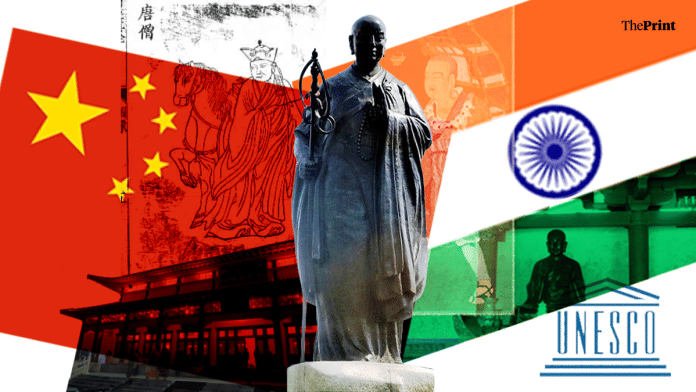


New Delhi: India and China are in preliminary talks for a possible joint nomination to UNESCO seeking recognition of shared cultural and historical ties associated with the Chinese monk Xuanzang, ThePrint has learnt.
Officials familiar with the matter said China reached out through diplomatic channels to convey an interest in pursuing a joint nomination for an inscription in UNESCO’s Intangible Cultural Heritage List. The Indian side responded and internal consultations are underway.
An Indian representative is expected to visit China in the coming weeks to hold discussions with counterparts. The visit will focus on identifying practices, narratives, and sites linked to Xuanzang that may qualify under UNESCO’s intangible heritage framework.
Xuanzang, also known as Hiuen Tsang, travelled from China to India in the 7th century during the reign of emperor Harsha. His journey covered regions that are now part of India, Nepal, Pakistan and Bangladesh. He studied at the monastic university of Nalanda and documented political, social and religious conditions of the time in his travel records. His accounts remain a source for the study of early medieval India.
Officials said the proposed nomination may include cultural practices linked to the transmission of Buddhist knowledge, pilgrimage routes associated with Xuanzang’s journey, and oral traditions preserved in monasteries and local communities. Both sides are assessing how these elements can be framed as living heritage in line with UNESCO criteria.
UNESCO’s Intangible Cultural Heritage (ICH) framework, under the 2003 Convention, recognises living traditions such as practices, expressions, knowledge systems and rituals that communities continue to transmit across generations, rather than physical monuments. The UNESCO lists together include hundreds of elements from over 150 countries, with multinational nominations forming a growing share as states collaborate on shared cultural traditions.
India ratified the convention in 2005 and currently has 16 elements inscribed on UNESCO’s Representative List, including yoga, the Kumbh Mela and Durga Puja, and has also been part of joint nominations such as Nowruz, a transnational cultural practice shared by several countries. Such joint inscriptions require participating states to agree on documentation, safeguarding measures and community participation, and are often seen as instruments of cultural diplomacy alongside heritage recognition.
Officials said a joint proposal would require alignment on the narrative and shared ownership of the elements included.
The outreach from China comes at a time when India-China relations have seen attempts at stabilisation after a period of strain following the 2020 border standoff along the Line of Actual Control. Diplomatic and military talks have continued, with both sides maintaining engagement through established mechanisms.
People familiar with cultural diplomacy efforts said cooperation in multilateral forums such as UNESCO is seen as a channel where both countries can pursue limited engagement without addressing core disputes. Cultural projects have in the past been used to signal willingness to maintain dialogue.
At the same time, officials cautioned that the proposal remains at an early stage and may take time to develop. UNESCO nominations require extensive documentation, including evidence of community participation, plans for safeguarding, and demonstration of the element’s continued practice.
The process also involves review by UNESCO bodies before consideration by the Intergovernmental Committee for the Safeguarding of the Intangible Cultural Heritage. Joint nominations add further layers of coordination between participating countries.
Sources said discussions will focus on mapping existing material on Xuanzang across archives, monasteries and academic institutions. India will be examining records related to Nalanda and other sites linked to his stay, while China will be compiling material from its own historical sources.
Officials indicated that if the proposal moves forward, it may also involve consultations with religious bodies and local communities connected to the identified practices. UNESCO guidelines require that nominations reflect community consent and participation.
There is no timeline yet for submission of the joint dossier. Officials said further clarity is expected after the planned visit by the Indian delegation and subsequent rounds of talks.
If pursued, the nomination would mark a rare instance of India and China collaborating on a cultural heritage proposal at a multilateral platform, even as broader relations continue to be shaped by unresolved issues.
(Edited by Gitanjali Das)
Also Read: Global media spotlights ‘no China-bashing’ note for Indian filmmakers citing Salman’s Galwan movie