



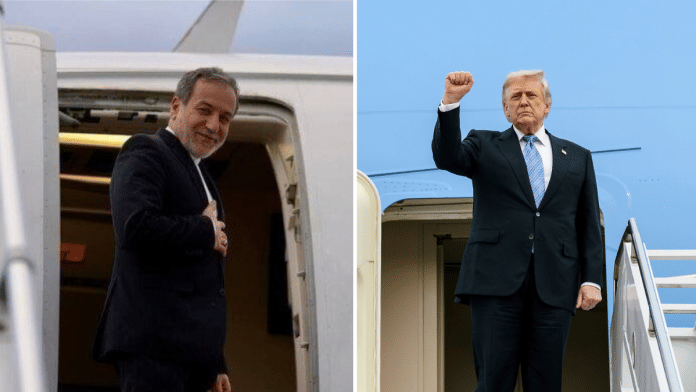
New Delhi: The 81st session of the UN General Assembly (UNGA) might see a thaw between Iran and the US amid a flurry of developments even as the West Asia conflict drags on.
The US State Department has agreed to provide protection to Iran Foreign Minister Abbas Araghchi, even as Washington imposed restrictions on movement of the Iranian delegation.
Barak Ravid of Axios in a report said that the US had approved Araghchi’s security, hours after US President Donald Trump told advisers that he would like to meet with Iranian officials attending the UNGA session this week, provided the circumstances are right.
This comes as several members of the broader delegation, including members of Iran President Masoud Pezeshkian’s media team, were reportedly denied visas.
“After review of the threats against him, he (Araghchi) will get a security detail from the Diplomatic Security Service,” Ravid wrote. The Diplomatic Security Service (DSS) is the principal law enforcement and security agency of the US Department of State.
A potential meeting could involve Araghchi, or other members of the Iranian delegation, as well as some of Trump’s senior advisers in New York, according to a CNN report.
Alongside the diplomatic manoeuvring, the Trump administration is also tightening economic pressure on Tehran. US Treasury Secretary Scott Bessent Tuesday warned that companies providing services to Iranian airlines including fuel, ground handling and ticketing could face secondary sanctions.
Araghchi arrived in New York Tuesday to lead Iran’s delegation to the 81st General Assembly, after a brief stop in Doha. Pezeshkian is expected to join him and address the assembly, while holding meetings with foreign leaders and other officials on the sidelines. Ahead of the Assembly, Tehran said it intends to use the United Nations forum to present its position and defend what it describes as the rights and interests of the Iranian people.
After arriving in New York, Araghchi spoke by phone with the United Nations secretary-general, António Guterres.
The Trump administration meanwhile has signalled that it is willing to engage directly with Iranian officials, even as Washington continues to demand that Iran abandon any ability to develop a nuclear weapon.
“I don’t think anything is scheduled at this point, but we’re certainly open to something like that,” Secretary of State Marco Rubio said in an interview with NBC’s ‘Today’, Tuesday. He said a meeting would need to have the prospect of producing a positive outcome and ultimately serve the administration’s goal of ensuring that Iran “can never have a nuclear weapon”, the CNN report said.
Mike Waltz, the US ambassador to the United Nations, likewise said that Trump was “always open” to dialogue. He however pointed to one of the administration’s central concerns—determining who in the Iranian government has the authority to speak for the country’s supreme leader.
“That’s a question I wish you could ask the Iranians,” Waltz said in an interview with CNN. “Will they sit down directly with us? And who is speaking for the ayatollah? That’s been a continuous issue.”
(Edited by Gitanjali Das)
Also Read: Iran’s Ghalibaf, US Fed & the ‘Straits Taylor Rule’: The ‘joke’ & the economics behind it