



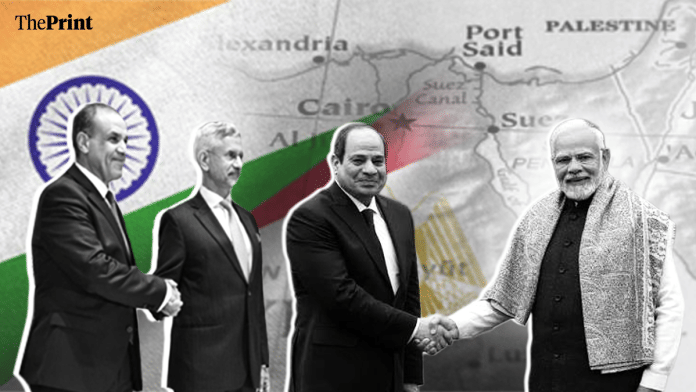

New Delhi: A call in April 2025, a quick pull-aside chat on the margins of an international summit last month, and a pending invitation for an official visit is the state of the highest level of exchanges between India and Egypt in the last year-and-a-half.
In 2023, India and Egypt upgraded their bilateral relationship to a ‘Strategic Partnership’, marking the growing convergences between the two countries. Three years later, the high-level relationship between the two countries seems to need another catalyst.
Egyptian President Abdel Fattah el-Sisi was the chief guest at India’s 74th Republic Day celebrations in January 2023, underlining the upwards momentum in ties. Prime Minister Narendra Modi reciprocated el-Sisi’s visit by travelling to the country in June 2023, where he was conferred with the Order of the Nile, the highest civilian award in the north African country.
El-Sisi returned to India later that year for the G20 summit in September. The flurry of exchanges in 2023 had signalled a potential revitalisation of New Delhi-Cairo ties after almost three decades of the relationship being left adrift. However, the 7 October 2023 Hamas attacks on Israel, and the subsequent conflicts revolving around West Asia have provided both countries with newer challenges and opportunities.
Nevertheless, the opportunities have yet to establish a firmer geostrategic alignment. A glaring example would be the fact Prime Minister Modi did not speak to El-Sisi during the ongoing war between Iran, the US and Israel.
Egypt has been playing a role in the process of mediating the conflict in West Asia. Modi has spoken to Crown Prince Mohammad bin Salman of Saudi Arabia, the King of Bahrain Hamad bin Isa Al Khalifa, the Amir of Kuwait Mishal Al-Ahmed Al-Jaber Al-Sabah, the Amir of Qatar Sheikh Tamim bin Hamad Al Thani, Sultan Haitham bin Tariq of Oman and made a quick visit to the United Arab Emirates (UAE) in May and met President Mohammed bin Zayed Al Nahyan.
Modi has also stayed in touch with President Masoud Pezeshkian of Iran, indicating his personal outreach to all the leaders in the region directly impacted by the conflict. With Egypt, however, there has been no call.
“With Egypt, with whom India’s history of alignment is far older, India shares a Strategic Partnership, and that elevation of bilateral ties occurred only in early 2023 when both sides sought to revitalise the relationship. It appears that the physical distance between India and Egypt is also being geopolitically felt. Both states, while being aligned on key geopolitical themes as well as their approach to Israel, are strategically adrift,” Bashir Ali Abbas, Senior Research Associate at the Council for Strategic and Defense Research told ThePrint.
In the 1950s and 1960s, the India-Egypt relationship was defined by the close friendship between Prime Minister Jawaharlal Nehru and president Gamal Abdal Nasser. The two were key to the establishment of the Non-Aligned Movement (NAM). By the 1990s, with the end of the Cold War, the relationship entered a deep freeze.
Also Read: Egypt envoy says a more ‘flexible trade network’ than IMEC would give India access to wider market
Invitation for a visit & IMEC
Diplomatic sources indicated an open invitation for Modi to visit Egypt. El-Sisi has made four visits to India since he came to assume power in Cairo, including for two multilateral visits—the India-Africa Forum Summit 2015 and G20 in 2023. In 2016 and 2023, El-Sisi travelled to India for state visits. Modi has been to Egypt once in June 2023.
The Egypt President has been invited to attend the BRICS Leaders’ Summit to be held in New Delhi this September, but the sense remains of the lost opportunity from India to showcase its interest in deepening the political relationship with a lack of a top-level visit by the Indian Prime Minister since El-Sisi last visited New Delhi in September 2023. The invitation was extended post El-Sisi’s last visit to India.
The relationship which looked to become key to India’s positioning in West Asia and North Africa, was further challenged by the launch of the India-Middle East-Europe Economic Corridor (IMEC). The corridor envisioned a second trade route connecting India to Europe via a land corridor connecting the UAE, Saudi Arabia and potentially Israel, thereby finding a way around the Suez Canal. The canal is key to Egypt’s geopolitical leverage, given that roughly 12 per cent of global trade flows through the Suez.
“One specific issue is that India and Egypt have not really reconciled their outlooks towards strategic connectivity. If you step away from the IMEC’s inherent logistical challenges and West Asia’s fresh conflicts since 2023 and zoom out, you see that IMEC revealed India’s lack of incentives to integrate Egypt with the IMEC’s key nodes,” said Abbas.
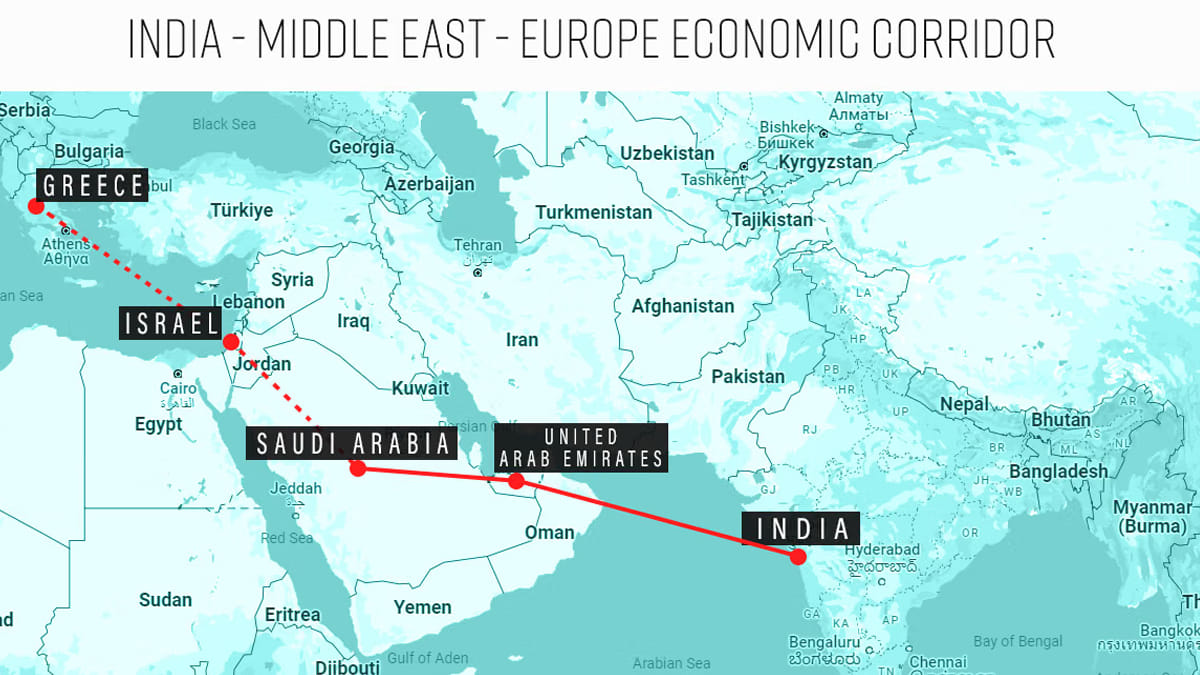
Abbas adds: “Egypt, for whom the Suez Canal continues to be one of its crown geo-economic jewels, has since sought to recommend, advise, and encourage alternative approaches that make new Asia-Europe sea-land-sea routes complementary to the existing Red Sea route.”
Egypt has not publicly stated it is against the trade route, but has offered an alternative—a network of routes that includes using the multimodal transport options within the country. Egypt is currently building the Green Line, a high-speed railway network that can carry passengers and freight connecting the ports of Ain Sokhna in the Red Sea to Marsa Matrouh in the Mediterranean. The route would offer a second land corridor around the Suez Canal. Egypt’s bet on such rail corridors has come at a time when maritime trade is facing numerous challenges, including attacks on civilian vessels in the Strait of Hormuz, Bab-el-Mandeb and Black Sea.
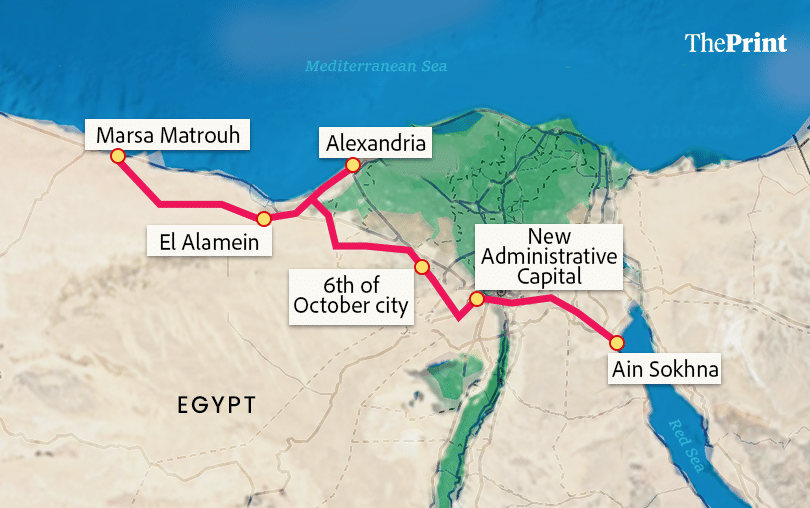
The tenuous situation in the maritime domain in West Asia, has shown the need for alternative routes. India and the UAE have sought to hasten the solidifying of the maritime trade routes between the two countries as part of IMEC. While the rest of the corridor, especially the connection to Europe remains up in the air, due to the wars in the region.
The multiple conflicts raging across the world has also impacted the trade between India and Egypt, further reducing another potential area of deeper cooperation. Two-way trade in goods between India and Egypt stood at $7.2 billion in the financial year 2021-2022, according to the Ministry of Commerce and Industry.
Trade between the two nations fell consistently over the next three years, to $4.7 billion in 2024-2025. In the last financial year (2025-2026) trade saw a sharp increase to $6.5 billion. The first two months of the current financial year (April-May) has seen Indian merchandise exports to Egypt grow by 11.53 per cent, from $598.11 million to $667.07 million. However, Indian imports from Egypt have fallen by 45 per cent to $293.7 million from $536.29 million during the same period last year.
In comparison, India’s trade and economic ties with its Gulf partners is far higher, especially with the UAE, which stood at $101.25 billion in the last financial year.
Defence & security: Growing green shoots
Despite the perceived political inertia, ties between New Delhi and Cairo have seen areas of activity in the last year, which indicates there remains some form of alignment, especially in the defence sector.
“The India-Egypt military relationship has remained robust at least with common understanding of threats and a history of deep cooperation. But it has not generated any new dividends at the politico-strategic level. For perspective, India has Comprehensive Strategic Partnerships with Gulf giants such as Saudi Arabia and UAE with whom India’s deep ties are relatively recent as are its military ties,” said Abbas.
Nadeem Ahmad Moonakal, a research scholar at the Rasanah Institute for Iranian Studies in Riyadh points to the first India-Egypt Strategic Dialogue held last October, co-chaired by External Affairs Minister S. Jaishankar and Egyptian Foreign Minister Badr Abdelatty as an indication of the closer engagement between New Delhi and Cairo.
“Apart from that [the Strategic Dialogue] this year both countries also took part in a joint defence committee meeting in Cairo. The Joint Working Group on counter terrorism was held in New Delhi in May 2026. Both countries have shared concerns and interests in the region,” adds Moonakal.
Moonakal adds that the bilateral relationship “continues to advance” with engagement at various levels, with a focus on expanding cooperation across several key sectors including “trade and investment, defence, renewable energy, maritime security, and education”.
These sectors are key for Cairo, in particular due to the current geopolitical context. However, there remains a sense that the two of the oldest civilisational states missed an opportunity to hasten the strategic convergence amid global churn.
India’s position on the Palestine issue during the BRICS Deputy Foreign Ministers and Special Envoys for the Middle East and North Africa (MENA) meeting held in April this year. India, as the chair of BRICS, had diluted the language on Palestine in the joint statement at the MENA meeting to roughly two paragraphs from around 16 paragraphs which was accepted by all members in 2025.
The drastic change in the language had led to serious pushback from several BRICS members including Egypt. The MENA meeting ended with no joint statement, while India released a chair statement. In May, the BRICS Foreign Ministers’ Meeting also saw no joint statement due to differences between Iran and the UAE, however, the language on Palestine was largely found suitable by all members, except Tehran.
“India and Egypt cannot rely on historical references alone to develop more efficient approaches to navigating a rapidly shifting geopolitical order. With unprecedented churn in the Western Indian Ocean, India and Egypt have no choice but to draw closer to each other strategically. This is both a hope and an expectation,” said Abbas.
(Edited by Nardeep Singh Dahiya)
Also Read: Murmu & Modi welcome Egypt’s Sisi. Snapshots from Republic Day chief guest’s ceremonial reception