



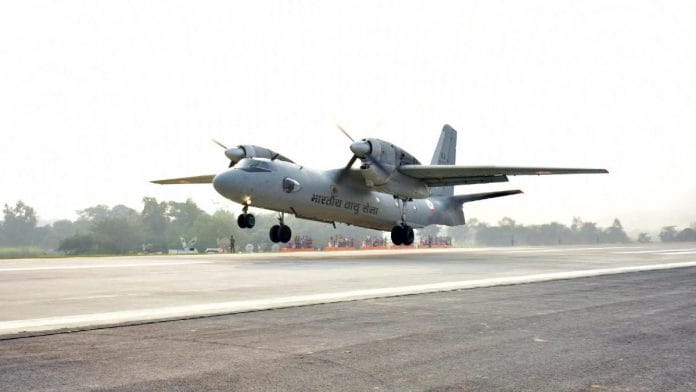

New Delhi: The IAF is in the final stages of finalising a Request for Proposal (RFP) for its long-awaited Medium Transport Aircraft (MTA) programme, a move that could finally pave the way for replacing the ageing Antonov AN-32 fleet after nearly two decades of delays.
Sources in the defence and security establishment said that the RFP is likely to be issued in the next three months, if not earlier.
The primary task of the over 100 AN-32s with the IAF is to deliver all that is needed for the sustenance of soldiers across the country, from high altitude and mountainous terrain to the island chains.
Incidentally, after a 2009 crash of an AN-32, India had signed a USD 400 million contract with the Ukrainian manufacturer Antonov to upgrade the IAF’s 105 AN-32s by overhauling the airframes and Ivchenko AI-20 turboprop engines, and fitting the platforms with advanced avionics, navigation and communication equipment.
However, the upgradation programme got stalled in 2015 due to the conflict between Ukraine and Russia when the latter annexed the Crimea region.
Later, India and Ukraine agreed to resume the upgrade programme as Kiev developed alternatives to replace the Russian-made systems on the platforms.
But the upgrade programme, which is now being carried out at the IAF’s base repair depot (BRD) in Kanpur, using equipment transferred from Ukraine, is yet to be completed due to supply chain issues.
The crash in Jorhat Saturday was the 10th such incident since its induction in 1984.
The Antonov AN-32 is an upgraded version of the AN-26, which was purchased by India from the erstwhile Soviet Union in 1984. It is a twin-engine turboprop aircraft, and had been employed as a tactical transport aircraft by the IAF since the beginning.
The AN-32 is considered the backbone of the IAF’s transport fleet, with the ability to carry up to 6.7 tons of cargo or 50 passengers across a wide variety of terrain.
While the C-295, jointly manufactured by Airbus and TATA group, which will replace the Avro aircraft, is the ideal replacement in terms of weight carrying capacity, MTA is the intended programme.
This is because the IAF is looking at MTA as the replacement for not just the AN-32s but also the IL-76s.
Also read: As India’s medium transport aircraft deal gets rolling, IAF has a tough decision to make
The original plan to replace AN-32s
The plan to replace the AN-32s started taking shape in the mid-2000s when India and Russia started discussing joint development of an aircraft with a cargo capacity of 15-20 tonnes.
The plan was for the first flight to take place in 2013. However, a formal agreement could be reached between Indian and Russian governments only in 2010 to formalise such a plan.
In May 2012, state-run Hindustan Aeronautics Limited (HAL) signed a tripartite general contract with United Aircraft Corp.-Transport Aircraft (UAC-TA), the Russian partner, and their joint venture, the Multirole Transport Aircraft Ltd (MTAL) for joint development of the MTA.
In November 2012, an office was opened for MTA Limited in Bangalore in which the UAC and Rosoboronexport of Russia held 25 percent share each, while HAL had 50.
However, the deal could never go through over differences in technical requirements and work share, and the plan was shelved in 2016.
MTA is reborn
In December 2022, the IAF revived the delayed programme and issued an RFI to foreign original equipment manufacturers (OEMs) for an aircraft having a load carrying capacity of 18-27 tonnes.
RFI is the first stage of formal interactions with an OEM and it is only after this that the force firms up its plans and approaches the Defence Ministry for clearances.
The IAF subsequently amended its RFI requirements for an aircraft with between 18 and 30 tonnes.
Three contenders are currently in the fray, though each falls into a different payload category. Lockheed Martin’s C-130J Hercules meets the lower end of the requirement with a payload capacity of around 19 tonnes. The KC-390 sits near the upper limit with a payload capability of 26 tonnes, while the Airbus A400M exceeds the specified requirement with a payload capacity of 37 tonnes.
(Edited by Viny Mishra)
Also read: Embraer takes on Lockheed, says its KC-390 is 30% cheaper, better suited for IAF than C-130J