





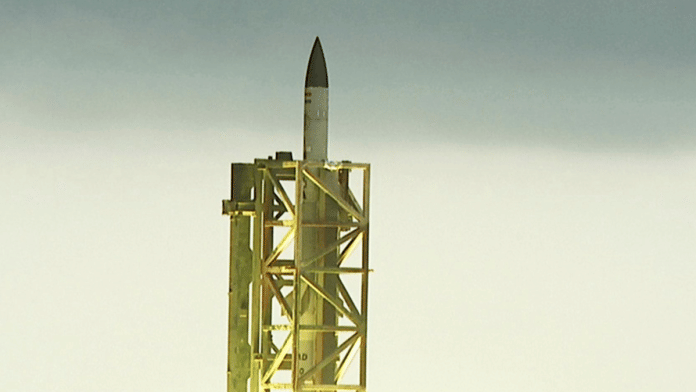


New Delhi: India has successfully carried out the final development trials of a multi-layered defence against long-range ballistic missiles, known as the Ballistic Missile Defence (BMD) shield, placing the country among a select group possessing the capability to defend against Intercontinental Ballistic Missiles (ICBMs).
The tests, which were conducted on 10-11 June by the Defence Research and Development Organisation (DRDO), involved two interceptor missiles to take down incoming ballistic missiles in both exo-atmosphere and endo-atmosphere.
“Multi-layered Ballistic Missile Defence (BMD) capability was successfully demonstrated. The interceptors successfully engaged their respective targets. The systems are designed and developed with the latest technologies to address the emerging missile threats,” the DRDO said in a statement announcing the tests.
India’s BMD programme was launched in 1999 after Pakistan’s maiden nuclear test in 1998 and China’s leaps in this sphere.
The BMD works on two levels — endo-atmospheric (within Earth’s atmosphere) and exo-atmospheric (the space stretching beyond Earth’s atmosphere).
The first missile test for a BMD system was conducted in November 2006, when a Prithvi-II missile was successfully intercepted in the endo-atmospheric level at an altitude of about 48 km.
The BMD has been developed in two phases. A third phase has also been initiated. While phase one deals with destroying incoming missiles at the endo-atmospheric level, phase two works in the exo-atmospheric level.
ThePrint had reported in 2019 that the first phase of BMD had been completed.
Phase 1 consisted of Prithvi Defence Vehicle (PDV) and Advanced Air Defence (AAD) interceptor systems. The second phase of the BMD consists of two interceptors known as the AD-1 and AD-2.
The Phase III, which has been initiated by the DRDO, will see the development of two new interceptor missiles, which are internally called AD-AH and AD-AM.
They will take down hypersonic weapons, glide vehicles that can change trajectory mid-flight, making them highly unpredictable targets, and also the Multiple Independently Targetable Re-entry Vehicle (MIRV) technology that allows a single ballistic missile to carry several nuclear warheads, each capable of being released to strike completely different targets spread over a wide geographical area.
The BMD consists of several launch vehicles, specialised long-range radars, Launch Control Centres (LCC), and the Mission Control Centre (MCC).
All these are geographically distributed and connected by a secure communication network.
The critical element of the BMD, besides the interceptors, are the radars. It was in the mid-2000s that India got Swordfish from Israel. The Swordfish is an active electronically scanned array (AESA) long-range tracking radar, specifically built to counter ballistic missile threats.
This radar is a derivative of the Israeli Green Pine long-range radar, which is the critical component of its Arrow missile defence system. However, Swordfish uses a number of indigenous systems.
The DRDO was subsequently able to make a new indigenous radar system with a higher range and capability.
(Edited by Ajeet Tiwari)