







New Delhi: India’s nuclear weapons stockpile saw a small spike in the last year, while deploying a small number of warheads on a ballistic missile submarine (SSBN) and conducting deterrence patrols, the Stockholm International Peace Research Institute (SIPRI) estimated in its latest yearbook released Monday.
“India was estimated to have a growing stockpile of about 190 nuclear weapons as of January 2026—a small increase from the previous year. These weapons were assigned to a maturing nuclear triad of aircraft, land-based missiles and SSBNs,” the SIPRI report says.
“However, the country’s recent moves towards placing missiles in canisters and conducting sea-based deterrence patrols suggest that India could be shifting in the direction of mating some of its warheads with their launchers in peacetime,” it added.
In 2025, SIPRI estimated that India had around 180 nuclear weapons. The number has increased to 190 in the latest report, while the institute estimates that India has deployed around 12 warheads, while 178 remain stored. In comparison, Pakistan’s stockpile of nuclear weapons in 2026 remains the same at 170, according to SIPRI’s estimates.
Islamabad continues to expand its nuclear capabilities through the development of new delivery systems as well as expanding its stockpiles of fissile materials. India, however, is looking to develop longer-range weapons systems with a focus potentially on China, while maintaining its long-standing rivalry with Pakistan.
“Over the past decade, India’s nuclear planning has placed a greater emphasis on investing more resources in longer-range weapon systems that appear to be focused on China, but its planning still remains heavily influenced by its long-standing rivalry with Pakistan,” the report said.
The report notes that both India and Pakistan took steps to ensure that the 87-hour conflict last May remained at the conventional level and reduced the risk of a nuclear crisis. The two countries have continued to focus on building dual-capable missiles to add to their already existing arsenals.
The institute highlights that India’s latest SSBN INS Aridhaman can carry twice the number of missile tubes compared with its two other nuclear-capable submarines – INS Arihant and INS Arighaat.
While the Arihant is equipped with the K-15 short-range submarine-launched ballistic missile (SLBM), the Arighaat has twice test-launched the K-4 SLBM, which has a longer range. India’s fourth SSBN is expected to enter service in 2027, according to SIPRI.
The report notes that India has around 152 launchers, primarily land-based launchers capable of carrying nuclear warheads. India has 88 launchers for land-based deployment of nuclear weapons, while it has around 48 air-based launchers. Its smallest launch capability remains sea-based, with only 16 launchers, according to SIPRI.
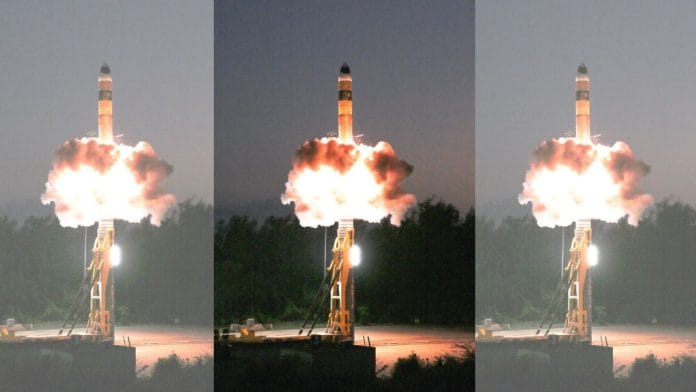
India has also made progress on the development of multiple independently targetable re-entry vehicles (MIRVs). The report notes that India’s Agni-V has demonstrated capabilities of carrying up to three nuclear warheads on a single missile.
Pakistan, in comparison, is continuing to develop a medium-range MIRV: the Ababeel. However, only a small number of tests have been carried out, with a significant gap between tests, indicating that the delivery platform is unlikely to be operationalised this year, according to SIPRI.
Islamabad currently does not have a nuclear-powered SSBN in its naval forces. However, SIPRI notes that it is likely to operationalise the Babur-3 sea-launched cruise missile (SLCM) that may be capable of carrying nuclear warheads in 2027. Islamabad’s launch capabilities remain significantly land-based and aircraft-based.
In comparison to India and Pakistan, China is currently expanding its nuclear arsenal faster than any other country globally. Beijing is estimated to have around 620 nuclear warheads, with 867 launchers, according to SIPRI.
“Depending on how it decides to structure its forces, China could potentially have at least as many ICBMs as either Russia or the USA by the turn of the decade. Yet even if China surpasses 1,000 warheads by 2030, that will still amount to only about one quarter of each of the current Russian and US nuclear stockpiles,” notes the SIPRI report.
There are roughly 12,187 nuclear warheads globally, with around 9,745 stored for potential use. The US and Russia continue to have the largest nuclear weapons stockpiles. The US has around 3,700 warheads, while Russia’s arsenal has marginally expanded to around 4,400 warheads.
The United Kingdom and France are also other known nuclear weapons powers, with Paris having around 290 warheads, while London has 225 in its stockpiles. North Korea and Israel are the two other nuclear weapons states, albeit Tel Aviv does not publicly acknowledge the existence of its warheads.
(Edited by Sugita Katyal)
Also Read: One missile, multiple warheads, many targets: India successfully test-fires Agni 5 with MIRV tech