



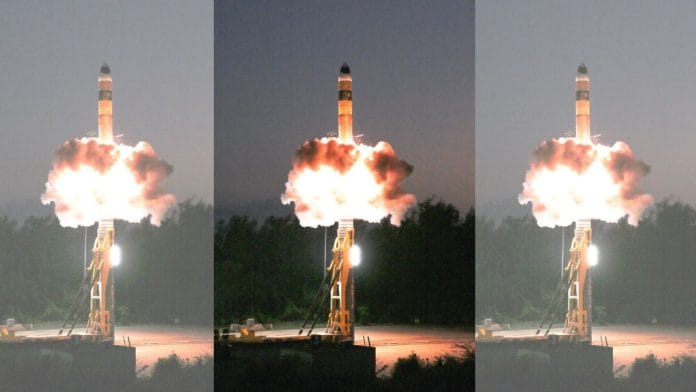

New Delhi: India carried out yet another successful test-fire of the Advanced Agni missile with Multiple Independently Targeted Re-Entry Vehicle (MIRV) system under Mission Divyastra from Dr APJ Abdul Kalam Island, Odisha.
The missile, test-fired Friday evening, was flight-tested with multiple payloads, targeted to different targets spatially distributed over a large geographical area in the Indian Ocean Region, the government said in a statement.
The test had triggered speculation on social media about Agni 6, the supposedly 12,000 km range missile, being tested. But no such proposal has been sought or sanctioned by the government.
Sources in the defence and security establishment said Friday’s test-fire was not of Agni 5 itself, which has been inducted into the Strategic Forces Command, but that of the MIRV technology. The Command is responsible for India’s nuclear assets.
On Friday’s test, the government said telemetry and tracking was carried out by multiple ground- and ship-based stations. “These systems tracked the entire missile trajectory from lift-off till the impact of all payloads. Flight data confirmed that all mission objectives were met during the trial,” the statement read.
With this successful trial, India once again demonstrated the capability to target multiple strategic targets using a single missile system. DRDO laboratories developed this missile with support from industries across the country.
It was in March 2024 that India first test-fired this MIRV technology on Agni 5, an announcement made by Prime Minister Narendra Modi.
MIRV technology helps Agni 5, an intercontinental ballistic missile (ICBM), in carrying several independent warheads as well as miniaturising them.
It means that a single missile by India can deploy multiple warheads to target different locations or the same location with a time gap. These warheads can include decoys to hoodwink the enemy’s ballistic missile defence programme.
While MIRV technology has been under development since the first Agni 5 test in 2012, the original plan was to incorporate it into the Agni 6 series of missiles that would have had a range of about 12,000 km.
However, the government has not sought any such proposal from DRDO due to strategic reasons.
DRDO chief Samir V Kamat recently said that the country has the technological ability for an Agni 6 and the project will be pursued when the government sanction comes in.
It is learnt MIRV technology was finalised with the Agni Prime missile and then after the tests, the decision was taken to go for Agni 5 as well.
The system, equipped with indigenous avionics and high-accuracy sensor packages, ensures that the re-entry vehicles reaches the target points within the desired accuracy.
The test also proves that India has also managed to ace the technology for miniaturised nuclear warheads.
Also Read: India’s new CDS Lt Gen NS Subramani—the soldier-scholar who is also an operations-oriented officer
What is MIRV?
According to the Washington-based Centre for Arms Control and Non-Proliferation (CACNP), MIRVs were originally developed in the early 1960s to permit a missile to deliver multiple nuclear warheads to different targets.
Right now, some countries reportedly have one missile that can carry up to 16 warheads, each in a separate re-entry vehicle.
Warheads on MIRVed missiles can be released at different speeds and in different directions, with such missiles capable of hitting targets as far as 1,500 km apart.
The US was the first country to develop MIRV technology, deploying a MIRVed Intercontinental Ballistic Missile (ICBM) in 1970 and a MIRVed Submarine-Launched Ballistic Missile (SLBM) in 1971. The Soviet Union caught up quickly and developed its own MIRV-enabled ICBM and SLBM technology by the end of the 1970s. The UK, France and China are the other countries that have this technology now.
Also Read: Warfare enters new dimension as Ukraine’s robot brigade records battle win against Russia