





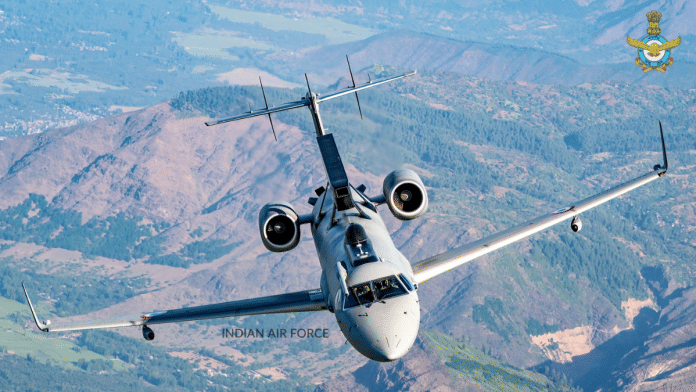

New Delhi: India’s next-generation airborne early warning and control aircraft (AEW&C) Netra Mk2 will undergo extensive modifications at home and Spain before being equipped with 100-plus indigenous radars, sensors and electronic systems capable of providing a full 360-degree picture of the battlespace deep inside enemy territory.
The six aircraft, based on the Airbus A321 platform, are expected to be delivered to the Indian Air Force (IAF) around 2032-33 and will represent India’s most capable indigenous airborne surveillance and battle management platform.
The development is part of the ambitious AEW&C Mk2 programme being executed by the Defence Research and Development Organisation’s (DRDO) Centre for Air Borne Systems (CABS), which is developing the mission systems while working with multiple partners for aircraft conversion and integration.
As part of the programme, CABS has this week signed a contract with Adani Defence Systems and Technologies Limited (ADSTL) as the Development-cum-Production Partner (DcPP) for the indigenous mission systems that will be installed on the aircraft.
The contract also includes integrated logistics, maintenance, repair and overhaul, and technical support for up to 30 years.
It also simultaneously signed a contract with state-owned AI Engineering Services Limited (AIESL) to convert six A321 aircraft, acquired by the IAF from Air India, from commercial passenger configuration into what is known as a “green aircraft”.
A green configuration means that the aircraft is stripped of all commercial interiors, including passenger seats, overhead bins, cabin fittings and associated equipment, leaving behind only the basic aircraft structure and essential wiring. This creates the platform on which the specialised military systems can later be installed.
Once this conversion is completed in India, the aircraft will be flown to Airbus facility in Spain, where the original equipment manufacturer (OEM) will undertake extensive structural and aerodynamic modifications necessary to transform a commercial airliner into an airborne early warning platform.
According to sources in the defence establishment, these modifications go far beyond simply installing the large radar housing on top of the aircraft.
“There are multiple design changes that have to be carried out. You cannot simply mount the rotodome because that changes the aircraft’s centre of gravity,” a source explained.
“There are structural reinforcements, power generation requirements, cooling systems and a host of other modifications. Since Airbus is the OEM, it is best placed to undertake these changes.”
The involvement of Airbus follows a contract signed by CABS with the European aerospace major in December last year for supporting the platform modification programme.
More than 100 sensors onboard
Once the structural work is completed, the aircraft will be equipped with one of the most sophisticated indigenous mission suites ever developed in India.
According to the sources, each Netra Mk2 aircraft will carry more than 100 radars, sensors, antennas and electronic warfare systems, enabling it to detect, identify, track and manage a large number of aerial and maritime targets simultaneously.
The system is expected to provide 360-degree surveillance over hundreds of kilometres, allowing operators to monitor enemy fighter aircraft, cruise missiles, drones, helicopters, transport aircraft and even surface vessels far beyond India’s borders.
The aircraft will also function as an airborne command-and-control centre.
Sources said the first three aircraft are likely to undergo mission-system integration with assistance from Airbus before subsequent aircraft are integrated increasingly within India by ADSTL and Adani Group.
Also Read: Defence ministry clears key ‘eye in the sky’ project to catch up with Pakistan
Filling a critical capability gap
Airborne early warning aircraft are often referred to as the “eyes in the sky” because they can detect threats that ground-based radars cannot, particularly aircraft flying at low altitudes or over long distances where the Earth’s curvature limits radar coverage.
Operating at high altitude, these aircraft dramatically extend the radar horizon and provide early warning of incoming fighter aircraft, cruise missiles, drones and other aerial threats. They also serve as airborne command posts.
Currently, India operates three Phalcon Airborne Warning and Control Systems (AWACS) mounted on Russian IL-76 aircraft. These larger platforms offer 360-degree coverage with detection ranges of around 400 kilometres.
In addition, the IAF operates three smaller indigenous Netra AEW&C aircraft based on the Brazilian Embraer platform, one of which is used by CABS for developmental activities.
While these aircraft have significantly enhanced India’s surveillance capability, they offer a shorter detection range—around 200 km—and carry fewer sensors than the larger platforms.
To bridge this gap, India is also developing six upgraded Netra Mk1A aircraft on the Embraer platform with newer radars and enhanced electronic systems. The contract for these is likely to be signed next year.
The Netra Mk2, however, will represent a significant leap in capability, combining the endurance and payload of the larger A321 platform with a new generation of indigenous sensors and mission systems.
Lessons from Balakot & Pak challenge
The acute need for additional airborne early warning platforms has become increasingly evident over the past decade.
During the aerial duel with Pakistan in 2019 following the Balakot strikes, a temporary transition between airborne surveillance assets reduced the IAF’s continuous radar coverage, a gap that Pakistan exploited during its retaliatory operation.
Pakistan operates eight Saab 2000 Erieye AEW&C aircraft and four Chinese ZDK-03 Karakoram Eagle AWACS. The fleet enables it to maintain round-the-clock surveillance.
They initially operated nine Saab aircraft, one of which got destroyed during Operation Sindoor.
Indian planners have long argued that a much larger AEW&C fleet is essential not only to maintain persistent surveillance along both the western and northern fronts but also to support long-range air operations and future network-centric warfare.
(Edited by Tony Rai)
Also Read: IAF achieved air superiority in Op Sindoor, forced Pakistan to seek ceasefire—Swiss think tank