



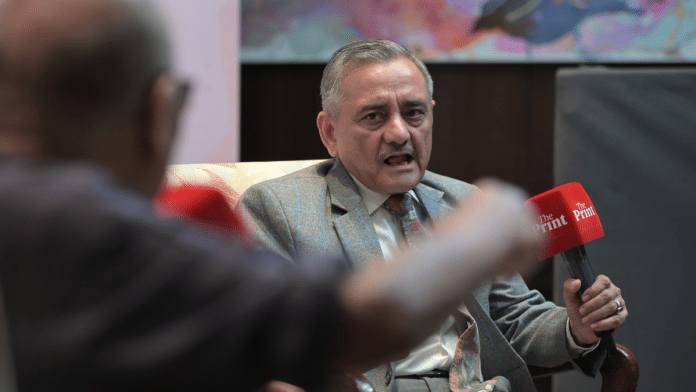
New Delhi: Former Chief of Defence Staff (CDS) General Anil Chauhan (retired) has sharply criticised the growing practice of “white labelling” in India’s defence manufacturing ecosystem, calling it a serious problem that undermines the country’s push for indigenous defence production.
In conversation with ThePrint Founder and Editor-in-Chief Shekhar Gupta and Editor (Defence & Diplomacy) Snehesh Alex Philip, the recently retired CDS did not mince words while responding to a question on white labelling, a term used to describe the practice of foreign-origin systems being supplied as indigenous products with little or no value addition.
At ThePrint’s marquee talk show Off The Cuff (OTC) on Saturday, Gen Chauhan said the responsibility of nationalism cannot rest solely with the armed forces.
In the last few years, India has placed defence orders worth several thousand crore of rupees with Indian companies in the push for indigenisation. However, concerns have surfaced that some vendors, including major players, are importing complete systems from abroad and making only cosmetic changes, such as repackaging, before supplying them to the armed forces.
In other cases, companies were found to be overstating the level of indigenous content despite falling short of the mandated requirements.
“White labelling has come to our notice when I was CDS. Who is doing this? Is nationalism etc. only for the services? Is it not for ordinary citizens of our country? Why are they doing it? Have they no responsibility?” a visibly upset Chauhan said.
He pointed out that Requests for Proposal (RFPs) clearly stipulate minimum indigenous content requirements—such as 40 or 50 percent—but companies were at times falsely certifying compliance.
“That is a problem. It is a larger problem which we have to address. There is no way that people who are procuring can go to every factory premises every time and get to understand this,” he said.
“So this responsibility of nationalism cannot be the preserve of the armed forces only. It has to percolate down to every citizen of the country, every manufacturer, every industrialist.”
The former CDS underlined that the issue was not merely one of procurement compliance but also of national responsibility. He argued the success of India’s defence Atmanirbharta programme depended as much on the integrity of industry as on the commitment of the armed forces.
(Edited by Sugita Katyal)
Also Read: Gorkha recruitment rests with Nepal, Agnipath only route to join Indian Army, says ex-CDS Chauhan