





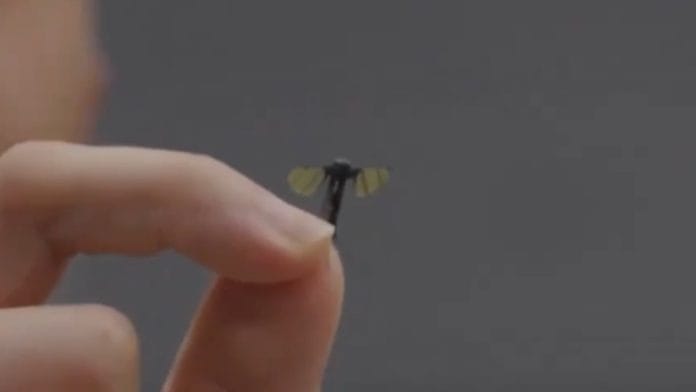

New Delhi: It is 2 cm long and weighs 0.3 grams. It has two tiny wings and three spindly legs. No, it’s not an insect, but China’s new military drone that could change the game of covert warfare forever. Developed in a robotics laboratory at the National University of Defence Technology (NUDT) in central China’s Hunan province, the micro-drone can also potentially be used to revolutionise various industries and services.
Its wings flap at 500 times per second. Its size makes it almost undetectable by conventional radar systems. It has a stick-thin body, packed heavily with sensors and it is engineered in a way that it looks like a mosquito.
The bionic microdrone was first displayed on China’s state-run military broadcaster, CCTV-7. “Here in my hand is a mosquito-like robot,” Liang Hexiang, a student at the NUDT, said on the broadcast. “Miniature bionic robots like this one are especially suited to information reconnaissance and special missions on the battlefield,” he added.
Media reports suggest the micro-drones could be deployed in swarms for warfare and espionage purposes. However, experts say, so far there is no evidence yet that the displayed prototype can be deployed for field operations. China is actively researching swarm technologies to get the micro-drones in action, but has encountered several challenges.
One of the biggest challenges is their extremely limited power, sufficient only for indoor flights. The weight and height of the drone, though largely an advantage in stealth operations, do come with payload constraints.
Fitting cameras, microphones and communication interceptors is a major engineering challenge. Outdoor use, at this nascent stage, is impractical as even a mild wind can destabilise the micro-drone. At present, the dream of a mosquito-size drone remains restricted to an experimental laboratory.
Bryce Barros, a security fellow at the Washington-based Truman National Security Project, told Newsweek: “The impact of this mosquito-sized drone on wartime surveillance will likely be minimal due to its limited capacity, short range, and presumable short battery life.”
Despite the limitations of the mosquito drone, there is speculation that, with modifications, it could see the light of day outside a laboratory.
So the potential impact and scope of these nearly invisible surveillance tools is still an exciting prospect. From military reconnaissance to civilian misuse, the purpose of these microdrones lies in the hands of the user.
It can infiltrate areas beyond the reach of conventional weapons, while the use of drones for civilian spying and industrial and political espionage cannot be denied. However, its ability to gather information without getting detected presents legal and ethical dilemmas.
Timothy Heath, senior defense researcher at the Rand Corporation, told The Telegraph: “If China is able to produce mosquito-sized drones, it would likely be interested in using them for various intelligence, surveillance and reconnaissance tasks, especially in places that larger drones struggle to access, such as indoor areas.”
Other countries too have already sensed the shift in modern warfare technologies and are increasingly exploring miniaturisation. Norway has developed a palm-sized helicopter-style micro-UAV, dubbed the ‘Black Hornet’, already in use by multiple armed forces, including the US military. The ‘Black Hornet’ comes with built-in cameras and sensors, controlled by a small handheld unit.
In 2019, Harvard scientists published updated research papers of their ‘RoboBee’ model, which looks very similar to the Chinese microdrone.
Some versions of the ‘RoboBee’ “transition from swimming underwater to flying” or “perch on surfaces using static electricity,” according to Harvard’s Wyss Institute. It also claimed to build an autonomous UAV that could be used for surveillance to agricultural and environmental monitoring.
The current prototype built by NUDT remains a lab demo as China steps into the domain of global micro aerial vehicles, providing a glimpse into a future where warfare and spycraft will not be measured in rockets or tanks but in millimetres.
Dedipya Agarwal is an intern who graduated from ThePrint School of Journalism
(Edited by Viny Mishra)
Also read: Army successfully tests indigenous FPV armed drone like those deployed in Ukraine war