


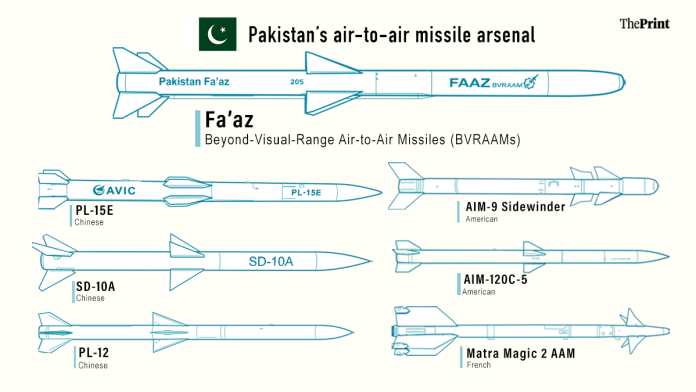
New Delhi: Pakistan recently flight-tested its first indigenously developed air-to-air missile (AAM), named Fa’az (Urdu for victorious). The development marks a significant step for the country, which has so far relied primarily on Chinese- and US-made missiles. For India, the development merits attention, as recent standoffs between the two countries have been characterised by aerial engagements and Pakistan could potentially use the missile for a future conflict.
On 3 November, the day of the test, Pakistan military’s media wing, the Inter-Services Public Relations (ISPR), said, “The successful flight test underscores the technical maturity, innovation and self-reliance achieved by Pakistan’s defence industry.”
A video released by Pakistan showed the missile fitted onto a JF-17 Thunder, the fighter aircraft jointly developed by Pakistan and China.
Equipped with a state-of-the-art terminal guidance system, Fa’az is designed to engage enemy aerial targets at longer ranges, placing it in the category of Beyond-Visual-Range Air-to-Air Missiles (BVRAAMs). Importantly, the missile shown in the video was the passive imaging infrared (IIR) version, known as Fa’az IIR. A separate active radar-guided (RF) variant is also under development.
IIR missiles are tactically more effective as they use thermal imaging to build a two-dimensional image or silhouette of the target before locking on, rather than relying primarily on the heat signature of the target as older infrared (IR) missiles do.
The Fa’az IIR has an estimated detection range of 40 kilometres, while the RF version has a detection range of 25 km. Both variants are projected to have a range exceeding 100 km and a maximum speed of Mach 3.5 (supersonic).
The missile is being developed under Pakistan’s National Engineering and Scientific Commission (NESCOM) by the state-owned defence conglomerate Global Industrial and Defence Solutions (GIDS). The company first showcased mock-ups of both Fa’az variants at a defence exhibition in Istanbul, Turkey, in 2023. GIDS maintains that its products are developed locally and that it owns their intellectual property rights.
Pakistan has not released detailed information about Fa’az’s flight test or disclosed the development status of its radar-guided RF variant. Regardless of when the missile enters operational service, the test marks a significant step for Pakistan’s air defence industry.
Writing for The War Zone, a defence and military analysis website, Thomas Newdick described it as “a significant development in the country’s efforts to establish a domestic air-to-air weapons capability and join a relatively small group of countries with the expertise to develop such weapons”.
Also Read: Why Pakistan’s veteran power broker Maulana Fazlur Rehman is now challenging the military
Moving beyond American and Chinese missiles
Air Marshal Diptendu Choudhury (Retd), an airpower specialist and author affiliated with several Indian think-tanks, told ThePrint that Pakistan was dependent on the US for long, but started looking to China after America imposed sanctions on the sale of F-16s to Islamabad in 1990. “The Chinese helped Pakistan with technology, while Pakistan assisted the Chinese air force in expanding its operational experience by way of bilateral joint exercises like Shaheen.” He added that there were limits to the extent of China’s assistance, prompting Pakistan to move towards self-reliance.
Beyond reducing dependence on foreign suppliers, greater domestic production could also allow Pakistan to export its weapons systems. Fa’az could complement the JF-17 Thunder, which Pakistan is already exporting, giving prospective buyers the option of acquiring both the fighter aircraft and its accompanying air-to-air missile.
However, Air Marshal AK Bharti, Director General of Air Operations during Operation Sindoor, questioned Pakistan’s claim that the missile was indigenous. “The indigenous component of Fa’az should be taken with a pinch of salt, as they could very well just be assembling foreign components,” he told ThePrint.
Foreign technological influences in Pakistan’s indigenous missile inventory cannot be ruled out, given Islamabad’s longstanding defence ties with China. GIDS is also developing a longer-range missile, called Fa’az-2, in technological cooperation with Turkey’s TÜBİTAK SAGE, which is developing the country’s own air-to-air missile, GÖKDOĞAN.
Air Marshal Bharti said India should take note of the development regardless of how much of the missile is indigenous. “It is a capability with the adversary, however small it may be,” he said.
Recent clashes between India and Pakistan have predominantly involved beyond-visual-range (BVR) engagements. A defining feature of Operation Sindoor was that aircraft from neither India nor Pakistan crossed into each other’s airspace and the fighting occurred through long-range and BVR platforms.
“The next India-Pakistan standoff, as indeed an aerial battle anywhere in the world, would predominantly be a BVR combat, but you cannot do away with within-visual-range AAMs (WVRAAMs) completely,” Air Marshal Bharti told ThePrint.
Against this backdrop, it is important to take stock of the PAF’s existing BVRAAM inventory.
PL-12/SD-10A
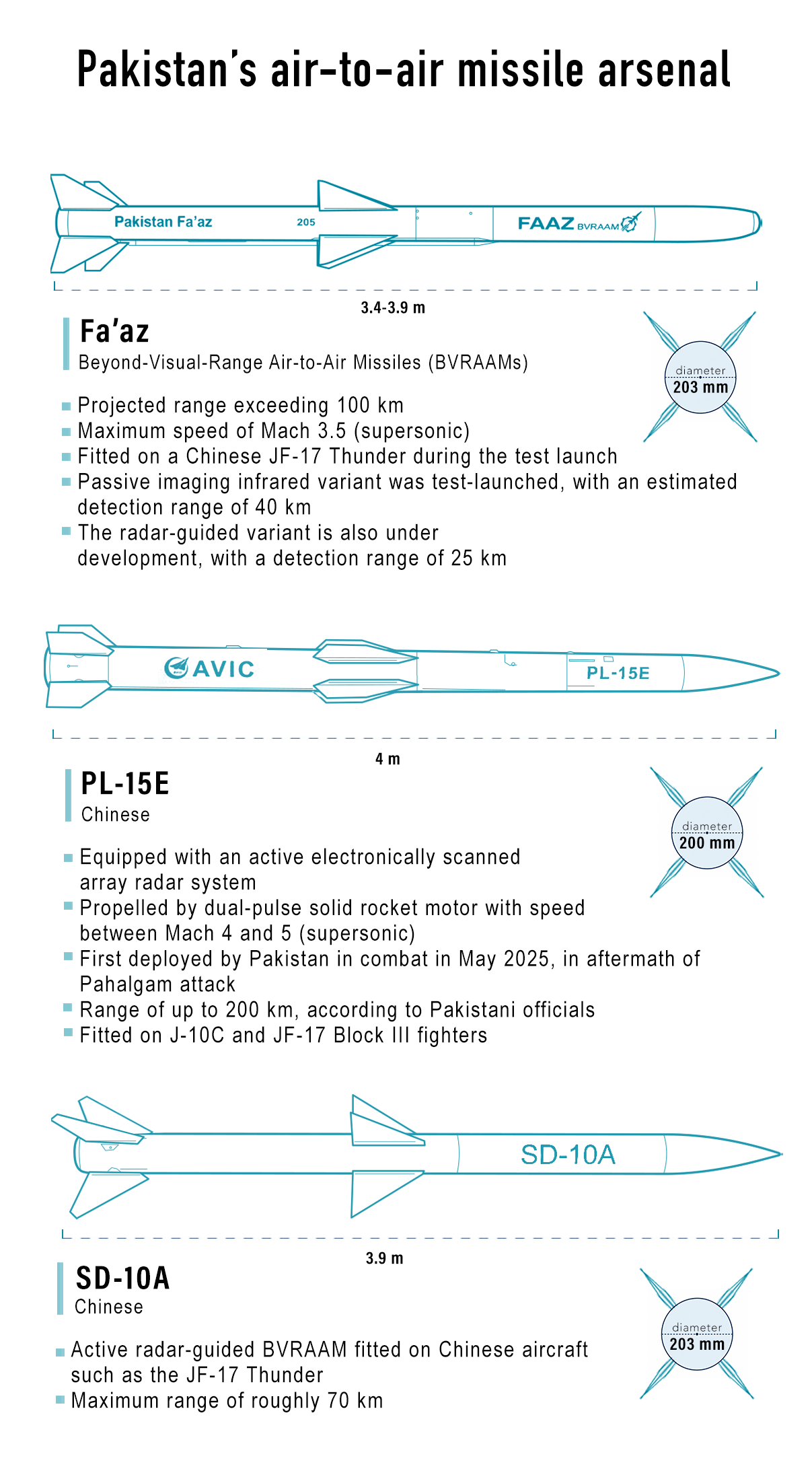
Among the longer-range missiles in Pakistan’s inventory is the Chinese SD-10A BVRAAM, an export variant of the PL-12 missile. It is produced under licence by the Pakistan Aeronautical Complex and appears to have partly influenced Fa’az’s design.
A report by the Royal United Services Institute (RUSI) said the PL-12 was China’s first indigenous active radar-guided air-to-air missile. It entered service with the Chinese Air Force and Navy in 2005.
The SD-10A is an active radar-guided BVRAAM fitted on Chinese combat aircraft, including the JF-17 Thunder. Its range is slightly lower than that of the PL-12 which, according to many estimates, has a maximum range of 100 km, with the export version having a maximum range of roughly 70 km.
PL-15E and Operation Sindoor
Another long-range missile in Pakistan’s inventory is the Chinese PL-15E, the export variant of the PL-15. It is integrated into the armament of the J-10C and JF-17 Block III fighters.
Designed as an advanced successor to the PL-12, the PL-15 is equipped with an active electronically scanned array (AESA) radar seeker. It is powered by a dual-pulse solid rocket motor and has a maximum speed of Mach 4–5 (supersonic).
The RUSI report notes that the PL-15 has a profile visually similar to the US-made AIM-120 C/D Advanced Medium-Range Air-to-Air Missile (AMRAAM), but “outranges the latest AIM-120D model and has a comparable maximum range to the Meteor [French-made missile]”.
Pakistan was the first export customer for the PL-15E. Its first deployment came during the May 2025 confrontation with India, following the Pahalgam attack. Missile debris reportedly fell inside Indian territory in Hoshiarpur, Punjab. Air Marshal AK Bharti subsequently confirmed at a press briefing following Operation Sindoor that Pakistan had used the missile, pointing to its debris.
The PL-15E’s operational range caught the Indian Air Force (IAF) off guard, according to a Reuters report. Indian officials had estimated its range at approximately 150 km. The missile, however, struck an Indian aircraft from a distance of nearly 200 km during combat, Reuters reported.
American AAMs
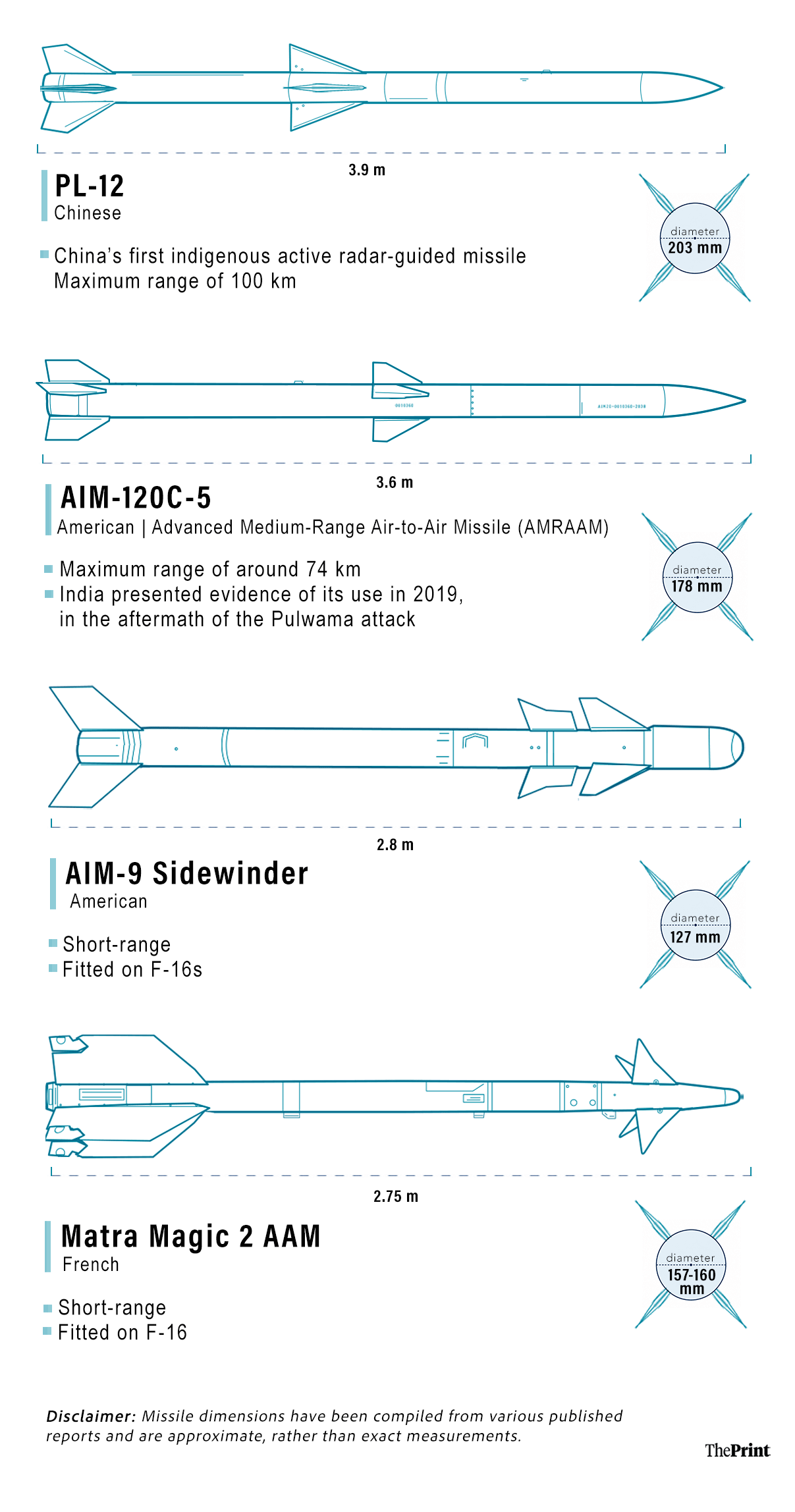
For its fleet of American F-16 Fighting Falcon aircraft, Pakistan relies on US-made AAMs, particularly the AIM-120C-5 AMRAAM. According to data from one of its operators, the AIM-120C-5 has a maximum range of around 74 km.
During the 2019 India-Pakistan confrontation following the Pulwama attack, India publicly displayed debris from an AIM-120C-5 as evidence that Pakistan had deployed its American-made F-16s against India.
“Pakistan claimed they did not use F-16. There is enough evidence to show that F-16s were used in this mission through their electronic signatures. Parts of AMRAAM air-to-air missile, which is carried only on the F-16s, was recovered east of Rajouri within Indian territory,” Air Vice Marshal R.G.K. Kapoor had said after the 2019 confrontation.
Air Marshal Diptendu Choudhury said the US had refused to acknowledge that Pakistan used F-16s against India, given Islamabad’s assurances that the aircraft would be used for counter-terrorism operations rather than against India.
Months after Operation Sindoor, the US confirmed the sale of AMRAAMs to Pakistan through defence manufacturer Raytheon. On 30 September 2025, the US Department of War issued a press release announcing contracts awarded to several American defence firms. The US Embassy in India subsequently confirmed the sale, but described it not as a new agreement to upgrade Pakistan’s existing capabilities, but as “an existing Foreign Military Sales contract for sustainment and spares for several countries, including Pakistan”.
Pakistan had earlier purchased 700 AAMs from US-based Raytheon in 2007. The order included 500 AMRAAMs, making it the largest international order for the weapon at the time, and 200 short-range AIM-9M Sidewinder missiles.
The bigger question here is whether Pakistan would deploy its American AMRAAM (and its F-16 fleet at large) against India again, even though the PAF’s large inventory of Chinese-AAMs provides enough alternatives to bypass American systems against India.
French and American short-range AAMs
The infrared-guided Sidewinder remains a short-range weapon of choice for Pakistan’s F-16 fleet. The PAF continues to operate the all-aspect AIM-9L and the older AIM-9P variants.
It also operates the French-made, infrared-guided Matra Magic 2 AAM, which is comparable to the AIM-9L and offers an alternative to the US-made weapon.
These short-range AAMs (SRAAMs) are primarily intended for within-visual-range (WVR) dogfights. Given the changing nature of aerial combat and the growing importance of BVRAAMs, their role in a future India-Pakistan confrontation may be more limited.
Implications for India
Air Marshal AK Bharti told ThePrint that India should take note of the development without being unduly alarmed. “Any new weapon the adversary gets will naturally be a cause of concern, but India need not be unduly alarmed by this development. Of course, India must continue to keep its eyes open and factor in each and every development across the border, in its larger scheme of things,” he said.
Given Pakistan’s asymmetry with India and its continued reliance on foreign suppliers, maintaining a substantial stockpile of AAMs remains critical for Islamabad. However, dependence on other countries poses both financial and geopolitical constraints and indigenous production could reduce the risk of the PAF depleting its BVRAAM supplies in the case of a prolonged conflict with India.
Air Marshal Choudhury said that, over and above the radar range, the missile’s range should be greater than the adversary’s. “India for the longest time, up until the Kargil war, had a BVR missile advantage over Pakistan. This advantage lay in the Indian Air Force’s AAM ability to outstick PAF’s.”
Put simply, the IAF’s missiles had a greater range than Pakistan’s weapons. By the 2019 Balakot strikes, however, Pakistan possessed more sophisticated AMRAAMs than India’s, the Air Marshal said.
India has its own indigenous BVRAAM family, Astra, developed by the Defence Research and Development Organisation (DRDO). The Astra Mk-1, with a range exceeding 100 kilometres, has already been inducted into the IAF. Its range is being extended, while the Astra Mk-2 is undergoing testing. Plans are also underway for the Astra Mk-3.
So, while Fa’az expanded the weapons options available to its Air Force, what will ultimately matter is whether Pakistan can match or exceed Indian missile ranges and how quickly it can produce and induct the missile into operational service.
India remains ahead of Pakistan in indigenous AAM development and has demonstrated this through its Astra programme.
Air Marshal Choudhury said, “There is a long way till Pakistan inducts Fa’az into its service. Nevertheless, India should keep up the pace and accelerate its own missile technology. It’s a cat-and-mouse game in which India should remain ahead of Pakistan both in terms of weapons capability and scalability. India should also widen its choices on the AAMs menu and should continue upgrading its missiles by increasing their ranges, and making them lighter and smarter.”
(Edited by Chingkheinganbi Mayengbam)
Also Read: A Muslim NATO in the making? How Türkiye and Pakistan are building defence ties