


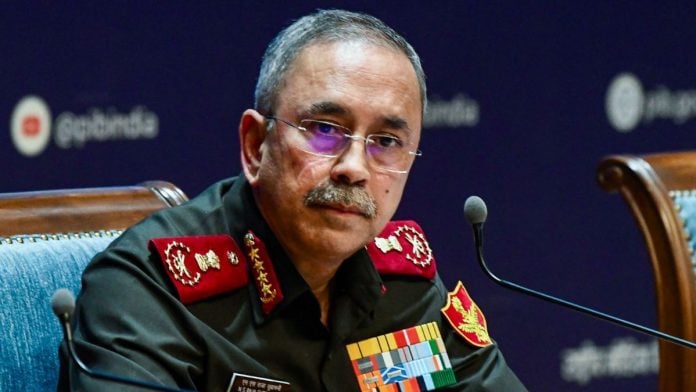
New Delhi: India has begun its Space-Based Surveillance-3 (SBS-3) programme to launch a 52-satellite constellation aimed at improving surveillance of its borders from space by reducing gaps between satellite passes, Chief of Defence Staff (CDS) General N.S. Raja Subramani said Friday.
He also flagged Pakistan’s growing space capability with Chinese assistance, adding that India must factor in the possibility of Turkey extending support to Pakistan.
The Cabinet Committee on Security cleared the third phase of SBS in October 2024 with an outlay of Rs 26,968 crore. Of the 52 satellites planned, the Indian Space Research Organisation (ISRO) will build 21, while private firms will build the remaining 31.
The surveillance satellites will carry a combination of electro-optical and synthetic aperture radar (SAR) sensors. They will be placed in low-Earth orbit (LEO), between 160 km and 2,000 km above the Earth. The programme’s original completion target is the end of 2029.
ISRO carried out the first two phases of the SBS programme over two decades, deploying the Cartosat and RISAT series of complementary satellites.
General Subramani was speaking at the ‘Vimarsh on Future of Warfare and India’s preparedness to conduct Multi-Domain Operations (MDO)’ event at the Vivekananda International Foundation in New Delhi.
Responding to questions from audience members, including veterans and a former ambassador, he said Pakistan’s space capabilities were improving with Chinese assistance, while its Space and Upper Atmosphere Research Commission (SUPARCO) was also working to develop indigenous capabilities.
“As far as the first question relating to Pakistan’s space capability, yes, its space capability is improving with Chinese help, and also SUPARCO (Space and Upper Atmosphere Research Commission), which is a Pakistani organisation, is working to develop its own capability. Now, we should also take it for granted that it will be helped by the Turkish too, and whatever capability is available with the Chinese in terms of ISR (intelligence, surveillance and reconnaissance), positioning, navigation, and timing (PNT), etc., will be available to the Pakistanis. So, that we will have to factor it into our calculus. Their ISR, etc., will be better,” he said.
He added that India must also assume Turkey would extend support to Pakistan, and that Chinese capabilities in intelligence, surveillance and reconnaissance (ISR), and positioning, navigation and timing (PNT), among others, would be accessible to Pakistan.
“But for us, having factored it into our calculus, we have to look at enhancing our capability. SBS-3, when it comes in, will enhance our capability to a great extent. Simultaneously, we are also working on methods to ensure that we are able to build and also launch more satellites. We are working with our private sector entrepreneurs,” he said.
Responding to questions on China’s space capabilities and asymmetric warfare, General Subramani said India should focus on developing the capabilities it needs rather than trying to match Beijing.
“I think we are all cognizant of what we need to do in space. SBS-3… launches have already begun. You have seen the launch of the NavIC (Navigation with Indian Constellation) satellite and the GSAT-7 (GSAT-7C), and there will be an increasing launch cadence to ensure that we can reduce… the revisit time to a very short extent,” he said.
On 15 October, the Ministry of Defence (MoD) signed a Rs 2,563 crore contract with NewSpace India Limited, a Bengaluru-based public sector undertaking, for a dedicated communication satellite capability, GSAT-7C, for the Indian Air Force.
“This indigenously designed, developed and manufactured satellite will enhance the secure, resilient and seamless communication capabilities for the assets of the Indian Air Force (IAF), thereby strengthening operational effectiveness,” the MoD said in a release at the time.
The GSAT-7A satellite, launched by ISRO in December 2018, was already providing networking and communication capabilities to the IAF. It is a geostationary satellite that carries Ku-band communication transponders and is built to provide communication capability to users over the Indian region.
“Revisit time” refers to how long it takes for a satellite’s sensors to observe the same spot on Earth again.
Speaking about China, he said India should not seek to match Beijing’s capabilities but focus on having enough satellites to monitor its borders and reduce the time between satellite passes.
“I don’t think that neither should we plan nor compete to try and get whatever China has got. We need to have enough to look at our borders and the ability to reduce that revisit time. Those calculations have been done, and we are looking at launching adequate number of satellites to have our ISR, PNT, and ELINT (electronic intelligence) resources,” he said.
On asymmetric warfare, he said the Indian armed forces were prepared to defend the country’s sovereignty and territory along the northern front.
“Second, as far as asymmetric warfare is concerned, I can assure you, sir, that in terms of terrain and in terms of operational aspects, the Indian Army and the Air Force are well geared on the northern front to defend our sovereignty and territory. I would not like to get into more operational details. As far as the Navy is concerned, it’s also equally capable,” he added.
(Edited Anupama Yadav)
Also Read: IAF achieved air superiority in Op Sindoor, forced Pakistan to seek ceasefire—Swiss think tank