



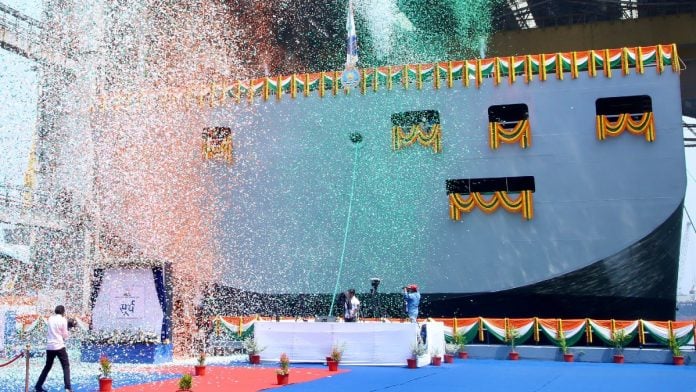
Hyderabad: Defence Minister Rajnath Singh Tuesday commissioned the first of the five indigenous Fleet Support Ships (FSS-1), Surya, at Hindustan Shipyard Limited (HSL) in Visakhapatnam, marking a critical evolutionary step in the Navy’s operational reach across the Indian Ocean Region (IOR).
The vessel was built with one clear role: to replenish frontline warships at sea with fuel, water, ammunition, and other essential stores, to bolster naval endurance. It fundamentally increases the Navy’s capacity to fight longer and harder at sea without returning to port, Chief of the Naval Staff, Admiral Krishna Swaminathan said, during the launch.
With a displacement of approximately 43,500 tonnes DWT (deadweight tonnage), Surya entered the water of the Bay of Bengal at Vizag just 18 months after steel cutting, a feat for the once-bootstrapped Hindustan Shipyard Limited. Steel cutting marks the official beginning of the shipbuilding lifecycle.
HSL has been commissioned and contracted by the Navy to build five Fleet Support Ships at a cost of Rs 19,500 crore, a Press Bureau of India statement said.
Launched the first indigenous Fleet Support Ship ‘INS Surya’ at Hindustan Shipyard Ltd in Visakhapatnam. The launch of FSS1 is a symbol of achievement, keel laying of FSS5 is a symbol of resolve and the new Slipway is a symbol of our growing capability. HSL is fast emerging as a… pic.twitter.com/xH3kfJHOEm
— Rajnath Singh (@rajnathsingh) October 6, 2026
Built to defend herself and support warships in replenishing themselves, Surya also has a helicopter deck that can accommodate multi-role helicopters. Her fit includes AK 630 guns, the Kavach decoy system, the marines torpedo defence system, and electronic warfare suites named Shakti, and Sea King 42 Charlie helicopters. Surya is a large vessel—223.6 metres long and 31.5 metres wide—equipped with two main engines of 2 MW each to help her sail at a top speed of 20 knots, according to details provided by HSL at the time of launch.
According to the PIB statement, the launch of the FSS-1 was coupled with the inauguration of a 300-tonne Goliath Crane and lengthened Slipway-4, which would not just assist HSL in larger constructions, but also cement the public sector undertaking (PSU) as a premier tier-one defence shipbuilder.
Speaking at the launch of the FSS-1, the defence minister applauded the transformation of Hindustan Shipyard from a financially distressed unit to an operationally functional Category-I Miniratna PSU.
“In 2025, we categorised Hindustan Shipyard as a Miniratna PSU and ensured it was financially restored. Today, HSL is part of an Integrated National Maritime Ecosystem, being part of the Eastern Naval Command, the Naval Dockyard, and the Visakhapatnam Port. As part of India’s maritime Vision 2030, I would like Hindustan Shipyard to team up with DRDO, Academia, industry, MSMEs, and start-ups to work together as an integrated team,” Rajnath Singh said.
The 85-year-old HSL was burdened by decades of negative net worth and operational inefficiencies dating back to the 1980s. For decades, it suffered from limited naval order flows and execution delays after shifting to the Ministry of Defence (MoD) in 2010.
However, after a sustained financial bailout from the Centre, HSL turned out financially and operationally, finally tripling its turnover in FY 2024, recording sales of Rs 1,400 crore from just about Rs 478 crore in FY21. In the last few years, the PSU was able to scale its order books significantly past Rs 20,000 crore, propelled by major projects like the Navy Fleet Support Ships. Earlier in August, HSL delivered the Navy-commissioned INS Nipun, the second indigenous Nistar-class Diving Support Vessel (DSV).
Admiral Krishna Swaminathan, Chief of the Naval Staff, said the FSS was critical for the Navy’s Blue Water Fleet. “It grants us three operational advantages: longer endurance, greater reach, and faster response in the Indian Ocean Region (IOR). These vessels will also be useful in humanitarian assistance, disaster relief, personnel evacuation, and help us respond in other emergencies.”
The vessel sails with a complement of 215 personnel and can carry about 20,000 tonnes of diesel, 2,500 tonnes of aviation fuel, and about 1,000 tonnes of fresh water for transfer to other ships at sea. It is equipped to also carry solid stores of provisions and coal, amounting to nearly 240 tonnes, HSL officials said during the launch.
The Chairman & Managing Director (CMD) of HSL, Rear Admiral C. Raghuram, VSM (Retd.), highlighted the historic nature of achieving three massive shipyard milestones simultaneously. At the launch of FSS-1, he said, “Two warships commissioned, a record year, and now three milestones in a single day,” referring to INS Nipun, the FSS-1, and the launch of the Goliath crane and the Slipway-4.
Rear Admiral Raghuram took over as CMD of Hindustan Shipyard Limited in July to help steer and expand HSL’s submarine and warship manufacturing capabilities.
HSL was established in 1941 as Scindia Shipyard by Walchand Hirachand in Visakhapatnam, with the foundation stone laid by Dr Rajendra Prasad, who later became India’s first President. Even before it was incorporated as a public limited company in 1951, the shipyard built Jal Usha, the country’s first modern ocean-going steamship built completely in independent India.
Later, in 1961, it was nationalised by the Indian government and renamed Hindustan Shipyard Limited.
(Edited by Amrtansh Arora)
Also Read: Indian Navy sailor arrested from Coimbatore for ‘leaking defence data to Pakistani operative’