





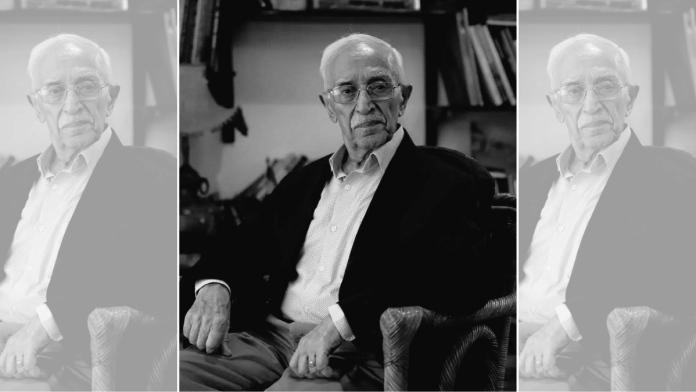


New Delhi: General Vishwa Nath Sharma, the army chief who led the Indian Army through a period of turbulence marked by the insurgency in Punjab and the deployment of the Indian Peace Keeping Force (IPKF) in Sri Lanka, died Friday in New Delhi at the age of 97.
Better known as General V. N. Sharma, he was the first President’s commissioned officer to become the Army chief. Commissioned into the Armoured Corps’ 16th Light Cavalry, he served as the 14th Chief of Army Staff (COAS) from 1 May 1988 to 30 June 1990.
Hailing from an illustrious military family, he was the son of late Major General Amar Nath Sharma. His eldest brother, late Major Som Nath Sharma, is the first recipient of the posthumous Param Vir Chakra. His other brother, Lt Gen Surinder Nath Sharma, retired as the Engineer-in-Chief of the Army.
His sister was Major Dr Kamla Tewari, who served in the Army Medical Corps.
Apart from the challenges in Punjab and Sri Lanka, he also inherited an active internal security scenario amid heightened tensions with Pakistan and the growing unrest in Jammu and Kashmir.
GeneralDhirajSeth, #COAS, and All Ranks of the #IndianArmy express profound grief on the passing of General Vishwa Nath Sharma, PVSM, AVSM, ADC, former Chief of the Army Staff. The Indian Army extends its heartfelt condolences to his bereaved family and loved ones.
— ADG PI – INDIAN ARMY (@adgpi) July 31, 2026
He took over as Army Chief from General K Sundarji, the architect of Operation Brasstacks and one of the Indian Army’s foremost military reformers.
While Gen Sundarji’s tenure saw a push for mechanisation and technological modernisation of the force, Sharma’s tenure was more measured, with a strong operational focus on both internal security and conventional warfare.
Managing IPKF in Sri Lanka
The biggest operational challenge Gen Sharma faced during his tenure was the IPKF operation in Sri Lanka. By the time he assumed office, the IPKF had already been deployed to fight the Liberation Tigers of Tamil Eelam (LTTE) and the Army was embroiled in an intense fight with the guerrilla group.
From what was meant to be a peacekeeping operation, it had turned into a full-fledged counter-insurgency campaign against a deadly guerrilla force. Under him, the Army had to adapt from conventional warfare tactics to jungle warfare, urban operations and intelligence-driven counter-insurgency.
The withdrawal of the IPKF began towards the end of his tenure and was completed in March 1990.
Punjab insurgency
Even as the IPKF operation was on, the Army was also pushed in to support civil authorities in combating militancy in Punjab. Although the Punjab Police took the lead role initially, the Army remained an important stabilising force, particularly in maintaining pressure on militants and ensuring that the insurgency did not spiral further.
This was the time when the Army learned and operated on an internal security doctrine that emphasised close coordination with state police rather than just a pure tactical military operation.
Kashmir on the brink
Another key development during Gen Sharma’s tenure was the rapid deterioration of the security situation in Jammu and Kashmir. The insurgency began gathering momentum in 1989, fuelled by Pakistan-backed funding to create local militants, infiltration and political instability.
Although the Army was initially not the primary force deployed in the Valley to counter militancy, Gen Sharma’s tenure saw the gradual expansion of the Army’s role.
Military career
During his 38 years of distinguished service, Gen Sharma held important commands, staff and instructional appointments.
As a Major, he saw action during the 1965 India-Pakistan War in the Lahore sector. As a Lieutenant Colonel, he commanded the 66 Armoured Regiment and was later appointed an instructor at the Defence Services Staff College, Wellington.
He was Col. General Staff Operations of an Armoured Division on the Western Front during the 1971 India-Pakistan War.
On promotion to the rank of Brigadier, he commanded a mountain brigade and an armoured brigade in the Rajasthan desert. He was appointed Brigadier General Staff of a Strike Corps in the Western Sector.
In 1980, he was promoted to Major General and commanded a mountain division in the Eastern Sector. He then served as Deputy Director, General Military Operations at the Army Headquarters.
He was then promoted to Lieutenant General and took over command of a reserve Corps in the Western Sector. Following this, he was appointed the Commandant of the prestigious College of Combat, now called the Army War College, at Mhow.
Gen Sharma took over as General Officer Commanding-in-Chief, Eastern Command in June 1987. As the Eastern Army Commander, his tenure witnessed a standoff with China at Sumdorong Chu along the Line of Actual (LAC) in Arunachal Pradesh.
The incident took place in June 1986 when a Chinese attempt to alter the un-demarcated LAC near village Sumdorong Chu in Tawang district of Arunachal Pradesh was discovered.
Under Gen Sundarji, who was the then Army chief, Indian troops had occupied Yangtse in 1987 in response to the Chinese intrusion in Sumdorong Chu.
Yangtse fell within India’s claim lines but was never occupied until 1987. It is only when the Chinese invaded Sumdorong Chu that the Indian Army decided to occupy Yangtse, much to the discomfort of the PLA.
The Sumdorong Chu intrusion led to a protracted military confrontation, which was only resolved after diplomatic negotiations in the mid-1990s.
This is an updated version of the report.
(Edited by Sugita Katyal)