



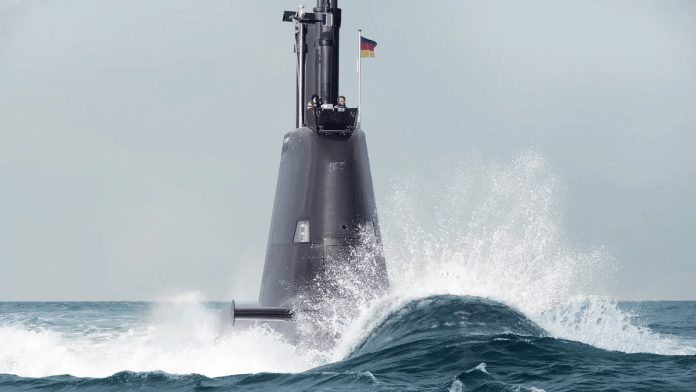
New Delhi: In one of the quickest global defence procurement processes for any big ticket item, Canada has selected German firm Thyssenkrupp Marine Systems (TKMS) to supply 12 state-of-the-art conventional submarines in less than four years of envisaging the programme.
The Canadian Patrol Submarine Project (CPSP) was launched in 2021 to replace the ageing Victoria-class submarines delivered by the British government to Ottawa. Under the project, a total of 12 conventional submarines were to be procured to enable simultaneous patrols in the Atlantic, Pacific and Arctic oceans.
In July 2024, the Canadian government formally announced its plans to procure 12 submarines. A Request for Information (RFI) was sent out 17 September that year. Two bidders, TKMS and South Korea’s Hanwha Ocean, were shortlisted in August 2025.
Three months later, formal proposal requirements were issued to the two companies and bids were submitted in March this year.
Throughout the process, both companies and their respective governments remained actively engaged with Ottawa, sweetening bids with competing economic and industrial incentives to strengthen their case.
Prime Minister Carney announces the preferred supplier for the Canadian Patrol Submarine Project – the largest defence procurement in Canadian history.
Learn more: https://t.co/upKkUiQtad pic.twitter.com/MVrueRDgnE
— Prime Minister of Canada (@CanadianPM) July 6, 2026
On 6 July, Canadian Prime Minister Mark Carney announced that TKMS was selected as the preferred supplier to begin negotiations for delivering the next fleet of submarines to the Royal Canadian Navy (RCN).
“Government of Canada and TKMS will now enter into negotiations to finalise the contracts and all arrangements required to deliver the requirements of the CPSP. Canada will conclude contracting no later than the end of 2027, with the first four submarines to be delivered ahead of schedule, in 2034,” reads an official statement issued by Ottawa.
It also added that in the event that negotiations with the preferred supplier are unsuccessful, Canada may designate Hanwha Ocean as the preferred supplier and enter into negotiations.
Stark contrast to India
The whole process stands in stark contrast to India’s own submarine production plan that was initiated in 1999 and only six have been built so far.
The Project 75 India, under which six new conventional submarines are to be built with Air Independent Propulsion System (AIP), has been pending for years. It was in 2008 that the Navy issued the RFI for the project. Eighteen years on, while TKMS has been selected, a formal contract is yet to be signed.
The proposal is still at the Contract Negotiating Committee (CNC) level with indications that the TKMS has been playing a hard ball on certain aspects.
Some in the defence establishment feel that the TKMS will harden its stand post the big Canada win because the Indian project will become less of a priority. Indian defence officials were amazed at the speed at which the Canadians have worked on the project.
As compared to the six Indian submarines which are to be built indigenously under a Transfer of Technology (ToT) with state-run Mazagon Dock Shipbuilders, all 12 Canadian ships will be built in Germany.
The Canadian way
From an Indian perspective, the timing is notable. Canada went from publicly launching the procurement in July 2024 to selecting a preferred supplier in July 2026—roughly two years.
However, the reason why this programme progressed so quickly is because the Canadian government had introduced one key change in its procurement process—creation of Defence Investment Agency (DIA).
The DIA is a new Canadian government agency established to accelerate defence procurement and oversee the delivery of major military capability projects. It is intended to address longstanding criticism that Canada’s defence acquisition system is slow, fragmented and bureaucratic.
The agency was formally announced in Canada’s 2024 defence policy, ‘Our North, Strong and Free,’ and became operational in 2025.
Functioning as a Special Operating Agency (SOA) within Canada’s Public Services and Procurement Canada (PSPC, the DIA has significantly greater autonomy and contracting authority than a normal government department. Its purpose is to function like a dedicated programme delivery organisation for defence acquisitions.
The DIA is led by Secretary of State (Defence Procurement) Stephen Fuhr, while day-to-day operations are overseen by CEO Doug Guzman. Incidentally, Guzman is a Canadian business leader with three decades of experience in global banking, wealth management, and financial services.
The focus, the DIA says, is reducing red tape and administrative delays, streamlining contract approvals while ensuring value for money, delivering timely capabilities to the Canadian Armed Forces and the Canadian Coast Guard driving Canadian innovation and industrial growth and strengthening strategic partnerships with Canadian industry and international allies.
The agency is responsible for managing major capital acquisition projects, coordinating procurement across government, working with Canadian and international defence companies and monitoring project schedules and costs.
It is also mandated to support industrial participation and economic benefits and implement Canada’s defence industrial strategy.
Currently, the DIA is overseeing several high-value programmes, including Arctic surveillance capabilities, new air and missile defence initiatives, naval recapitalisation and other major procurements under the ‘Our North, Strong and Free’ defence policy besides the submarines.
It should be noted that the DIA does not decide what equipment the Canadian Armed Forces need. Instead, it takes approved military requirements and manages their execution.
Just like in India, the Canadian Armed Forces identifies an operational capability gap while the Department of National Defence validates the requirement.
High-priority projects are assigned to the DIA, which has integrated procurement teams comprising personnel drawn from the procurement agency, department of national defence, Canadian Armed Forces, Coast Guard besides other relevant ministries. These teams manage the programme from market engagement to contract award and delivery.
The agency combines technical, financial, legal, contracting and industrial expertise into a single project team accountable for delivery.
(Edited by Tony Rai)
Can’t believe Adani cannot build a submarine quickly in his backyard??
There’s a lot India can learn from this, and we still have a long way to go in several areas. Accountability should remain at the heart of our institutions, and national security must always be a top priority. The Air Force Chief’s emphasis on operating in mission mode is a mindset worth embracing across the board. At times, however, it feels like we struggle more with execution and meeting timelines than we should.
India has made significant progress, but there’s still room to build a stronger culture of responsibility, efficiency, and timely execution.At the same time, ensuring that every citizen has access to roti, kapda, and makan must remain a fundamental national commitment. But these priorities need not come at the expense of other critical areas. A nation can—and should—strengthen its social foundations while simultaneously investing in national security, innovation, governance, and long-term strategic capabilities. Progress on one front should reinforce, not delay, progress on the others.