


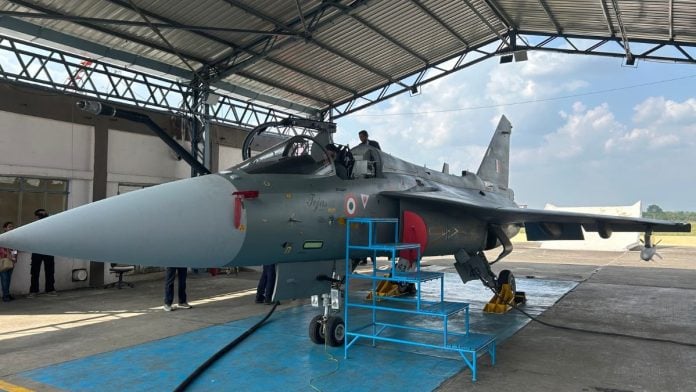
New Delhi: The first Tejas Light Combat Aircraft (LCA) Mark-1A (Mk1A) is likely to be handed over to the Indian Air Force (IAF) early in 2027, possibly as soon as January, a source in the know told ThePrint Thursday, on condition of anonymity.
State-run aerospace and defence company Hindustan Aeronautics Limited (HAL) missed the original February 2024 deadline to begin deliveries of the first tranche of 83 Mk1A jets, contracted for Rs 36,400 crore in February 2021. The slippage was attributed primarily to delays in the arrival of the F404-IN20 engines from American manufacturer GE Aerospace. The complex process of integrating weapons and systems has also affected the project. Deliveries of the first tranche were originally scheduled to be completed by February 2028.
In September 2025, HAL received a follow-on order for a second tranche of 97 Mk1A aircraft, worth over Rs 62,370 crore. Deliveries under this contract are expected to begin in financial year 2027-28 and conclude over six years.
By September this year, American engine maker GE Aerospace, headquartered in Evendale, Ohio, United States, had shipped a total of 14 F404-IN20 engines to HAL for the Tejas Mk1A fleet. They were supplied under a 2021 deal for 99 engines. The first engine arrived only in March 2025, although deliveries were originally slated to begin in 2023.
“Two requirements related to the Tejas Mk1A had been pending, including one or two functions or capabilities linked to the Israeli-origin radar. The software and integration issues are being fixed. Some concessions from the IAF may be involved. These will be addressed after the first one or two jets are handed over, informed by the IAF’s use of the jet,” said the source.
“The programme appears to be on the cusp of meeting certain major requirements,” the source said. “If everything goes to plan, the first one or two jets could be handed over in January itself, ahead of the Aero India 2027 aerospace and defence exhibition.”
Aero India, the country’s flagship biennial aerospace exhibition, is organised by the Ministry of Defence’s Department of Defence Production, and held at Air Force Station Yelahanka in Bengaluru. Its 16th edition will run from 8 to 12 February 2027.
The IAF has previously indicated that it is willing to relax some requirements temporarily to ease the Tejas Mk1A’s induction, provided they are met within a set time-frame. The remaining requirements are now close to being met, and their certification is not far off.
A company source declined to say when the first jets would be handed over to the IAF. The source did indicate, however, that the service and the defence public sector undertaking were working towards induction with strengthened coordination. “The IAF project management team, HAL and the certification agency are all involved in the process,” the company source added.
The development follows remarks by Air Chief Marshal Ashutosh Dixit, who took charge as the 29th Chief of the Air Staff at the end of October. The day after assuming office, he named the homegrown Tejas Mk1A and Mk2 fighters and the Advanced Medium Combat Aircraft (AMCA), together with Indian-made sensors and weapons, as the IAF’s “highest priority”. “We will fight with Indian solutions,” Dixit said, adding that the force would field these systems in large enough numbers to sustain prolonged operations. Bringing the IAF’s combat strength back up towards its sanctioned level, he said, would be his “foremost task”.
HAL has to meet the Air Staff Qualitative Requirements (ASQRs) agreed for the Mk1A jets. ASQRs are specific, documented standards, qualifications and performance metrics that equipment must meet to fulfil operational requirements.
The Israeli ELTA EL/M-2052 active electronically scanned array (AESA) radar was originally meant to equip only a part of the 83 jets ordered in the first tranche, with the remainder to be fitted with the Defence Research and Development Organisation’s (DRDO) Uttam AESA radar. In 2025, however, HAL decided to fit all 83 jets in the first tranche with the EL/M-2052, owing to the time being taken to certify the Uttam.
The Mk1A is an improved variant of the indigenous Tejas Mk1, which is already operational with the IAF. A 4.5-generation fighter, it comes equipped with an AESA radar, the standard for modern fighter radars. Instead of a single antenna that has to be physically moved, an AESA radar uses hundreds of small transmitter-receiver modules whose beams are steered electronically. This lets it scan faster, track several targets at once, detect adversaries at longer ranges and resist jamming better.
The Mk1A also carries beyond-visual-range (BVR) missiles, which can strike enemy aircraft too far away for the pilot to see, so adversaries can be engaged from greater distances. Its electronic warfare suite protects it against adversary sensors and weapons. And because it can be refuelled in mid-air, the jet can reach more distant targets and patrol an area for longer before it has to return to base.
The Tejas Mk2, envisaged as an even more advanced variant that will be heavier and run on more powerful GE engines, is yet to fly in prototype form.
The AMCA, for its part, is India’s stealth combat aircraft in development. It is being pursued through an industry partnership model, and the process of picking the company or consortium that will help develop and build its prototypes is under way.
There are three contenders: the Tata Group, and two consortia, led by the Kalyani Group and Larsen & Toubro (L&T) respectively. Whichever of them wins, HAL’s monopoly on making combat aircraft will come to an end. Viewed this way, the AMCA programme is an effort to create a second combat aircraft production line in India, alongside HAL’s capacity.
The start of inductions of the Tejas Mk1A matters all the more because the IAF is at its lowest strength in 60 years, with 29 active fighter squadrons against the sanctioned 42.
(Edited by Nardeep Singh Dahiya)
Also Read: HAL hands over final two Tejas Mk1 trainers 16 years after IAF order, all eyes on Mk1A now