


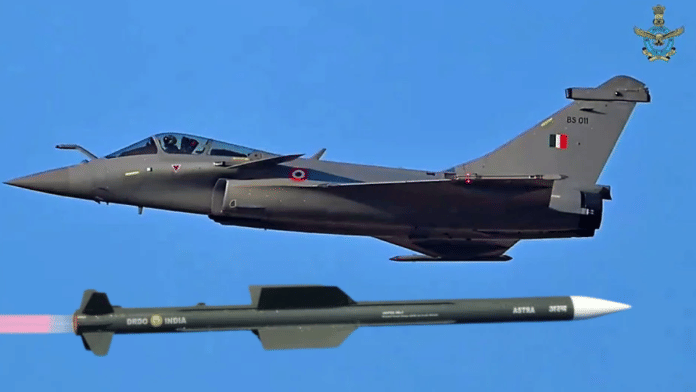
New Delhi: The Indian Air Force (IAF) will integrate the homegrown beyond-visual-range air-to-air Astra missile on its French-origin Rafale fighter jets, as the freedom to fit and use weapons of its choice without needing any foreign approval is one of its two non-negotiables for the 114 additional jets being acquired, a source in the know told ThePrint Wednesday.
The other non-negotiable is the ability to communicate freely and securely with the IAF’s networks as well as its other aircraft and assets. “Both these capabilities will feature in the contract when it is signed,” the source said.
The weapons integration capability is expected to pay off, the source underscored, as the Indian defence industry has already shown it can develop and manufacture a range of air-to-air and air-to-ground weapons.
“The IAF will be able to integrate weapons of its choice, indigenous munitions included, on the 114 additional jets without depending on anyone else, and can do the same on the original tranche if required. This has been part of the negotiations,” the source said. “This will allow indigenous weapons such as the Astra to be integrated on the Rafale.”
A second source within the defence establishment confirmed this, saying: “Weapons integration capability will come with the current procurement proposal. The Astra missile will be integrated on the Rafale, and this can be done across the fleet, both the original tranche and the additional jets.”
Access to specialised ground support equipment, such as the weapons test bench, will allow the IAF to test, calibrate and configure the aircraft’s weapon systems, the second source added.
“Weapons integration will be a unilateral capability, giving the IAF a free hand in the matter,” the first source said.
Since a weapons package makes up a sizeable share of a fighter jet’s overall price, arming the Rafale with homegrown weapons could, in time, also cut the bill for the IAF. It would also give the force the flexibility to shape the jet’s offensive capabilities around its changing requirements.
“The second non-negotiable is that the software-defined radio (SDR) aboard the 114 jets must be able to exchange information faster with every IAF platform, both in service and yet to come, no matter where it was built. This has also been ensured under the acquisition underway,” said the first source. Such rapid communication makes possible what the military refers to as net-centric operations. The IAF’s current fleet, a mix of mostly Russian- and Western-origin jets and limited indigenous platforms, is already largely capable of such operations, and the additional Rafales will blend seamlessly into that mix.
An SDR is a flexible, programmable communication system through which aircraft can exchange data securely over networks. It is the basis of net-centric air warfare, in which the systems that spot targets, the aircraft that fire on them and the commanders directing them are all connected at every moment. As a result, several aircraft can share what they see and work as a team to locate, track and strike targets, an approach known as collaborative engagement. This capability is key to realising what the IAF leadership describes as “any sensor, best shooter”.
“Every pilot, radar, remotely piloted aircraft and commander must be able to see what everyone else sees, in real time, as if they were all in the same cockpit. This is also crucial given the arrival of stealth combat aircraft in our neighbourhood,” the first source explained.
This source however, made clear that the aircraft’s complete “source code”, the software backbone controlling its sensors, weapons and mission systems, had not been part of the ask. “Even where an aircraft is manufactured locally, access to its so-called ‘source code’ is not the norm,” they added. Such access, the source said, would not be needed to integrate weapons unilaterally or to run net-centric operations through the SDR.
An estimated Rs 3.6 lakh crore worth of proposals from the three services, the purchase of more Rafale jets among them, cleared the first stage of government defence buying in February this year, when the Defence Acquisition Council granted them “acceptance of necessity”. The council is the Ministry of Defence’s highest decision-making forum.
For the 114 Rafale aircraft alone, the cost has been estimated at around Rs 2.7 lakh crore, and the acquisition is yet to receive final approval from the Prime Minister-led Cabinet Committee on Security. Production in India is being built into the agreement, with locally manufactured content in the aircraft eventually rising to between 55 and 60 percent.
France will supply only the first lot, in fly-away condition, while the bulk will roll out of Indian facilities. Assuming the agreement is signed by early 2027, deliveries of the first fly-away jets are expected to start from 2030 onwards.
The IAF got its first 36 Rafale jets under a deal signed in 2016, while the Indian Navy placed an order for 26 of the aircraft’s marine version in 2025. The Rafale is a twin-engine, multirole, 4.5-generation fighter designed and built by France’s Dassault Aviation.
(Edited by Gitanjali Das)
Also Read: Modi govt opens up conventional missile production to private players. Astra & Pralay up for grabs