



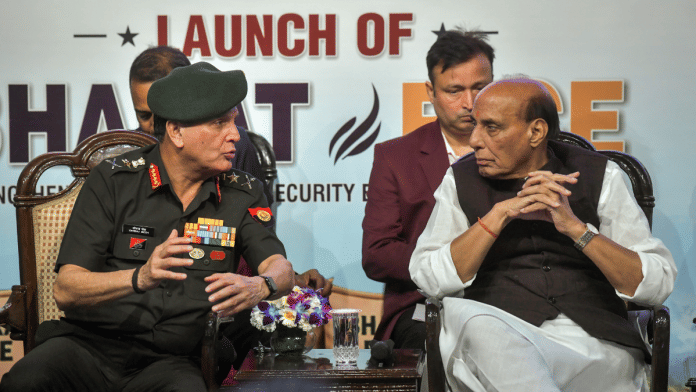
New Delhi: Defence Minister Rajnath Singh has launched the Bharat Rice initiative for the Indian Army at an event, where the Army also signed a five-year memorandum of understanding (MoU) with the Food Corporation of India (FCI) to strengthen military logistics during operational contingencies.
The Bharat Rice initiative is intended to streamline the supply of rice to troops, particularly those stationed in remote areas of Ladakh and the North East.
Bharat Rice was originally introduced by the government in February 2024 as part of its broader Bharat Brand range of essential commodities to provide consumers with rice at subsidised prices.
The event was attended by Army chief Staff General Dhiraj Seth, Minister of Consumer Affairs, Food and Public Distribution Pralhad Joshi, and representatives of FCI and the National Agricultural Cooperative Marketing Federation of India Limited (NAFED).
Under the new arrangement, rice will be delivered directly to Army supply depots instead of requiring individual depots to collect their allocations from local FCI facilities. The initiative is intended to streamline distribution, particularly to troops deployed in remote and forward areas.
The rice will be supplied in 10-kg and 30-kg bags. The smaller packaging formats are intended to make handling and transportation easier in difficult terrain.
The Department of Food and Public Distribution has allocated 1.25 lakh metric tonnes of rice for the Army, according to the details provided for the initiative. The allocation and delivery schedule will determine how the arrangement is implemented across the Army’s supply network.
The rice will be supplied through an institutional arrangement involving NAFED and will be custom-milled according to prescribed defence specifications. Quality checks are intended to ensure that the rice is free from foreign matter and admixtures, with limits on broken, damaged and discoloured grains.
The supply arrangement is scheduled for the financial year 2026–27. Its implementation follows 18 months of coordination among the Army, FCI, NAFED and the Department of Food and Public Distribution.
Five-year logistics agreement
Separately, the five-year MoU between the Army and FCI establishes a framework for the military to use identified FCI warehousing infrastructure, manpower and material-handling equipment during operational contingencies. The agreement can be extended by mutual consent.
The arrangement will allow the Army to incorporate civilian logistics infrastructure into its operational plans, including for additional storage, rapid mobilisation and the forward positioning of supplies closer to operational areas.
The agreement draws on lessons from Operation Sindoor, highlighting the need for resilient supply chains that can respond to contingencies arising at short notice and continuing over extended periods. It also reflects a broader government approach to coordinating civilian infrastructure and military requirements, in line with the objectives of the PM Gati Shakti National Master Plan.
The defence ministry has also highlighted other Army welfare and modernisation measures, including specialised nutritional rations for newly inducted Agniveer recruits, greater standardisation of ration scales across the three armed forces, and proposals to introduce organic rations at forward locations.
Ashwin Shekhar is an alum of ThePrint School of Journalism, currently interning with ThePrint.
(Edited by Tony Rai)