



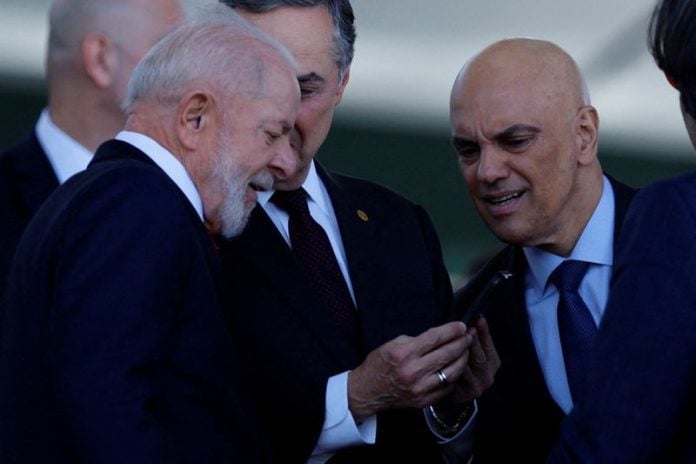
SAO PAULO/BRASILIA, Oct 24 (Reuters) – Just days before his 81st birthday, Brazilian President Luiz Inacio Lula da Silva this week took ownership of a brand new smartphone, one that former aides said was his first ever.
Lula’s choice to finally adopt a foundational artefact of modern life may be a tacit acknowledgment that he has failed to keep pace with a Brazilian electorate that now spends much of its life online. That may count against him in Sunday’s presidential runoff.
“I’m becoming the king of selfies, a real internet user,” Lula told supporters at a recent rally in Brasilia, hinting at his renewed efforts to better navigate social media campaigning.
Lula’s new technological adventure illustrates a generational shift in Brazilian politics, where a candidate’s ability to convert millions of followers across platforms like TikTok, Instagram and WhatsApp into votes can now catapult them to the upper echelons of Brazilian power.
During congressional elections that took place alongside the first round of this month’s presidential vote, a number of younger, social media-savvy candidates dominated their races.
Running for the right-wing Liberal Party, Nikolas Ferreira, 30, and Lucas Pavanato, 28, both took more than 3 million votes in their respective races, while leftist candidates who were elected with over half a million votes each included Erika Hilton, 33, and Ana Elisa Silva, who is just 21.
LULA LEARNS THE ROPES
Lula, a former shoeshine boy turned metal worker, trade union leader and global leftist icon, first ran for president in 1989, and is seeking an unprecedented fourth term in office. Standing in his way is right-wing Senator Flavio Bolsonaro, who is the son of ex-President Jair Bolsonaro and surprised pollsters by topping the first-round vote. The 45-year-old senator has been engaging voters directly with his own YouTube channel.
Ana Elisa Silva, a law student from Minas Gerais, joined Lula’s inner circle to help him better navigate the unfamiliar social media landscape after his disappointing first-round performance.
“In my view, digital communication is not a generational privilege,” Silva told Reuters. “Age may influence familiarity with certain platforms and formats, but it does not determine the ability to communicate, mobilize, or build a community.”
For a politician like Lula — who freely admits his distaste for cellphones — the change required some adjustments, Silva said.
“His political communication trajectory predates the internet. (It was) forged through his relationships with workers, trade unions, grassroots movements, and massive rallies,” she said. “This experience remains important, but it needs to align with changes in how people consume information, especially young people.”
THE EVOLUTION OF POLITICS
The emerging power of so-called “influencer politicians” represents the natural evolution of a phenomenon that started with politicians reaching out to social media figures for campaign support, said Maximo Zaldivar, regional director for Latin America and the Caribbean at the International Foundation for Electoral Systems.
“The influencer has their own political capital,” Zaldivar said, referring to their amassed followings across social media platforms. “That’s what they bring to the table and no politician can compete with that.”
Among “influencer politicians,” Ferreira sits in a league of his own. A staunch Bolsonaro supporter and the son of an evangelical pastor, he boasts nearly 25 million followers on Instagram, equivalent to more than 10% of Brazil’s population.
Though anyone can jump on social media, success demands commitment and consistent messaging, said Julia Zanatta, 41, an influential conservative lawmaker from southern Brazil with over 1 million followers on Instagram. She secured more than half a million votes in this month’s election.
“I never thought about whether I’d reach more people or if I’d displease anyone,” she said.
(Reporting by Luciana Magalhaes and Oliver Griffin in Sao Paulo and Lisandra Praguassu in Brasilia, Editing by Rosalba O’Brien)
Disclaimer: This report is auto generated from the Reuters news service. ThePrint holds no responsibility for its content.