



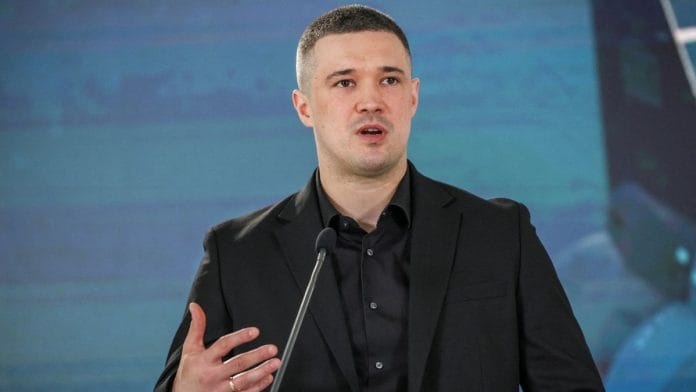
New Delhi: More than a thousand Ukrainians gathered outside President Volodymyr Zelenskyy’s office in Kyiv Thursday, chanting “shame” and demanding the reinstatement of Mykhailo Fedorov, the country’s popular and reform-minded defence minister, who was removed from office after serving for six months.
Protesters carried placards asking “For what?”, and warning that “the Russians are celebrating”. Some demanded the removal of Ukraine’s commander-in-chief, General Oleksandr Syrskyi, instead. Fedorov’s ousting followed a prolonged disagreement with Syrskyi over the direction of Ukraine’s military reforms.
His dismissal was announced Wednesday as part of Zelenskyy’s second major government reshuffle in a year. The changes also saw Prime Minister Yulia Svyrydenko leave office, with Zelenskyy endorsing Naftogaz chief Sergii Koretskyi as her successor.
Speaking at a joint press conference during British Prime Minister Keir Starmer’s visit to Kyiv Thursday, Zelenskyy said: “If the sides can’t resolve an issue, I will have to resolve it. Together we win, and together we’re responsible for the things that cause confusion and public reaction.”
Starmer’s trip to Kyiv, his final overseas visit as prime minister, coincided with renewed Russian attacks on Ukraine. An overnight missile strike on Kyiv killed two people and wounded five, while separate attacks Wednesday killed at least six people elsewhere in the country, including three in the southern port city of Odesa.
Also Read: Trump opens door for Ukraine to build Patriot missiles as Kyiv pushes to expand its own arsenal
Six months as defence minister
Fedorov, 35, was appointed defence minister on 14 January 2026, making him the youngest person to hold the post in Ukraine’s history. His dismissal on 15 July brought his tenure to an end after six months.
Yet, his influence on Ukraine’s war effort began long before he formally took charge of the defence ministry.
At the age of 28, Fedorov entered Zelenskyy’s first cabinet in 2019 as Ukraine’s inaugural minister for digital transformation. He became closely associated with the Diia digital-governance platform, which allowed Ukrainians to access government documents and services through their mobile phones.
Russia invaded Ukraine on 24 February, 2022, beginning a conflict in which both sides have suffered significant losses. Russia has continued to bombard Ukrainian cities, while Ukraine has employed missile and drone strikes against vital Russian oil and military infrastructure.
Following the outbreak of the war, Fedorov applied his technology-driven approach to military communications, fundraising, equipment procurement, and drone warfare.
Drone warfare & military procurement
Fedorov helped establish the “Army of Drones”, which began in 2022 as a crowdfunding and procurement initiative to supply Ukrainian units with unmanned aerial vehicles.
As Ukraine expanded its drone programme, it established the Unmanned Systems Forces in June 2024—the world’s first dedicated military branch focused on drone warfare.
As defence minister, Fedorov pushed a data-driven strategy intended to counter Russia’s larger army through speed, automation, robotics, and domestically produced weapons.
His ministry increased production of reconnaissance and long-range strike drones used to target Russian logistics, ammunition depots, radar systems, air defences, and oil infrastructure.
Fedorov also promoted Brave1 Market, described as an “Amazon for weapons”, through which military units could directly purchase approved drones, electronic-warfare equipment, and other battlefield technology.
The system was intended to shorten procurement times and allow frontline units to select equipment according to their operational requirements.
Starlink’s battlefield utility
One of Fedorov’s most consequential early interventions came during the opening days of Russia’s invasion, when he publicly appealed to Elon Musk to activate SpaceX’s Starlink satellite internet service over Ukraine.
Tens of thousands of Starlink terminals were subsequently deployed across the country, providing communications for military units even when cellular towers, fibre-optic cables, and electricity infrastructure were damaged.
Fedorov was also credited with working with SpaceX to restrict Russian forces’ unauthorised use of Starlink terminals.
In a statement Wednesday outlining his ministry’s record before his departure, Fedorov said his team had worked with SpaceX to identify and block terminals being used by Russian forces.
Conflict with Ukraine’s military command
Fedorov’s rapid reforms brought him into conflict with Oleksandr Syrskyi, who has served as Ukraine’s commander-in-chief since February 2024.
The dispute centred on the implementation of technological and organisational reforms within the Ukrainian armed forces.
Fedorov advocated for technological asymmetry, rapid innovation, and greater autonomy for frontline units.
Syrskyi and the General Staff—the military body responsible for operational planning and command—were associated with a more traditional, centralised approach to warfare and retained control over the introduction of new systems across the armed forces.
Fedorov told a press conference Thursday that he had proposed to Zelenskyy that both Syrskyi and Chief of the General Staff Andrii Hnatov be replaced. Zelenskyy rejected the proposal and told him that he did not plan to remove Syrskyi.
“When the president said he did not plan to replace Syrskyi, I… said I would learn to work with him,” Fedorov said.
However, he claimed that “all the initiatives we proposed were blocked” and that he did not know how Ukraine could win the war under the existing arrangement.
“Instead of finding a way of defeating Russia asymmetrically—which is the commander-in-chief’s job—he’s found a way of splitting our country,” Fedorov said of Syrskyi.
Zelenskyy, standing alongside Starmer, confirmed that the disagreement had not been confined to the two men personally.
He described the conflict between the General Staff and the defence ministry as “systemic”, occurring “at various levels”, and said that cooperation between Fedorov and Syrskyi had repeatedly required his intervention.
Syrskyi responded in a brief Telegram statement, saying he was “proud” of the operation mounted to defend Kyiv in 2022 as Russian troops approached the capital.
He said he would continue to “focus on the war and on an effective strategy”, before wishing Fedorov “continued success”.
Why the ousting triggered protests
Fedorov’s popularity rested partly on his image as a modern, accessible official who appeared more closely connected to entrepreneurs, engineers, and younger Ukrainians than to the country’s traditional political and military establishment.
He was seen as an official capable of cutting through military bureaucracy and accelerating innovation at a critical time when Ukraine is seeking technological advantages over Russia.
The reaction to his removal extended beyond street demonstrations: Pavlo Yelizarov, a deputy commander of Ukraine’s air force and an important figure in its drone operations, resigned in protest, describing Fedorov’s dismissal as a “great evil” for the country’s defence.
Fedorov said he had rejected Zelenskyy’s offer to remain in government as a presidential adviser.
His removal leaves the continuation of his procurement and technological reforms in the hands of Ukraine’s next defence minister, who has yet to be officially appointed, as the country continues to confront Russian bombardment, personnel shortages, and mounting pressure on its air-defence systems.
Kyra Menon is an intern with ThePrint.
(Edited by Sugita Katyal)
Also Read: How Russia kept Ukraine war machine running despite sanctions—NYT probe finds Japan link