





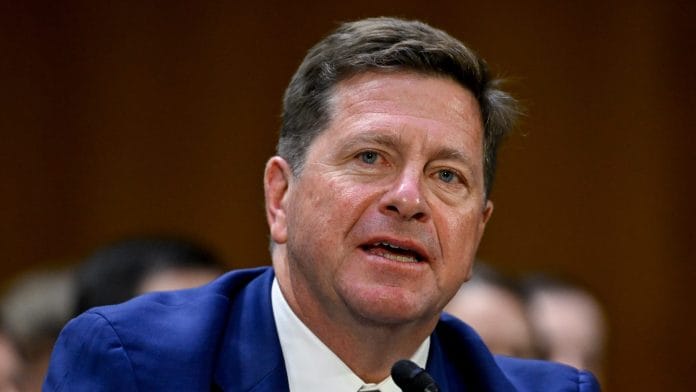



New Delhi: The US Senate Tuesday confirmed Jay Clayton as Director of National Intelligence (DNI), placing a corporate lawyer and financial regulator with limited conventional intelligence experience at the helm of America’s sprawling network of spy agencies.
Clayton was confirmed in a largely party-line vote of 51-47, with Republicans backing US President Donald Trump’s nominee and Democrats voting against him. His appointment ends the brief and turbulent tenure of acting intelligence director Bill Pulte, who oversaw sweeping dismissals at the Office of the Director of National Intelligence (ODNI).
Clayton’s ascent is unusual. Unlike several previous intelligence directors, he has not served in the military, the Central Intelligence Agency (CIA), the National Security Agency (NSA), or on congressional intelligence committees. Instead, his career has spanned an elite Wall Street law firm, the country’s principal securities regulator and one of America’s most powerful federal prosecutors’ offices.
While Republicans have highlighted his record of managing major institutions and handling financial and national security cases, Democrats have pointed to lack of conventional intelligence experience and asked whether he can deliver assessments that challenge the White House, if necessary.
Also Read: Suspected of leaking travel info, Secret Service agent on US V-P Vance’s detail under review
From Wall Street to Washington
Born at Fort Eustis in Virginia and raised primarily in Pennsylvania, Walter “Jay” Clayton III trained himself as a lawyer and spent much of his career at Sullivan & Cromwell, one of Wall Street’s most prominent law firms. He became a partner and served on its management committee, where he co-headed the firm’s corporate practice and advised major companies on mergers, capital markets transactions and regulatory matters.
Trump, during his first term, nominated him to lead the Securities and Exchange Commission (SEC) shortly after taking office in 2017. Clayton was sworn in as SEC chairman in May that year and remained in that role until December 2020.
During his tenure, the regulator said it prioritised protecting individual investors, expanding access to investment opportunities and strengthening oversight of financial markets.
He returned to government in April 2025 as the US Attorney for the Southern District of New York. The Manhattan-based office handles some of America’s most consequential cases involving terrorism, sanctions violations, public corruption, organised crime and financial fraud.
Clayton led the office until he was nominated as the intelligence director and stepped back from the routine operations during the confirmation process. His tenure included cases with international and national security dimensions, though he has never worked directly within the US intelligence apparatus.
A heated confirmation hearing
Clayton had previously attracted bipartisan support, particularly during his nomination to the SEC. But Democratic opposition sharpened during his 15 July confirmation hearing before the Senate Select Committee on Intelligence.
In a tense exchange, Georgia Democratic Senator Jon Ossoff, the youngest sitting US senator, repeatedly pressed Clayton on whether former president Joe Biden had won the 2020 presidential election.
Clayton declined to answer in those terms, saying only that Biden had been “certified” as president. His response alarmed Democrats, who fear he could tailor intelligence assessments to accommodate Trump’s political claims instead of defending the community’s analytical independence.
During the hearing, Clayton also faced questions about his lack of traditional intelligence experience and subpoenas issued to journalists while leading the Manhattan prosecutor’s office.
His confirmation nevertheless proceeded with unanimous Republican support and no Democratic votes.
Clayton succeeds Bill Pulte, a businessman and Trump ally whose background was in housing finance, with no prior experience in intelligence or national security. Pulte, who was confirmed in March 2025 as director of the Federal Housing Finance Agency, was appointed acting DNI on 19 June after Tulsi Gabbard’s departure while Clayton’s nomination awaited Senate consideration.
His brief tenure at the Office of the Director of National Intelligence (ODNI) was marked by rapid staff reductions. CNN reported that Pulte announced a fifth and “near-final” round of dismissals on Tuesday, claiming on X that the successive cuts had eliminated approximately 30 per cent of the agency’s workforce, though that figure has not been independently verified. Pulte’s announcement came just hours before the Senate confirmed Clayton.
Gabbard’s departure
Tulsi Gabbard, a military veteran and former Hawaii congresswoman, served four terms in the House of Representatives as a Democrat before joining the Republican Party in October 2024.
She made history as the first Hindu elected to the US Congress and the first American lawmaker to take the oath of office on the Bhagavad Gita before Trump appointed her as DNI on 12 February 2025. She resigned from the role on 22 May 2026, citing her husband’s bone cancer diagnosis.
During her tenure, Gabbard pushed for a broad overhaul of the intelligence establishment, arguing that it had become excessively bureaucratic and vulnerable to political influence. Her planned workforce reduction formed part of a wider Trump administration effort to shrink and reorganise national security institutions.
The decision on whether to continue that approach or moderate the restructuring now lies with Clayton as he seeks to stabilise the agency.
What does the ODNI do?
The Office of the Director of National Intelligence (ODNI) was created after the intelligence failures preceding the 9/11 attacks in 2001 to improve coordination across US spy agencies. The Director of National Intelligence heads the 18-agency US intelligence community, oversees the National Intelligence Program and serves as the president’s principal intelligence adviser.
The office brings together assessments from agencies including the CIA, NSA, FBI, Defense Intelligence Agency, and the intelligence arms of the State, Treasury, Homeland Security and Defense departments. Its central task is to ensure intelligence is shared across government and presented to policymakers in a coordinated and objective manner.
Clayton has argued that ODNI should focus on coordinating and overseeing intelligence rather than conducting operations itself. He now inherits a smaller, unsettled agency and must prove he can safeguard the independence of the intelligence reaching the White House.
Kyra Menon is an intern with ThePrint
(Edited by Jeyasri AT)
Also Read: After brief lull, US, Saudi Arabia launch joint air strikes against Iran-backed militia in Iraq