





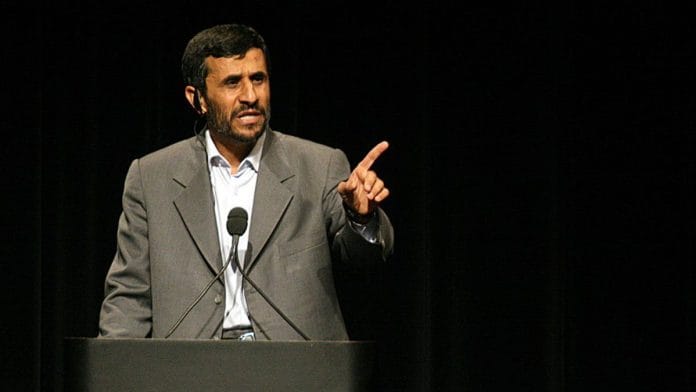


New Delhi: Following the first US-Israeli strikes on Iran, President Trump allegedly mused in public that Mahmoud Ahmadinejad, the ex-president of Iran, would be the best man to lead the country after a regime change, according to a newsbreak by The New York Times.
The report, which has led to a controversy, raises questions over why Washington, DC, and Tel Aviv would discuss a man linked to hardline, anti-West rhetoric as part of Iran’s future leadership.
Ahmadinejad was injured on the war’s first day by an Israeli strike at his home in Tehran, in what was a plan to set him free from house arrest, according to the NYT. Once it failed, Ahmadinejad allegedly “became disillusioned with the regime change plan”.
Mahmoud Ahmadinejad, an engineer and Conservative politician, served as Iran’s president from 2005 to 2013. A populist leader, he rose to power speaking for ordinary Iranians and challenging Western influence in West Asia. Aggressive speeches, nationalist politics, and confrontational foreign policy marked his presidency. He then served as Tehran’s mayor.
Though Ahmadinejad was once seen as close to Iran’s regime, his ties reportedly weakened later. After leaving office, he criticised parts of Iran’s clerical leadership and repeatedly attempted political comebacks, only to be blocked from elections.
Some suggest these tensions prompted Western leaders to believe that Ahmadinejad could be separated from Iran’s current power structure. Others believe the US-Israeli discussions reflect how regime-change calculations around Iran were uncertain and divided at the height of the war.
Neither Washington, DC, nor Tel Aviv has confirmed the claims.
“The plans, reported by the New York Times, were widely seen as implausible or as disinformation put out by Ahmadinejad’s supporters or the Israeli intelligence services,” The Guardian has reported.
Hardline anti-US, anti-Israel stance
The NYT report is controversial precisely due to Mahmoud Ahmadinejad’s long history of anti-West, anti-Israel politics—as president, he repeatedly criticised the US and openly challenged Israel’s lawfulness.
Several of his speeches drew condemnation from Western governments and European institutions. For instance, Ahmadinejad said in 2010, “The 11 September incident was a big fabrication as a pretext for the campaign against terrorism and a prelude for staging an invasion against Afghanistan.”
He also frequently criticised Western powers for trying to dominate global politics. In a 2009 speech, he said, “The era of capitalist thinking and imposition of one’s thoughts on the international community, intended to dominate the world in the name of globalisation and the age of setting up empires is over.”
Moreover, he accused the West of interfering in West Asian affairs and Iran as a country resisting foreign pressure. His speeches made him one of the most recognised hardline leaders in global politics during the late 2000s.
Israel considered Ahmadinejad as one of the most serious threats in the region because of his statements and Iran’s growing military and nuclear ambitions during his presidency.
In another 2006 controversial speech, Ahmadinejad said, “The existence of the Zionist regime is tantamount to an imposition of an unending and unrestrained threat so that none of the nations and Islamic countries of the region and beyond can feel secure from its threat.”
Role in Iran’s nuclear push
Mahmoud Ahmadinejad was closely linked to Iran’s nuclear programme. Under his leadership, Iran accelerated uranium enrichment activities despite growing pressure and sanctions. Ahmadinejad insisted that the programme was aimed at energy development.
However, the US and Israel repeatedly accused Tehran of trying to develop a nuclear weapons capability. This led to rising tensions between Iran and Western countries, with sanctions severely affecting the former’s economy.
The Ahmadinejad government’s aggressive nuclear policy became one of the defining issues of his presidency. It increased fears of military confrontation in the region.
Ahmadinejad, defending Iran’s stand during the nuclear dispute, said in 2006, “If all of you gather and also invite your ancestors from hell, you will still not be able to stop the Great Iranian nation.”
Despite these fiery speeches, he also publicly supported diplomacy in global conflicts. “All questions on international security have to be settled only through dialogue because using force will not lead anywhere,” he once said.
(Edited by Madhurita Goswami)
Also Read: Global media terms India fuel price hike ‘modest, but symbolic’, spotlights food safety ‘distrust’