





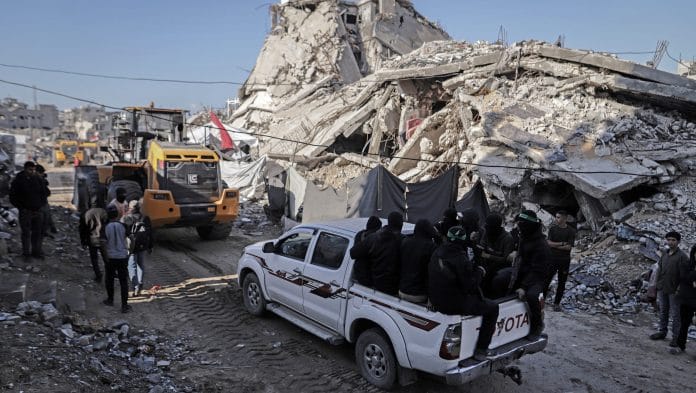



In presenting a 20-point plan for the Gaza Strip in September, US President Donald Trump promised more than an end to the war between Israel and Hamas. He proposed a remaking of the territory into what he called New Gaza. The aim was not only to improve life for its residents but to ensure such a conflagration would not recur.
While the fighting in Gaza has generally stopped, there’s been little progress toward the broader, so-called Phase 2 goals of the plan. Hamas formally agreed only to the Phase 1 conditions and rejects a Phase 2 demand for its own disarmament. That’s drawn threats from Israel to resume the war, which devastated Gaza and pulled Hamas allies Iran and militias in Lebanon and Yemen into the conflict.
Here’s what’s been achieved in Gaza so far and the challenges still facing the stakeholders in Trump’s plan:
A hitch in finalizing Phase 1
Phase 1 of the plan is close to completion. A ceasefire — albeit a shaky one — has been in place since Oct. 10. Gazans are receiving more humanitarian aid. And Israeli forces have withdrawn to the eastern half of Gaza, which has been largely emptied of civilians.
Dozens of hostages, living and dead — the last Hamas was holding from the Oct. 7, 2023 invasion of southern Israel that triggered the war — have been exchanged for hundreds of Palestinians who’d been imprisoned by Israel. But the remains of hostage Ran Gvili, an Israeli policeman, are still unaccounted for.
Hamas says that locating the body in the ruins of Gaza under winter rains may be impossible. Israeli officials accuse the group of stalling and insist there can be no moving on to Phase 2 until Gvili’s remains have been returned.
Prospects for disarming Hamas
The Trump plan calls for Hamas to lay down its weapons and give up all political power in Gaza. The Iran-backed group, which is designated a terrorist organization by the US and the European Union, has balked at this while signaling it might be willing to be integrated into the military of a future Palestinian state. The government of Israeli Prime Minister Benjamin Netanyahu rules out the creation of such a state.
Hosting Netanyahu at his Mar-a-Lago estate in Florida on Dec. 29, Trump said he wants to get to Phase 2 in Gaza “as quickly as we can” but added “there has to be a disarming of Hamas.”
The UK, junior partner to the US in implementing the Gaza plan, is trying to apply the lessons of the Northern Ireland peace process in working to persuade Hamas to decommission its weapons consensually. British officials involved in that effort said it would apply to heavier arms such as rockets and land mines, leaving some Hamas members with rifles.
Hamas has signaled it might be amenable to this. Israel isn’t. In a year-end interview on Fox News, Netanyahu said disarmament means you “got to take all these rifles, take them away from them.”
Arrangements for security and governance
Trump is expected to name fellow heads of state or government to a “Board of Peace,” which his plan envisages temporarily overseeing post-war Gaza. The impressive turnout of foreign dignitaries, at short notice, to the formal launch of the plan in the Egyptian resort town Sharm El Sheikh on Oct. 13 suggests the US president will not lack for candidates.
Under the Board of Peace there’s meant to be an International Stabilization Force (ISF) made up of foreign troops and an interim administration of Palestinian technocrats responsible for delivering public services.
In November, the United Nations Security Council, in an endorsement of Trump’s plan, gave its imprimatur to the idea of forming the ISF, but no country has publicly committed to contributing forces to it. Eli Cohen, a member of Netanyahu’s security cabinet, said on Army Radio on Dec. 31 that three countries have committed to joining the force, but he declined to name them.
Trump, who prizes his rapport with Turkish President Recep Tayyip Erdogan, has expressed openness to Turkey’s participation in the force. Netanyahu’s government has ruled it out, citing Turkey’s hosting of Hamas leaders and Erdogan’s antagonistic statements about the Jewish state in recent years.
Members of an interim Palestinian government have also not been identified. Their participation could hinge on whether their safety can be guaranteed. That, in turn, raises questions about whether the ISF would be willing and able to resort to force against Hamas or other armed groups.
Few officials involved in the deliberations believe the ISF would ever play more than a facilitating role in a consensual disarmament of Hamas. Trump’s plan speaks of “a process of demilitarization of Gaza under the supervision of independent monitors, which will include placing weapons permanently beyond use through an agreed process of decommissioning.”
If Hamas doesn’t comply, there’ll be “hell to pay,” Trump said at Mar-a-Lago. He said that unnamed countries would “wipe out Hamas.” Israel failed to achieve that goal after two years of full-scale war.
A precarious fallback option
Point 17 of Trump’s plan makes a provision for Hamas’ recalcitrance. In such circumstances, it calls for the post-war administration and reconstruction to begin in the half of the Gaza Strip under Israeli army control. Under the plan, this would require Israeli forces to gradually hand over territory to the ISF as they pull back toward an envisaged buffer zone inside the perimeter of the strip.
Netanyahu appears to have taken issue with the idea of New Gaza taking shape behind the Yellow Line marking Israel’s redeployment, at least if that entails Hamas being left lethal and in power on the other side. Gaza, he said on Nov. 16, “will be demilitarized, and Hamas will be disarmed. Either this will happen the easy way or it will happen the hard way.”
Still, a US official said Israeli forces are clearing unspent ordnance and rubble in the part of Gaza they control, mainly around the southern city of Rafah, and installing utilities in what appear to be the first steps toward resettling Palestinian civilians there safely away from Hamas’ reach. Israel has neither confirmed nor denied that.
The costs of rebuilding
The Trump blueprint ambitiously promises that “an economic development plan to rebuild and energize Gaza will be created by convening a panel of experts who have helped birth some of the thriving modern miracle cities in the Middle East.” Yet past Gaza wars have seen pledges of foreign aid unimplemented, and the current bill is massive — $70 billion, according to an estimate by the UN, EU, and World Bank.
Clearing munitions alone could take two years, according to Israeli estimates, and no one knows for sure how much of the hundreds of miles of Hamas tunnels remain to be plumbed and blocked or demolished. That spells potentially a generation-long displacement of most of the territory’s 2 million Palestinians. The Trump plan calls for those who want to emigrate to be allowed out, but resettlement opportunities for Gazans are limited.
Disclaimer: This report is auto generated from the Bloomberg news service. ThePrint holds no responsibility for its content.