



A new Pew Research survey covering 36 countries and two territories shows Donald Trump’s global ratings have declined sharply, and how confidence in the United States as a reliable partner has also fallen. The survey finds widespread scepticism about Trump’s handling of trade, Gaza, Iran and the Ukraine war, with many traditional American allies expressing declining trust in Washington.
In episode 1855 of Cut The Clutter, ThePrint Editor-in-Chief Shekhar Gupta breaks down what the latest Pew data reveals about Trump’s standing across the world, America’s changing global image, and how India and Pakistan are on opposite ends.
Here is the transcript, edited for clarity.
How popular, or unpopular, is US President Donald Trump across the world? Trump has exercised American power in a way no American president has. One invaded Iraq, another Afghanistan. Vietnam, too, is from the recent past, yet no US leader changed the world order as much or shaken up the world order as Donald Trump has.
That’s why views on him across the world are significant. The changes are, too, and Pew has helped us by producing new research to understand just that. The story is in the headline: ‘Trump gets negative reviews internationally as fewer say US is a reliable partner.’ Trump is down globally, as is the US, and quite significantly.
Before getting into areas where they are down and how that rating fares across countries, here’s a little story.
Also Read: Americans say staying informed is important, but few are well informed themselves, finds Pew
Down the memory hole: This goes back to 2008, or thereabouts, when David Mulford was the US Ambassador to India. Mulford visited us at The Indian Express, where I used to work. A young person from the editorial team asked him how it felt to represent a country whose president has the lowest ratings, and is the most unpopular in his country.
The US is a democracy, and the general pattern is that presidents become unpopular over time, particularly in their second term. These ratings are almost weekly. George W. Bush, who was president then, had really low ratings at that point. Mulford said, ‘Look, I know my president’s ratings are down, but I know that he gets ratings of nearly 70 percent in India.’
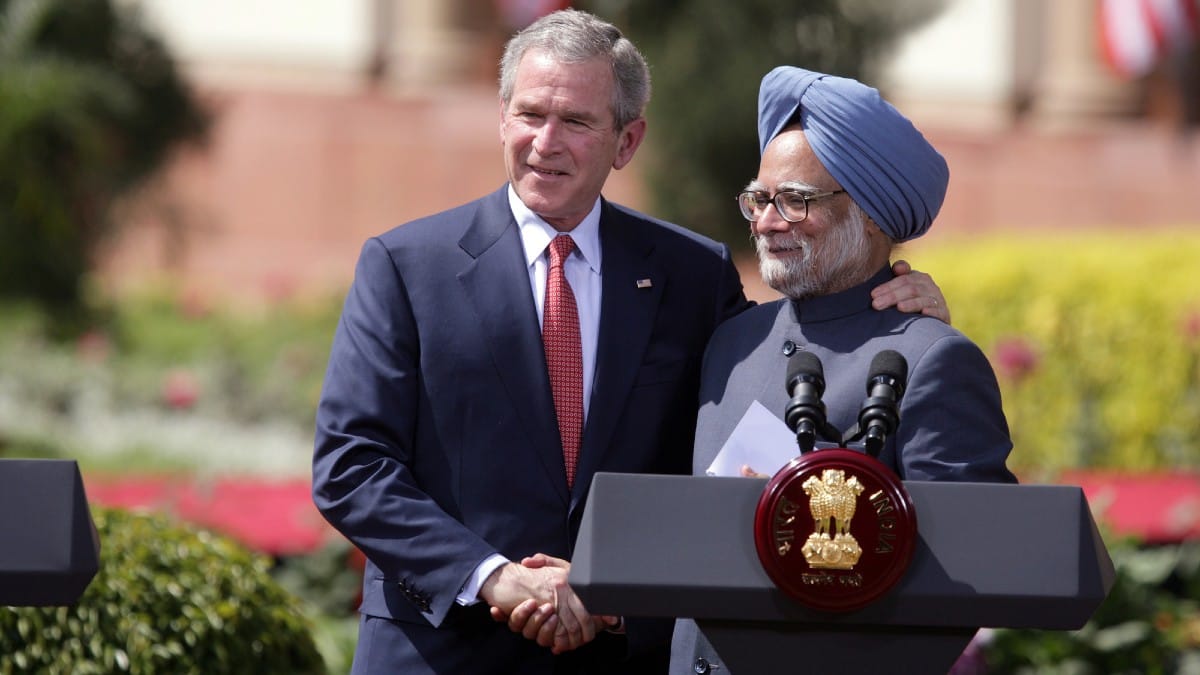
This was also the time when, after the nuclear deal, Manmohan Singh had said to George Bush, ‘President Bush, the people of India love you dearly or greatly,’ or something like that, for which he was also criticised in India. Moral of the story? An American president can be unpopular at home, but still be popular in many parts of the world. In India, American presidents and America have been quite popular for the past 25 years.
In fact, America’s popularity and reliability ratings have been going up. We don’t have data from Pew for every year of the research that they’ve done, but we have sufficient evidence to show that in India, America’s and the American president’s ratings have been high.
This is a survey of 36 countries and two territories. The territories are East Jerusalem and the West Bank; Pew was unable to conduct research in Gaza.
Rate Race: What are the highlights of this data? There is no country surveyed where Trump has become more popular than before. In some countries, the fall in popularity is not much, like Israel, but it has fallen significantly everywhere. Trump’s ratings for handling some key issues in the world, for example tariffs, Gaza, Iran, his claims over Greenland and the Russia-Ukraine war, are particularly poor.
In the US, favourable views of the country have dropped. In many countries, the popularity of the US has had double-digit declines. These are Indonesia and Italy, and this was before his dust-up with Prime Minister Giorgia Meloni, because this research was conducted between February and May this year.
In general, Trump has become much more unpopular in countries with a large Muslim population, lie Malaysia, Pakistan, Turkey, and, of course, the Palestinian territories.
Now Turkey happens to be a US ally as a member of NATO, the only Asian country—most of Turkey is in Asia. It is where the US stores nuclear weapons. Yet in Turkey, America and Trump are among the least popular or the most unpopular.
That singing feeling: Pakistan is a major non-NATO ally, and has lately been promoting itself, talking about its role as a mediator. The Pakistanis have even produced a new video, obviously done by the Inter-Services Public Relations (ISPR), the media and public relations wing of their armed forces. With a very zippy tune, the video is done in a very American style with American singers, guitarists and performers; performers saying the US loves Pakistan and then going on to say ‘we love Pakistan, the peacemaker’.
That’s the title of the song. So while the ISPR and the Pakistani establishment are trying to say that the Americans love them, by implication that they also love America, the picture that the Pew survey paints is exactly the opposite.
In most of the key countries, most of Europe, American allies, etc., green—positive—is down and blue up. Do you consider America reliable? Everywhere green is down. Everywhere blue is up, except in two countries: Hungary and Israel. Hungary, obviously, as Viktor Orban was there; even his successor is sort of right of centre. So Hungary has improved by 6 percent and Israel by 4 percent. Everywhere else it’s down.
Also Read: Americans judge compatriots harshest, Pew survey finds. Indians are kinder—sort of
Quality issues: Americans lecture everybody else on the quality of their democracy. Pew has surveyed these 36 countries on what they think of the quality of American democracy.
Some 56 percent globally think that the US does not respect the liberties of its own people. Only 39 percent believe that the US does. So, the US, in terms of its image, is no paragon of democratic virtue today.
The details tell a story. Trump doesn’t get more than 50 percent anywhere over his handling or his policy on Gaza. In Israel, however, there’s a nuance; 48 percent of Israelis support Trump’s policies on Gaza.
Among Israeli Jews, this support is 58 percent while among Israeli Arabs, it is only 14 percent. Add the two, and the weighted average or the weighted median, in this case, comes to 48 percent.
Among Palestinians in East Jerusalem and the West Bank, it is only 3 percent. In fact, those 3 percent must be some really unusual people, like the unusual 18 percent of Indians who still approve of his handling of trade. Those are really remarkable Indians, genuinely argumentative Indians who are happy to go on the other side. That is one in five Indians.
Mr Popular?: What about the highest and lowest confidence in America? The country with the highest confidence, the Philippines, is at 68 percent. Israel is at 66 percent. Then Nigeria, Kenya, and Ghana, at 65, 63 and 54 percent, respectively.
Trump must have done something good for those countries for him to be so popular there. Then, Hungary, the usual suspect, with the Orban effect, the Right-wing effect, is at 44 percent. In Colombia, he is very popular with 43 percent. And then India, a major country, is at 39 percent. No confidence comes close at 36 percent.
What about Pakistan? A lot of people in India, particularly in the commentariat, think Trump is leaning toward Pakistan. He is looking after Pakistan, hosting Asim Munir, calling him his favourite Field Marshal. He is patting Prime Minister Shehbaz Sharif on the back, as is Vice-President J.D. Vance. In Pakistan, Trump gets just a 12 percent confidence rating; that’s only one in eight Pakistanis reposing confidence in Trump. The remaining 82 percent have no confidence in Trump.
West Bank and East Jerusalem are the worst for Trump; only 4 percent confidence and 87 percent no confidence. In Turkey, only 6 percent believe in Trump while 92 percent are against him.
Trump has been flattering Erdogan all this while. One reason, and that’s Netanyahu’s complaint, is that Trump did not let him carry out his plan of unleashing a Kurdish rebellion on Iran the moment the fighting started. The reason was that Trump was persuaded by Erdogan not to allow it because Turkey, Syria, Iran, and Iraq see Kurds as a threat. Turkey, most of all. Trump deferred to Erdogan and did not allow this Netanyahu plan to go on. Yet he is incredibly unpopular in Turkey; 92 percent say no confidence.
It’s surprising that Trump’s ratings are very poor in Sweden as well, because he did not claim Greenland from Sweden. He claimed Greenland from Denmark, but maybe this is the Scandinavian viewpoint. Scandinavia is very liberal, a little bit to the Left, although the Right has been winning in many of these countries now. But he has an 89 percent no confidence rating in Sweden.
Again in Malaysia, 87 per ent negative and 13 percent positive. About the same percentage. In fact, almost the same as Pakistan.
Also Read: Almost 15% of the global population are Hindus. Pew study puts the count at 1.2 billion
Friendly fire: Across the board, Trump is very unpopular among his allies. And that is what I quoted, a slogan on a truck: ‘Aisa koi saga nahi, jisko humne thaga nahi’, meaning there’s no friend or family member I haven’t swindled yet.
This applies to Trump because there is no ally or friend who he has not humiliated or harmed in his second term. And that is why the negative buzz comes from traditional allies, friends or frenemies. They are now unsure if they can count on American protection. This includes Japan, Australia and South Korea, the first two members of the Quad, and the third almost in the Quad because it is also in the same geographical neighbourhood.
Very few people across these 36 countries and two territories approve of Trump’s handling of international issues.
What are these issues? International humanitarian aid: disapproval of 56 percent; immigration policies: 65 percent disapproval; Venezuela, where he picked up the president or kidnapped the president: 63 percent disapproval; the war in Ukraine: 72 percent disapproval: and Iran: 74 percent disapproval.
Most of the countries surveyed or a large number of them, are America’s friends or allies. But 74 percent, including Pakistan, disapprove of Trump’s handling of Iran.
76 percent negative, tariff: 77 percent negative, Greenland: 68 percent negative. I think if there was a question on how many people find it funny, you might get a rating of 98 percent because that sounds like a joke.
How is the US viewed around the world? Hungary has a favourable rating at 58 percent. Poland is at 49 percent, almost half. Japan is 50 percent favourable and 50 percent unfavourable. In the Philippines, Trump is very popular, with 56 percent positive and 41 percent negative. Sweden, once again, 80 percent negative and 19 percent positive.
In India, 45 percent is still positive. This, however, is a decline. In 2024, for example, towards the last days of the Biden administration, the US got 51 percent confidence rating from India. Now it’s at 45 percent.
Coming to some of the others, the new friends of the US, or at least those countries that see the US as a new friend or an old friend. In Pakistan, 15 percent have confidence in the US and 81 percent have no confidence. Israel is the exact opposite of Pakistan: 81 percent have confidence in the US and 19 percent do not. And Turkey pretty much is at Pakistan’s standard, with 84 percent negative and 13 percent positive.
Leading lights: There’s one more data point: how does each country view the world’s leaders right now? We’ll talk about Trump, Macron, Xi Jinping, Putin, Netanyahu. In India, 39 percent say they like Trump and 33 percent say they like Macron very much. For Putin, it’s 51 percent, which is to be expected. Russia is very popular in India. Netanyahu gets only 34 percent, quite a surprise.
That really tells us that Netanyahu has got bad press in India generally, because a lot of people in India are not happy with how he has acted in Gaza. But the most interesting thing in the Indian numbers is Chinese President Xi Jinping, who 25 percent like, higher and way better than in Poland and Japan, for example. And once again, because Pakistan has become so central to America in the region, in Pakistan only 12 percent like Trump, 19 percent like Macron. Xi Jinping in Pakistan has 83 percent popularity, which is where he should contest elections.
He will sweep that election, and if he comes to contest that election, the Pakistan army would not even dare to interfere with that election. Maybe that’s one way for Pakistan to have a fair election. And then Putin in Pakistan is at 32 percent. Netanyahu, as expected, is 3 percent. I would not expect even 3 percent in Pakistan, but there are always outliers everywhere.
Also Read: Amid Indo-Pacific Command name change, US’s repeated use of incorrect India map back in focus
Nosey business: In our country, going right back to the Indira era, Americans have always been looked at as interfering. In fact, in those days, Piloo Mody, who used to be a wonderful parliamentarian, once walked into Parliament with a badge saying, ‘I am a CIA agent.’ Mody said that by way of making fun of this propaganda that foreigners were interfering in India’s politics, and that’s why Mrs Gandhi was having problems at that time.
I shall not use the expression ‘Third World’ because our professor Steve Cohen taught us not to use two expressions. He said never use the expression ‘superpower’ and ‘Third World’. His argument was that once you use that expression, then all debate and argument closes because you put somebody, a very important country or a very important section of the world in one box, and then you can’t have any argument or debate.
So I will say 17 middle-income countries. Of these, India is the only one where less than 50 percent think that Americans are interfering. Social media platform X is full of breast-beating about the ‘deep state’, and this runs contrary to that view. In any case, it’s nobody’s argument that social media represents popular opinion. That’s an echo chamber.
And this survey is particularly limited, particularly focused on these 17 middle-income countries, where India also features. Sixteen of these 17 countries believe that America does interfere in the internal affairs of other countries. In fact, if you see the median there, the point between the lowest and the highest percentage, it’s 75 percent of America interfering in the world’s affairs. Turkey is at 75 percent. Pakistan is at 76 percent.
India shining: India is an outlier because here more than 50 percent do not say that America interferes. Only 47 percent say that, and 30 percent say America does not interfere. India is the only country among the 17 where this is a minority opinion.
Then, for a touch of supreme irony, Pew also surveyed Americans to find out if they think America interferes in other countries’ internal affairs. So globally, among middle-income countries, the median is 75. In America, 83 percent believe that their country interferes in other countries’ internal affairs.
In fact, if you want to understand the 45 percent Indian rating for America, 45 percent is high, given how Trump’s America is rated right now. We also need to see when America was the most popular and the most trusted in India. In the spring of 2015, the American ratings were 70 percent positive and only 8 percent negative. So under Trump, you can say, to use an Americanism, you’ve come a long way, but in the wrong direction.
In conclusion, I will also bring you a data point from last year’s Pew survey, conducted in the spring of 2025. There, 80 percent of the people surveyed across the world described Trump as arrogant, 67 percent called him a strong leader and 65 percent described him as dangerous. And significant increases in this category were noticed in countries where Trump is relatively popular, that is, Hungary, Nigeria, and India.
So dangerous, strong, and arrogant, yet popular.
Also Read: Colombia elects Trump-backed political newcomer Espriella as Right-wing populism surges worldwide