







By Idrees Ali and Phil Stewart
DUBAI/WASHINGTON, May 5 (Reuters) – Washington said Iran had not breached a fragile ceasefire in the Middle East conflict on Tuesday, following an exchange of fire between the two sides the previous day as U.S. forces attempted to force open the Strait of Hormuz.
The U.S. military said it had destroyed six Iranian small boats, as well as cruise missiles and drones, after President Donald Trump sent the navy to escort stranded tankers through the strait in a campaign he called “Project Freedom”.
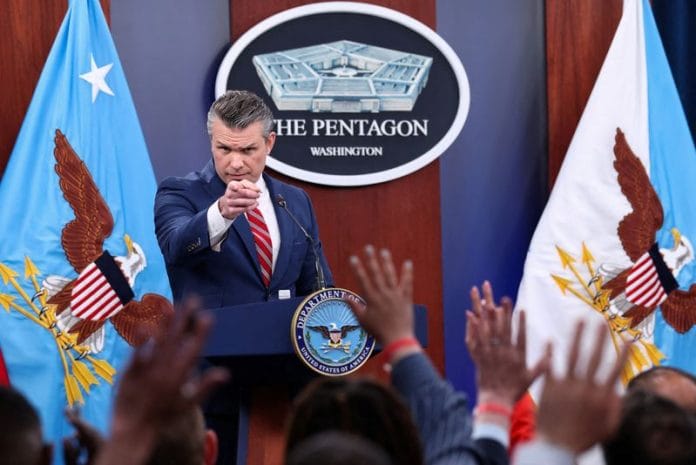
U.S. Defense Secretary Pete Hegseth said the operation to protect commercial ships was temporary and the four-week-old truce was not over. “We’re not looking for a fight,” he told a press conference on Tuesday. “Right now the ceasefire certainly holds, but we’re going to be watching very, very closely.”
Iran fired missiles at U.S. ships on Monday and attacked the United Arab Emirates, a key regional ally of Washington, with missiles and drones.
Iran’s parliament speaker, Mohammad Baqer Qalibaf, said breaches of the ceasefire by the U.S. and its allies had endangered shipping through the strait, which carries a large share of the world’s oil and fertiliser supplies.
“We know well that the continuation of the current situation is unbearable for the United States, while we have not even begun yet,” he said in a social media post.
ATTACKS IN THE GULF
The narrow strait has been virtually shut since the United States and Israel began attacks on Iran on February 28, triggering disruptions that have pushed up commodity prices around the world.
Hegseth said the U.S. had successfully secured a path through the critical waterway and that hundreds of commercial ships were lining up to pass through.
Several merchant ships in the Gulf reported explosions or fires on Monday, and an oil port in the UAE, which hosts a large U.S. military base, was set ablaze by Iranian missiles. The UAE reimposed flight restrictions on its airspace on Tuesday.
Iran has effectively sealed off the strait by threatening to deploy mines, drones, missiles and fast attack craft. The United States has countered by blockading Iranian ports and mounting escorted transits for commercial vessels.
The U.S. military said two U.S. merchant ships made it through the strait, without saying when, with the support of Navy guided-missile destroyers.
Iran denied any crossings had taken place, though shipping company Maersk said the Alliance Fairfax, a U.S.-flagged ship, exited the Gulf under U.S. military escort on Monday.
The commander of U.S. forces in the region said his fleet had destroyed six small Iranian boats, which Iran also denied. Iranian media quoted a military commander as saying U.S. forces targeted civilian and cargo vessels, killing five civilians.
Iran also said it fired warning shots at a U.S. warship approaching the strait, forcing it to turn back.
Reuters could not independently verify events in the strait as the two sides issued contradictory statements.
General Dan Caine, the chairman of the Joint Chiefs of Staff, said that since the ceasefire was announced on April 7, Iran had fired at commercial vessels nine times and seized two container ships.
He said Iran has attacked U.S. forces more than 10 times.
However, the attacks fell “below the threshold of restarting major combat operations at this point”, Caine told reporters.
UAE OIL PORT ABLAZE
Iranian Foreign Minister Abbas Araqchi said Monday’s events showed there was no military solution to the crisis. He said peace talks were progressing with Pakistan’s mediation, and warned the U.S. and the UAE against being drawn into a “quagmire.”
Araqchi was travelling to Beijing on Tuesday for talks with his Chinese counterpart, his ministry said.
Iranian authorities released a map of what they said was an expanded maritime area now under Iranian control, stretching beyond the strait to include lengthy sections of the UAE coastline.
After a day of reported drone and missile attacks inside the UAE on Monday, including one that caused a fire at Fujairah, an important oil port, the UAE said Iranian attacks marked a serious escalation and it reserved the right to respond.
The Iranian map included Fujairah and another Emirati port, Khorfakkan, both of which lie on the Gulf of Oman and which the UAE has relied on since the start of the conflict to bypass the blocked strait.
Iran’s state television said military officials had confirmed they attacked the UAE in response to the “U.S. military’s adventurism”.
PEACE EFFORTS STALLED
The war in the Middle East has already killed thousands and roiled the global economy. U.S. and Iranian officials have held one round of face-to-face peace talks, but attempts to set up further meetings have failed.
Trump has said the U.S.-Israeli attacks aimed to eliminate what he called imminent threats from Iran, citing its nuclear and ballistic missile programmes, its support for Hamas and Hezbollah and its “menacing activities”.
Iranian state media said on Sunday that the U.S. had conveyed its response to a 14-point Iranian proposal via Pakistan, and Iran was reviewing it. Neither side gave details.
A senior Pakistani official involved in the talks said “backdoor diplomacy” was continuing. “We have put in a lot of efforts, actually both the sides have narrowed gaps on majority issues,” the source said.
Tehran’s proposal would defer talks on its nuclear energy and research programmes until after agreements to end the war and on shipping security. Trump said over the weekend he was still studying it, but would likely reject it.
Trump has insisted Iran must surrender its enriched uranium stockpiles to prevent it producing a nuclear weapon – an ambition Tehran denies.
(Reporting by Reuters bureaux; Writing by Jonathan Allen and Stephen Coates; Editing by Andrea Ricci, Alex Richardson and Ros Russell)
Disclaimer: This report is auto generated from the Reuters news service. ThePrint holds no responsibility for its content.