





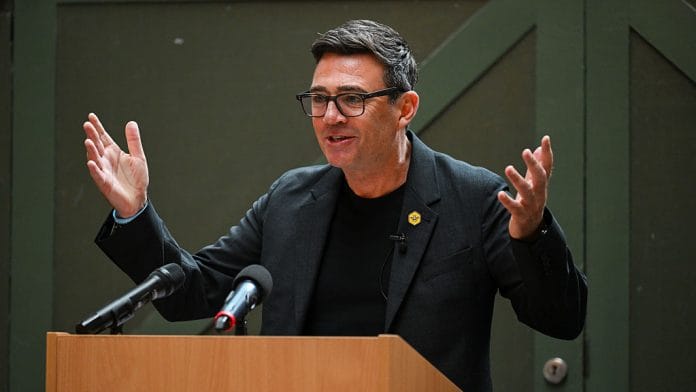


The UK is once again changing its prime minister and, as is customary for the governing Labour Party, the new leader will not be a woman. The party that throughout its 120-year history has defined itself as progressive and representative of the “many not the few,” has consistently failed to deem a woman worthy of the highest office of state.
It’s now certain that Andy Burnham will enter 10 Downing Street on July 20 and become the UK’s 59th prime minister and Labour’s 20th leader. There are lots of reasons I think Burnham is a good person to be put in charge of the country right now. But it remains a stain on the party that it hasn’t nurtured and enabled a woman to take on the role — and I know a lot of female Labour legislators who feel the same.
When Keir Starmer was elected Labour leader in 2020, there was some consternation that his victory over two able women meant that, yet again, the party was outflanked in terms of gender equity by the Conservatives, who, despite their more traditional outlook, have now boasted four female leaders including the era-defining Margaret Thatcher. The unspoken message was that Labour would do better next time. But with Boris Johnson in his pomp in No. 10 and the party reeling following the electorally disastrous reign of the far-left socialist Jeremy Corbyn, many seemed to feel that Labour needed someone who, you know, looked like a prime minister (which, in my experience, equates to looking like a man).
The other tacit implication was that, while Starmer might not actually be female, as an enlightened guy who loves his wife and daughter he could safely be entrusted with the promotion of women’s rights. It didn’t work out that way.
Starmer did give senior roles to female MPs — such as Chancellor Rachel Reeves — and his cabinet included a record number of women. But they were never members of his inner circle. Some say they were shut out of what became known as the Downing Street “boys’ club,” subject to cruel briefings described by minister Lisa Nandy as “dripping with misogyny,” or sidelined like Deputy Leader Lucy Powell, who was denied a cabinet post.
Meanwhile, his strategy on tackling violence against women and girls stalled, to the extent that the responsible minister, Jess Phillips, quit in protest. Many female MPs privately remain certain that the scandal involving the appointment of Jeffrey Epstein’s friend Peter Mandelson as US ambassador would never have happened had women been involved in Starmer’s decision-making.
So why has Labour plumped for a leader with XY chromosomes once again? When Starmer stumbled, a few female names entered the conversation before swiftly being nixed. Angela Rayner: Too troublesome. Shabana Mahmood: Too inflexible. Yvette Cooper: Too boring. With Labour in an existential fight against the right-wing populists of Reform UK, Burnham’s return to Parliament made his ascension a fait accompli. Sorry, ladies, but this one’s too important to risk a woman on.
This freezing out of female politicians on the left reminds me of conversations I had with Democratic strategists during a recent trip to the US. The 2028 presidential election will be the most important since, well, the last two or three, and virtually everyone I spoke to was convinced that after the debacle of Kamala Harris’ run, they couldn’t possibly gamble on a woman next time. (To be fair, the Republicans have never nominated a woman, and given their current frame of mind, that seems unlikely to change any time soon.)
In Europe, it’s not just the Tories who’ve had successful female leaders. Women have represented right-of-center parties across the continent, often with marked success. Whatever your view of their policies, there can be no doubt that Germany’s Angela Merkel and Giorgia Meloni of Italy have been formidable leaders, while Marine Le Pen changed the face of French politics.
Elsewhere, and even in lands that are far from bastions of democracy, dynastic politics have trumped misogyny from India to Argentina to Myanmar. One or two lefty democratic parties have deigned to appoint a woman — the Nordics and Antipodeans have a pretty good record — but that only highlights Labour’s failings.
Of course, it’s not just in politics that women have hit a glass ceiling; it feels as if we’re falling back on many fronts. As my Opinion colleague Beth Kowitt has pointed out, women have been passed over in a succession of top job appointments this year, and the number of female CEOs running Fortune 500 firms remains at just 11%. Only 9% of FTSE 100 companies are headed by a woman. The UK gender pay gap in the financial sector is such that women earn just 78p for every pound their male colleagues take home. Just 36% of High Court judges are female, according to the latest figures.
That only makes it more important that politics takes a lead — particularly in parties that claim to have equality and fairness at their heart.
Burnham is alive to the risk of alienating 50% of the electorate, along with many of his own lawmakers. At a meeting of the women’s parliamentary Labour Party this week, he promised the sexist briefings would stop on his watch, and disavowed a preposterous quote from a (presumably male) ally suggesting he would be Labour’s “first female prime minister” because he’s interested in touchy-feely stuff like childcare as well as the “bombs and budgets” that male PMs supposedly cleave to.
It will be instructive to see if Burnham puts his money where his mouth is when it comes to drawing up his cabinet. Currently, three of the four big offices of state — foreign, home and treasury — are occupied by women (the fourth being the office of the prime minister). Yet there are rumors Burnham may promote his pal Ed Miliband to the role of chancellor, and even bring back Miliband’s brother David (despite the siblings’ longstanding and bitter feud) at the Foreign Office. As one despairing minister put it to the Times, surely there can’t be more Milibands than women in senior roles in Burnham’s new administration?
Labour’s track record on gender equality at the very top continues to disappoint. For the sake of the country, I hope Burnham can mark a break with the endless churn, and return to a more stable era when prime ministers stuck around long enough to actually get stuff done. But he must also put equality at the heart of his government — and when it does come to succession planning, do everything in his power to ensure a woman finally heads the party of the people.
This column reflects the personal views of the author and does not necessarily reflect the opinion of the editorial board or Bloomberg LP and its owners.
Rosa Prince is a Bloomberg Opinion columnist covering UK politics and policy. She was formerly an editor and writer at Politico and the Daily Telegraph, and is the author of “Comrade Corbyn” and “Theresa May: The Enigmatic Prime Minister.”
Disclaimer: This report is auto generated from the Bloomberg news service. ThePrint holds no responsibility for its content.