






Long a bridge between Europe and the Middle East, Turkey is seeking to capitalize on its strategic location to attract more rich residents as instability hits rival wealth hubs from London to Dubai.
The country recently announced it’s ushering in a range of tax incentives for monied expats and investors abroad, ranging from minimal inheritance tax, the chance for 20 years of overseas income free from local levies and an amnesty program to bring in undeclared assets held overseas.
Turkey is seeking to burnish its credentials as a regional finance and wealth center after political turbulence and unorthodox monetary policy stymied some of its ambitions in recent years. The nation’s home-grown rich have often sought to take assets overseas to counter frequent bouts of high inflation and currency devaluation while landmark projects, such as the Istanbul Financial Center, still lag Gulf rivals on global indices.
The new policies arrive at a sensitive time for some rival finance centers. Dubai and Abu Dhabi, recent magnets for international wealth, have been tested by the US war in Iran and localized attacks, shaking their status as regional safe havens. The UK, home to a sizeable Turkish community, has seen numerous wealthy residents depart after it ended a tax perk that shielded foreign income from local taxes. Wealth hubs in Europe and elsewhere are vying to welcome in those unsettled by the turbulence.
The new measures, at least in part, echo the UK’s former non-dom regime, which offered the possibility of virtually tax-free living for those generating significant income outside the country. With that system gone, competition is heating up. Italy, for example, has become a magnet for those fleeing the UK thanks to its flat-tax regime, proximity and lifestyle.
Still, within the EMEA region, the Gulf in many ways offers some of the most advantageous financial conditions. In recent years it’s welcomed in a steady stream of traders and hedge funds, among others, thanks to the lure of tax-free income. But the recent uptick of hostilities between the US and Iran serves as a further reminder of their location within a historically volatile region. Turkey now sees a chance to offer an alternative to them, closer to Europe, even if it’s unclear how many people are likely to sign up. “We are determined to make Turkey not only a destination for investment, but also a global center where investments are managed, trade is directed, and capital comes together,” President Recep Tayyip Erdogan said earlier this year.
One potential target group of the new measures are wealthy Turks in countries such as the UK and Germany. The latter counts about three million people of Turkish descent, considered to be the largest diaspora from the country in the world. In the UK, large numbers of people of Turkish descent are concentrated in northern and eastern parts of London, among others.
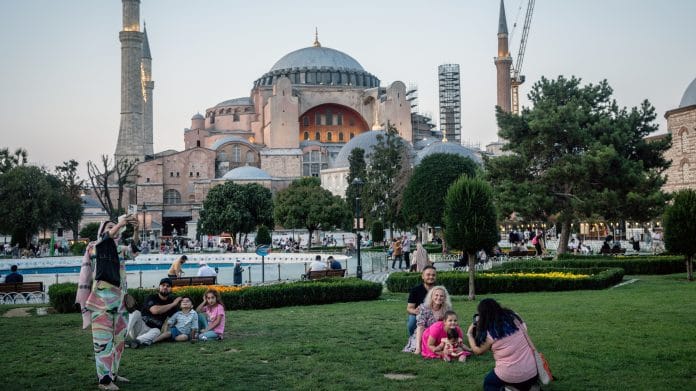
For those interested in setting up — or returning — Turkey can offer attractive lifestyle options alongside the new tax perks. Istanbul, the financial capital, boasts a history stretching back millenia. Daily architectural and cultural reminders of its position as a seat of imperial power for four empires include the Hagia Sophia and Topkapi Palace.
For Europeans, its location offers shorter travel times back home, easier access to Asia and less formidable summer temperatures than in the Gulf. Other amenities include top-quality healthcare, international schools, high-end marinas and even waterfront mansions on the Bosphorus.
Safety and property rights can also be a concern. Turkey’s widening use of corporate seizures has turned TMSF, the state fund that manages confiscated assets, into an unlikely business empire controlling more than 1,000 companies. The Istanbul Financial Center opened in 2023 with ambitions of turning the city into a global finance hub. Despite housing the central bank and major state-owned lenders, it’s so far had limited success in attracting foreign institutions.
The country does, though, offer potential residents another advantage: the possibility of a passport to those willing to buy local real estate worth at least $400,000 and hold it for a minimum of three years. Some European countries have been looking to phase out such so-called Golden visa and passport programs.
Turkey’s citizenship by investment program was launched in 2017 and has drawn wealthy Russian and Chinese nationals due to its relatively low requirements. This year immigration firm Henley & Partners put Turkey in its list of strategic jurisdictions for global mobility and access. Burak Demirel, head of Turkey at the firm, said it’s seeing inquiries about relocation from India, the US, the UK, Germany and France.
“Turkey is one of the few countries that has both a citizenship by investment program and a tax system designed for wealthy international families,” said Peter Ferrigno, tax services director at Henley & Partners.
“The terms are attractive and Turkey offers a good lifestyle alternative to the Gulf,’’ said Timothy Ash, Russia and Eurasia programme associate fellow at Chatham House. “I guess the challenge for financial professionals operating out of Dubai, Doha or even Riyadh isTurkey still does not have the critical mass of international finance business to justify the move.”
Enes Basar, 34, relocated from Istanbul to London in 2017 with the idea of doing a two-year stint at the UK division of his family’s candy business, Kervan Gida Sanayi ve Ticaret AS. Nine years on, he’s still there, having risen to managing director.
“I’m thinking more about how can I grow my business instead of the tax,” he said in an interview. “I could start to manage from Turkey, but managing from here, living from here, that’s much easier for me.”
–With assistance from Ugur Yilmaz, Inci Ozbek and Benjamin Stupples.
Disclaimer: This report is auto generated from the Bloomberg news service. ThePrint holds no responsibility for its content.