





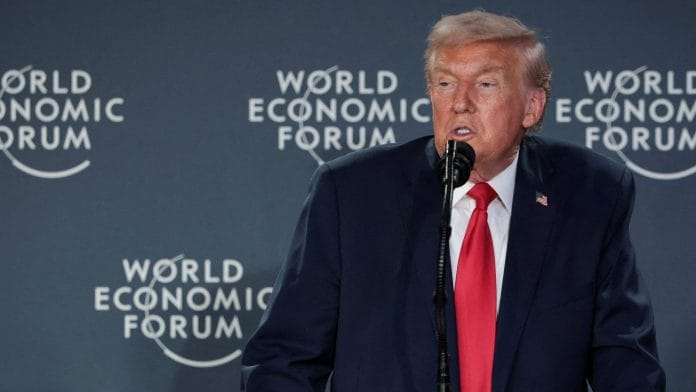



The US officially exited the Paris Agreement on Jan. 27. It’s the second time President Donald Trump has pulled out of the pact that commits almost 200 countries to keep global warming to no more than 2C (3.6F), and ideally 1.5C, above pre-industrial levels.
Compared with his first term in office, Trump has escalated his retreat from global cooperation to reduce greenhouse gas emissions. Just weeks before the exit from the Paris deal took effect, he ordered the withdrawal of the US from the United Nations treaty that underpins international climate talks, as well as more than 60 multilateral organizations focused on the environment, peace, gender equality and democracy.
As the US government vacates its seat at the negotiating table, the rest of the world is likely to continue pursuing joint efforts to tackle rising temperatures — the past three years have been the hottest on record, marked by deadly and costly wildfires and flooding. But progress could be more difficult without the participation of the largest economy and biggest historical polluter, whose absence may also give some nations cover to make less stringent commitments.
Even if a future administration in Washington reverses Trump’s changes, in the interim, climate organizations will have to grapple with the loss of billions of dollars of US funding — unless other nations or philanthropies step in to fill the void.
Why is the US withdrawing from climate organizations?
Trump’s January presidential memorandum said the US would pull out of climate groups because they’re “contrary to the interests of the United States.” The White House framed the move as saving taxpayers’ money from “ineffective or hostile agendas.”
Trump has made no secret of his climate denial. He told the UN General Assembly last year that climate change is “the greatest con job ever perpetrated” and that renewable energy is a “joke.” Since returning to office, he’s escalated efforts to undermine climate action both at home and at the global level.
Within hours of his inauguration last year, Trump issued an executive order for the US to begin the process of withdrawing from the Paris Agreement. Now, Trump is quitting the treaty that’s the bedrock of that landmark 2015 pact.
What’s the foundational UN climate treaty that the US is pulling out of?
The UN Framework Convention on Climate Change is the legal mechanism under which countries gather every year to discuss how they can collectively lower emissions and adapt to global warming.
It was established in 1992 during the term of President George H.W. Bush, whose administration realized the world needed a treaty to address emissions. “The US was the first country to ratify it,” said William Reilly, who served as administrator of the Environmental Protection Agency under Bush. “The premise was and remains: The response to planetary warming must be planetary.”
Every country in the world signed onto the UNFCCC. Once the US exits — a process that takes a year under the terms of the treaty — it will be the first one to ever withdraw. It’s also pulling out of the UNFCCC’s main financial mechanism, the Green Climate Fund, which has approved more than $19 billion for projects in developing nations. Trump had already canceled $4 billion that previous US administrations committed to the fund.
What other climate bodies has the US said it’s leaving?
Trump is also pulling the US out of the Intergovernmental Panel on Climate Change, a UN body that’s the leading authority on climate science. The IPCC, composed of hundreds of the world’s top scientists, was created in 1988. Its reports are authoritative, comprehensive guides to understand past, present and future climate change.
The panel won the 2007 Nobel Peace Prize for its work, and its scientific assessments provided the foundation for the Paris Agreement. Three years after that deal was signed, a single sentence in a 631-page IPCC report launched countries, cities, companies and more on their “net zero” emissions journeys.
Among the other environment-related groups the US is leaving are the International Renewable Energy Agency, which works to support the adoption of technologies such as wind, solar and hydropower, and the International Union for Conservation of Nature, a nearly 80-year-old authority on the health of the natural world.
How will the US pullback impact global efforts to cut emissions?
The US is the second-largest emitter after China on an annual basis, so Trump’s disengagement will make it more difficult to keep global emissions in check. On top of that, his administration has sought to derail efforts to curb pollution within UN bodies that the US remains a part of.
Last year, it thwarted the International Maritime Organization’s framework to reach net-zero emissions, leaning on levers such as the threat of tariffs to pressure nations into delaying a global carbon tax for the shipping sector. The US also banded with countries including Saudi Arabia to block limits on new plastic production, deadlocking global talks convened by the UN Environment Programme.
US greenhouse gas emissions were already heading in the wrong direction before Trump’s domestic policy changes — such as rolling back incentives for clean energy and pushing to accelerate oil and gas production — really take root. The country’s emissions rose in 2025 after two years of declines, according to preliminary estimates from the Rhodium Group, as the country burned more fossil fuels for heating and to power data centers.
Still, the energy transition is global, so while Trump can slow progress, he won’t be able to stop it. Annual investment in clean energy is outpacing what’s being put into fossil fuels. Some $2.3 trillion was directed toward the energy transition in 2025, according to BloombergNEF, a new record.
A lot more money will be needed to avoid the worst effects of climate change and billionaire Bill Gates recently said that market forces alone won’t be enough to move the energy transition at the speed needed to meet the Paris Agreement’s targets. Government support is key to scaling up nascent carbon-cutting technology to drive down costs.
How will the US withdrawal change the dynamics of climate diplomacy?
Once the US officially exits the UNFCCC, it will only be able to attend global climate summits as an observer and won’t be allowed to participate in discussions on a potential roadmap to phase out the use of fossil fuels.
The US withdrawal is unlikely to prompt other nations to reconsider their position — no country has yet followed America in pulling out of the Paris Agreement. Instead, countries will move forward without the US, said Erin Graham, a global affairs expert at the University of Notre Dame. But its absence could strengthen the position of oil producers such as Saudi Arabia that have previously worked to water down ambition in international climate forums.
European nations, Japan, South Korea and China are likely to try to fill the diplomatic vacuum. China, in particular, will have the authority to lead, said Maria Ivanova, the director of Northeastern University’s School of Public Policy and Urban Affairs.
Whether it will take up that mantle is unclear. While China is the frontrunner when it comes to deploying clean energy capacity and adopting electric vehicles, activists were disappointed that it kept its focus on national priorities at last year’s UN climate summit, COP30. China warned against trade barriers to maintain its lead as the world’s green tech hub and asserted its right to keep using coal.
How will a US exit impact funding for climate groups?
The UN was already facing a financial crisis, driven largely by the US’s refusal to pay its contribution to the regular budget. The Trump administration hasn’t paid the $826 million it owes in dues for 2025, and the country still owes around $660 million in arrears.
The core budget of the UNFCCC is funded by governments. The US is the largest contributor ahead of China. It was supposed to meet more than a fifth of the €74.1 million ($88 million) budget for 2024-2025 and provide a similar share for the following two-year cycle. As of October, the country had only paid 3% of its contribution for 2025 and its outstanding obligations totaled $8.5 million.
The IPCC, meanwhile, gets its funding from the World Meteorological Organization — the UN agency for atmospheric science — and the UN Environment Programme, as well as voluntary contributions from member governments and the UNFCCC. The US has also been a big financial contributor to the IPCC, providing tens of millions of dollars since the panel’s founding. However, the country didn’t contribute anything last year, according to the latest data available, marking the first time it’s withdrawn funding since 2017, when Trump was previously in office.
Any country could step in to make up the difference. Whether they’ll opt to do so is hard to say. China “doesn’t provide a lot of voluntary contributions to the UN,” said Graham. Meanwhile, the finances of European countries are already stretched thin from supporting Ukraine’s war efforts and increasing their domestic defense spending.
States and philanthropic institutions could help plug the gap, and there’s precedent. In the late 1990s, billionaire Ted Turner set up the UN Foundation to support the UN and seeded it with $1 billion. Bloomberg Philanthropies committed $15 million to help fund the UNFCCC after the US exited the Paris Agreement the first time, and again pledged to help cover the gap with other groups when Trump initiated the second exit. Are US scientists still able to collaborate with peers on IPCC research?
Yes, and they remain at work. The IPCC relies on scientists to volunteer their time as authors, and the vast majority of US researchers involved don’t work for the federal government. That means they’re free to continue collaborating on the next series of reports, which are slated to come out starting in 2027.
That said, the US State Department usually nominates American scientists to work on the IPCC’s assessment cycles and didn’t do so in 2025. This prompted the American Geophysical Union and a network of universities to found a group that aims to ensure US scientists can participate in the IPCC’s reports, and it nominated 282 people for the upcoming assessment cycle.
Pulling out of the IPCC is “really consistent with the anti-science agenda” of the Trump administration, Graham said. Since Trump has returned to office, the US government has frozen federal grants, fired researchers, promoted contrarian climate research and reduced the availability and collection of data that’s used around the world, including by the IPCC.
Will it be possible for the US to reenter the UN climate agreements?
Simon Stiell, executive secretary of the UNFCCC, said that the “doors remain open” for the US to reenter the treaty, as the country previously did with the Paris Agreement under President Joe Biden. But it’s unclear whether the process would be simple under US law.
The Constitution requires two-thirds of the Senate to approve a treaty. Whether a president can unilaterally abandon a treaty without the Senate’s consent and whether a subsequent president can rejoin without a fresh vote are open legal questions.
The Senate gave its unanimous assent to ratify the UNFCCC in October 1992. The current Republican majority is unlikely to try to stop Trump’s withdrawal from the convention, although others could mount legal challenges. Should another vote be needed to rejoin the UNFCCC, reaching the two-thirds threshold would be much more difficult given the greater political polarization.
The Paris Agreement is different because President Barack Obama originally signed the accord as a “sole executive agreement” rather than a treaty. Trump was therefore twice able to withdraw from the Paris climate pact and Biden rejoin without consulting lawmakers.