



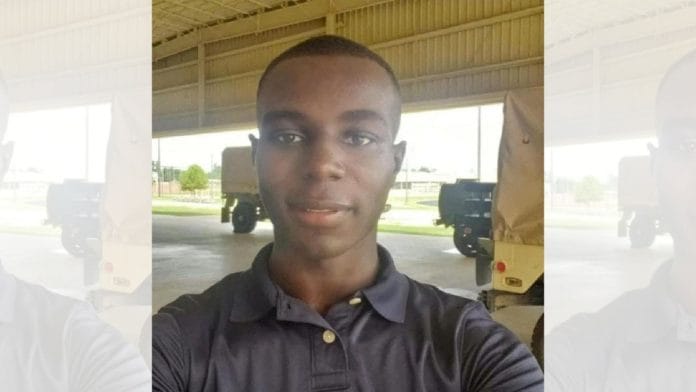

Seoul: North Korea’s claim on Wednesday that U.S. soldier Travis King fled racism and abuse in America comes as Pyongyang pushes back on Washington’s criticism of the North’s human rights record.
North Korea broke nearly a month of silence on King, who is Black, issuing a state media report that he had confessed to illegally and deliberately entering the North, driven by “ill feeling against inhuman maltreatment and racial discrimination within the U.S. Army” and disillusionment with inequality in U.S. society.
King has not been directly heard from, but an uncle in United States told media this month his nephew said he experienced racism during his military service.
The state media report comes a day before the United Nations Security Council is due to meet at the behest of Washington to discuss human rights abuses in North Korea.
For decades Pyongyang has highlighted racial discrimination in the United States as what it says is an example of Washington’s hypocrisy, and analysts said North Korea is likely to use King’s case to resist pressure over human rights.
“North Korea will likely highlight racism in the United States and use it as a means to counter the United States’ criticism of North Korea’s human rights situation, rather than engaging in negotiations with the U.S.,” said Lim Eul-chul, a professor of North Korean studies at South Korea’s Kyungnam University.
North Korea’s foreign ministry cited racial discrimination, among other ills, in a statement on Tuesday calling it a “mockery of human rights and deception on the international community” for the United States to call Thursday’s meeting on human rights.
“Not content with conniving at and fostering racial discrimination, gun-related crimes, child maltreatment and forced labour rampant in its society, the U.S. has imposed unethical human rights standards on other countries and fomented internal unrest and confusion,” the statement said.
In 2018, Pyongyang released a “White Paper on Human Rights Violations in the U.S.”, which accused the administration of Donald Trump of aggravating the “racial discrimination and misanthropy” already “inherent to the social system of the U.S.”, citing white supremacist violence in Charlottesville, Virginia.
During the protests after the police killing of George Floyd in 2020, North Korean officials cited “extreme racists” in America and criticised authorities’ response for threatening to “unleash even dogs for suppression”.
In a report at the time, C. Harrison Kim, a professor at the University of Hawaii, told NK News, a Seoul-based site that monitors North Korea, that although the relationship had waned, Pyongyang’s “alliance with the Black Power movement was a very real thing”.
In 1969 Pyongyang hosted American author and activist Eldridge Cleaver, head of international affairs at the Black Panther Party (BPP), who wrote that North Korea and its “great leader” had “heightened our consciousness to a level that makes us equal to the task of dealing with our number one enemy, the U.S. imperialist aggressors”.
North Korean state media has its own history of issuing racially charged statements.
In 2014 the state news agency published a report calling then-U.S. President Barack Obama a “monkey”.
“He looks like an African native monkey with a black face, gaunt grey eyes, cavate nostrils, plump mouth and hairy rough ears,” one North Korean was quoted in the Korean-language report. A government official said Obama had a “disgusting monkey look even though he is wearing a fancy suit like a gentleman”.
A landmark 2014 U.N. report on North Korean human rights concluded that North Korean security chiefs – and possibly leader Kim Jong Un himself – should face justice for overseeing a state-controlled system of Nazi-style atrocities.
That report included allegations that North Korea conducts forced abortions on women suspected to have been impregnated by men in China, driven by an underlying belief in a “pure Korean race” in North Korea to which mixed-race children are considered a contamination of its “pureness”.
(Reporting by Josh Smith and Soo-hyang Choi. Editing by Gerry Doyle)
Disclaimer: This report is auto generated from the Reuters news service. ThePrint holds no responsibilty for its content.