






From the Apostle Paul to Ira Gershwin, mountains have for millennia been a symbol of immovable stability. A warming planet is undermining that, leaving landslides, floods, and avalanches in its wake.
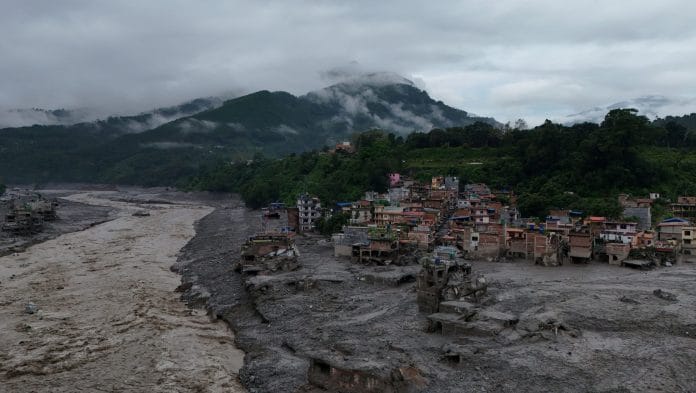
The apocalyptic scenes after Wednesday’s flash floods on the border between Nepal and China’s Tibet region are the latest example of the devastation that can result. At least 157 people have been confirmed dead and hundreds more are missing after a wall of mud and rock swept through valleys in the Himalayas, causing the Trishuli river to rise nine meters (30 feet) in half an hour.
Preliminary investigations suggest that a slide of ice and rock unleashed a surge of water, debris and boulders downstream. Researchers must work fast: The initial disaster may have left behind a fresh dam of material, which could prompt further flash flooding if it crumbles.
You might be tempted to dismiss the significance of climate change in all this. Individual heatwaves, cold snaps and extreme rainfall events can be linked to global warming with high confidence these days using weather-attribution science. The same influence can be traced in droughts and wildfires, though with less certainty. Landslides and their associated floods, however, can result from such complex chains of failure in once-stable ground that the signal of global warming gets lost amid the noise.
That may be the case for individual events. But the broad backdrop is exceptionally clear, because the crucial component that holds together many high-altitude landscapes isn’t granite, schist or limestone: It’s ice.
Nearly a quarter of the land area of our planet lies beneath ice sheets or within permafrost regions — places at high latitudes or altitudes where the earth remains frozen from one year to the next and ice acts as a kind of glue binding soil and rock together. As temperatures rise that frozen structure weakens, threatening a sudden collapse like snow sliding off a ski chalet roof in spring.
This is now happening to mountain terrain on four continents. When permanent ice disappears, steep slopes can give way under their own weight. Repeated cycles of freezing and thawing make the process more destructive. Water penetrates deep into cracks before crystallizing, gradually wedging the rock apart and driving deeper with each seasonal cycle.
Glaciers themselves can act as buttresses propping cliffs upright. As the atmosphere warms, they retreat up the valley, stripping away supports that have stabilized the landscape for millennia. When water falls as rain rather than snow, it’s more likely to erode the surface and carve deep channels, further undermining the soil.
The evidence of accelerating instability is mounting. In records dating back to 1950, eight of the 10 worst years for glacier ice losses have occurred since 2016. Above 3,000 meters in the eastern Himalayas, landslides are now displacing five times more material than they were in the 1980s. The frequency of glacial lake outburst floods, a particularly damaging disaster where the dam impounding melted water from a glacier gives way suddenly, grew almost three-fold between the 1990s and the 2010s.
Despite the horrifying footage, this week’s tragedy may not even be the worst instance. More than 6,000 people were killed around the Indian pilgrimage town of Kedarnath in 2013, when torrential monsoon rain, snowmelt and an overflowing glacial lake combined to produce catastrophic floods. Another 200 were marked dead or missing in 2021 when water and rock swept through two hydropower plant construction sites in Chamoli, southeast of the town. Summer in the Himalayas is rapidly becoming a time when such events are a recurrent feature, rather than a freak occurrence.
The damage isn’t confined to Asia, either. Glacial outburst floods have become an annual threat to Alaska’s capital, Juneau, with the last surging through just weeks ago. At the exclusive Swiss ski resort of Zermatt, a new $630 million hydropower dam has been designed in part to shield the town as the Gorner glacier melts. Worldwide, about 15 million people live in regions at risk of glacial lake floods.
There is no sign that the world is working to curb our emissions with anything like the urgency required to avert this calamity. In Europe, where summer heatwaves have caused more than 30,000 excess deaths, politicians are now treating climate as a toxic issue, while companies abandon net zero targets. India, home to the largest population at risk from mountain flooding, is likely to add more emissions to the atmosphere than any other country over the coming decade. The US is dismantling policies intended to shrink its own carbon footprint.
Unlike the disintegration of highland slopes, these political acts are choices, not forces of nature. Mountains may be moving beneath our feet. That is no excuse for those in power to stand still.
Disclaimer: This report is auto generated from the Bloomberg news service. ThePrint holds no responsibility for its content.