







According to Donald Trump, Iran is on the ropes and “willing to give us practically anything.” This, as the weekend exchanges of fire indicate, is fantasy. Yet it’s worth rethinking these stop-start peace talks as more of a process necessary to establish what the post-conflict balance of forces in the region will really be. That implies a choppy future for the negotiations — but also suggests they could yet salvage something positive from an ill-judged war.
Iran, for example, established during the fighting that it can close the Strait of Hormuz, so it now wants to embed that leverage for peacetime use. But how much control can it demand? By moving tankers through Omani waters, often with their transponders off, the US is saying “not much”; Tehran has pushed back by striking vessels using the Omani route without its permission. The contest is far from over.
Something similar is happening in Lebanon, which was sucked into the war when Hezbollah began firing rockets into Israel in March. Israel invaded; Iran has made a ceasefire there key to the broader 14-point Memorandum of Understanding that it struck with the US. The MOU commits both sides to “ensuring the territorial integrity and sovereignty” of Lebanon, which in Iran’s view means a full Israeli withdrawal.
The language can, however, be read to cut both ways. It should also require the subordination of Hezbollah — an armed, Iran-backed, non-state actor that’s been undermining Lebanese sovereignty for decades — to Lebanon’s government. US Secretary of State Marco Rubio has, to his credit, tried to do just that.
In the trilateral framework agreement that the US signed with Lebanon and Israel on June 26, Rubio secured two potential breakthroughs that could turn the war into something more positive. The first and insufficiently celebrated is that Beirut has, in the very first clause, recognized the right of the state of Israel “to exist in peace.” This is new.
Just as important, the agreement establishes a process under which Israel should withdraw from the territory it’s occupied, pocket by pocket, after Lebanon’s own armed forces have taken control and dismantled Hezbollah’s military infrastructure. The deal then pledges US aid to help civilians rebuild.
The aim here is clear: to avoid Israel’s withdrawal creating a security vacuum for Hezbollah to fill, repeating similar past cycles of withdrawal and return. The potential impact is wider still: The deal, reached under US moderation and coercion, has forced Prime Minister Benjamin Netanyahu to embrace a political strategy to end the war, instead of relying solely on force in an endless attempt to eradicate Israel’s enemies.
Agreeing with Israel and the US to “rebuild the State’s monopoly on the use of force” is, of course, very different from Lebanon doing it. There were immediate pro-Hezbollah protests following news of the deal’s signing, and the group threatened a return to civil war. Iran made clear that it saw its Shiite proxy as the sole true guarantor of Lebanese sovereignty. Again, this is the start of a process that can discover the true balance of forces in Lebanon, with the final outcome dictated accordingly.
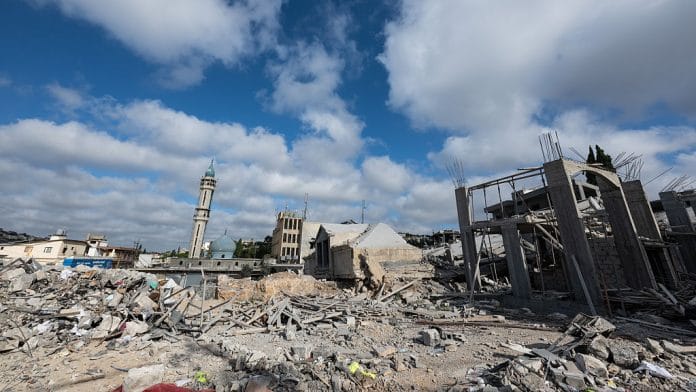
Lebanon’s prominence in the US-Iran ceasefire deal was fitting; it had suffered at least 4,320 casualties from the war as of Friday, according to the country’s Ministry of Public Health, more than any other country involved, including Iran. More than 1 million Lebanese have been displaced from their homes — a huge figure in a nation of 6 million.
But Iran doesn’t care about Lebanon’s wellbeing. It sees this religiously fractured nation as a front line for its zero-sum contest with Israel. Israel, meanwhile, just wants Hezbollah disappeared, so its northern towns and villages are never again subjected to rocket, missile or drone attack from across the border. None of that bodes well for a lasting peace.
As Paul Salem, a Middle East program senior associate at the Center for Strategic and International Studies in Washington, told me: “We’re still in the same logjam,” even if the framework agreement takes a step in the right direction. Hezbollah — like its sponsors in Tehran — feels emboldened by the Feb. 28 war, he said, so it has no intention of abolishing itself or compromising. All the more reason for the US, Israel and the Lebanese state to follow through on their financial and security pledges, because the key to success or failure will lie in breaking Hezbollah’s hold over Lebanon’s Shiite community.
Historically, Shiite trust in the state — where the president is always Maronite Christian, the parliament 50% Christian and the prime minister Sunni Muslim — has been low. This division of power, set by France in 1943, was based on the results of a 1932 census showing Lebanon’s Christians to be in a slight majority over Muslims. Today, though, Shiites account for an estimated one third of the population, about the same as Christians and Sunnis, respectively. Shiites feel they get a raw deal; Hezbollah has set itself up as the only force willing to protect them.
Shiites also, however, tend to suffer disproportionately whenever Israel invades the south, and many have become frustrated with Hezbollah for repeatedly baiting Jerusalem on Iran’s behalf, at their expense. The goal, which Egypt has proposed in a plan for Lebanon, should be to integrate Hezbollah and the wider Shiite community into the state, both politically and militarily.
This can best be done by drafting those Hezbollah fighters who want to continue bearing arms into the Lebanese Armed Forces, making Hezbollah purely a political party. There are precedents, including Sinn Fein’s emergence as the political wing of the Irish Republican Army in Northern Ireland. This gave Catholic Republicans a political stake in peace, created negotiating partners for London and Dublin, and made way for the eventual “decommissioning” (or warehousing) of IRA weapons. Nearer to home, Syria’s government folded numerous radical Sunni militias into a new national army, and is now folding in Kurdish troops, too. Iraq, under US pressure, is also trying to bring Iran-backed militias under state control.
All of these moves were, or indeed are, difficult and problematic. There are major question marks over the process in Iraq, in particular. Yet the alternative — an attempt by Lebanon’s official military to simply disarm Hezbollah by force – would all but guarantee a resumption of Lebanon’s bloody, sectarian civil war.
The US plan may not work — nothing else has. But it does have leverage. If Iran’s Islamic Revolutionary Guard Corps want an Israeli withdrawal from Lebanon, plus a greater political role for Hezbollah in Lebanon, money and US-backed guarantees that Iran itself will not be attacked again, including by Israel, then the Sinn Fein-ization of Hezbollah should be among the concessions that it’s asked to make.
This report is auto generated from the Bloomberg news service. ThePrint holds no responsibility for its content.