




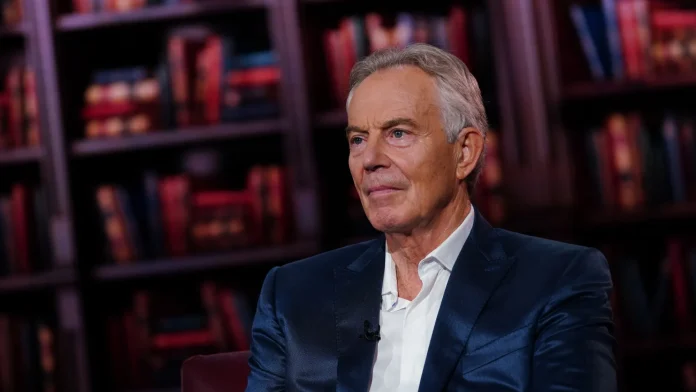

Tony Blair is not just any backseat driver. He is the UK’s and the ruling Labour Party’s most successful living politician, the winner of three decisive general elections. So when he talks, Andy Burnham needs to listen, even if the prime minister in the driving seat dislikes what he hears.
Blair’s zeal for the Iraq War lost him the hearts of much of the country yet he still has plenty to offer. His judgment on foreign affairs may be dubious, but his vision today for domestic renewal is a forward-looking challenge to Burnham’s nostalgia for life before the era of “neoliberalism.”
On the eve of Labour’s annual conference, the party’s elder statesman called on the current PM to restart negotiations on rejoining the European Union within a decade and make it the cornerstone of his 10-year plan for government.
Rejecting the Burnham government’s piecemeal approach to talks with Brussels, Blair writes, “Everything should be on the table,” with the UK abandoning its red lines on rejoining the customs union and the single market, and its opposition to freedom of movement within Europe. No need for a new referendum, apparently. In the aftermath of Brexit, he called for a second plebiscite to reverse the 2016 defeat. He now doubts the wisdom of voters.
Although allies are urging him to rejoin the EU’s tariff-free customs union, Burnham (at heart an ardent Europhile) has declared that plans to rejoin the bloc are for “another day.” Nigel Farage’s Euroskeptic Reform UK may be sinking in the polls, but the PM hesitates about reviving Brexit’s chief protagonist by putting his defining passion back on center stage. He will also have read the small print on Blair’s intervention with a beady eye.
“We should use Britain’s negotiations as a lever for those within the European Union who also want to see EU reform,” according to Blair. Good luck with that. As the Centre for European Reform think tank observes, “Nonsense is pouring forth: about what rejoin would cost; about what things the EU will never give us would provide; about how we can change the EU from the outside.”
Burnham agrees on the ultimate goal of European reunion but not the Blair strategy. Nor does he see the risks the same way: He needs to get reelected and Blair does not. As I predicted, Burnham has ruled out a snap election. Campaigning on a platform of rejoining Europe and raising taxes to pay for more public spending — he has doubled down on his idea for a costly “National Care Service” — would have been a gift to Reform and Tories alike.
Beyond the agonizing over reversing Brexit, it’s the two men’s differences over domestic politics that matter most.
Burnham represents Labour’s soft-left wing in a decades old internal party fight over the pace and direction of public-service reform. Blair champions private-public partnerships and digital government. The present leader wants control of utilities and to build a strong, interventionist state balanced by an enhanced role for local government.
The soft-left view is that Blair’s New Labour project in the late ‘90s and early 2000s too readily accepted Margaret Thatcher’s privatizations, council house sales and Treasury control over municipal affairs. When Blair warned recently against moving to the left on taxes and welfare, the PM accused him of “not understanding what’s going on.”
Burnham talks a good game about the importance of “working across the aisle” but it has not amounted to much so far. Blair’s own Tory opponents were so awed by the man they called “The Master” that they adopted his relaxed social liberalism wholesale and picked up the baton of his public-service reforms. Unencumbered by the opposition that Blair met with from his own lawmakers, sometimes his Conservative inheritors went one better.
The latest international PISA tables of education outcomes tell one such story. Along with Estonia, England is one of few European countries to have improved in literacy, numeracy and science to near East Asian standards. France, Germany and the Netherlands went backward. Devolved Scotland and Wales, both run by the soft left, are trailing badly.
Blair’s initiatives to free state schools from the dead hand of local bureaucrats and the teaching unions were the beginning of a benign education revolution expanded and developed by his Tory successors, who restored old-fashioned classroom methods against the wishes of the progressive education establishment. US states such as Mississippi, Alabama, Louisiana and Tennessee that have copied English policies using synthetic phonics for reading and subject-based curricula are improving quickly, too.
Yet Burnham’s government cannot bear to acknowledge this fortunate legacy. Education Secretary Lucy Powell, a “good-vibes” politician like her boss, discourages the opening of free schools and academies and dilutes the rigor of school inspections. Blair understood that public-service reform dies without perpetual prodding from No. 10.
Silicon Valley is another bete noire of Labour progressives. Malign social-media algorithms, AI doom-mongering and Elon Musk’s support for Europe’s extreme right have given Tech Bros a bad name. Ever the modernizer, Blair embraces the digital future, but he is compromised in his party’s eyes by Oracle boss Larry Ellison’s munificent financial support for the ex-PM’s think tank.
The software company Palantir Technologies Inc. has controversial contracts with Israel’s military and America’s ICE, but its £330 million ($437 million) deal with the National Health Service seems to have helped cut surgery waiting lists and discharge times from hospitals. Burnham is being advised to use a break-clause to end the seven-year contract and install an in-house alternative. And yet the last time the NHS went down this road, it squandered £10 billion on one of the worst public-sector contracting fiascos in history.
Burnham, like all the other PMs of recent vintage, is in a far tighter spot than Blair was when he succeeded a Tory government that left him a decent economic inheritance. The current administration must find the wherewithal to pay for soaring social-security bills, enhanced defense spending and the ballooning interest rates on the national debt. Cutting benefits and/or raising taxes are the only remedies, but both are politically perilous. As in times past, Blair is the apostle of a third way: a productivity revolution across the state sector based on the smart use of AI and joined-up data.
Burnham is right to say that politics has moved on since Blair’s heyday, and sometimes his predecessor’s messianic neophilia can grate. However, we’ve still seen no sign of a growth plan from the new man, and he’s even put off a third runway for Heathrow Airport. “The Master” may not have all the answers but he merits a hearing.
This column reflects the personal views of the author and does not necessarily reflect the opinion of the editorial board or Bloomberg LP and its owners.
Martin Ivens is the editor of the Times Literary Supplement. Previously, he was editor of the Sunday Times of London and its chief political commentator.
Disclaimer: This report is auto generated from the Bloomberg news service. ThePrint holds no responsibility for its content.
Also Read: UK’s Burnham pledges to fight next election on social care reform
The “ Old master “ messed up on Iraq. Cost him his place in history.