





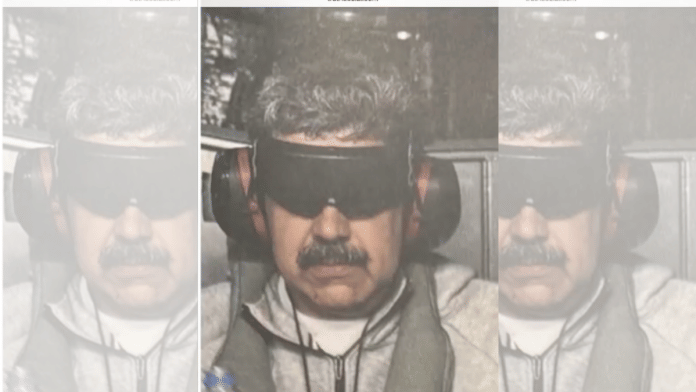



New Delhi: The legitimacy of United States’ military operation in Venezuela and “capture” of President Nicolas Maduro and his wife is under scrutiny, with especially the Democratic Party in America questioning its legality. However, this is not the first time the US has used military force to capture a sitting foreign leader to face its courts on drug charges.
US President Donald Trump waved off questions regarding its legality in an interview to Fox News Saturday, calling the Democrats ‘weak, stupid people’, and asserting that they should instead say—“great job”. Maduro and his wife Cilia Flores are aboard the USS Iwo Jima on the way to the US.
The operation has led to at least two arguments in its favour from the Republican Party. Mike Lee, the US Senator from Utah, announced that the action “likely falls within the President’s inherent authority under Article II of the [US] constitution”.
“This action likely falls within the president’s inherent authority under Article II of the Constitution to protect US personnel from an actual or imminent attack,” wrote Lee in a statement on X.
Lee added that Maduro was “arrested” to stand trial in the US on “criminal charges”, and that the military operation was “deployed” to defend those carrying out the President of Venezuela’s arrest.
Just got off the phone with @SecRubio
He informed me that Nicolás Maduro has been arrested by U.S. personnel to stand trial on criminal charges in the United States, and that the kinetic action we saw tonight was deployed to protect and defend those executing the arrest warrant… https://t.co/lXCxhPoKSZ
— Mike Lee (@BasedMikeLee) January 3, 2026
Vice President J.D. Vance chimed in to defend the operation, highlighting Maduro’s indictments in the US for “narcoterrorism”.
“Maduro has multiple indictments in the United States for narcoterrorism. You don’t get to avoid justice for drug trafficking in the United States because you live in a palace in Caracas,” Vance wrote on X.
Democrats have called the military action without Congressional approval unconstitutional. Senator from Virginia, Mark Warner wrote on X, “Using military force to enact regime change demands the closest scrutiny, precisely because the consequences do not end with the initial strike.”
He added, “ If the United States asserts the right to use military force to invade and capture foreign leaders it accuses of criminal conduct, what prevents China from claiming the same authority over Taiwan’s leadership? What stops Vladimir Putin from asserting similar justification to abduct Ukraine’s president? Once this line is crossed, the rules that restrain global chaos begin to collapse, and authoritarian regimes will be the first to exploit it.
However, the charter of the United Nations (UN), for example, maintains that no member-state shall use the “threat or use of force” against the “territorial integrity” or “political independence” of any state. However, Washington has in the past carried out similar actions against the military dictator of Panama Manuel Noriega in 1989, bringing back the leader to the US to face the American justice system on drug smuggling charges.
In Maduro’s case, the US has followed a similar operation. Maduro was indicted in 2020 on charges related to narcoterrorism. The US Department of Justice had at the time offered a $15 million reward for his arrest, which was increased to $50 million last year when Trump returned to power.
An indictment Saturday unsealed by the US Department of Justice saw the addition of Flores to the charges, along with Maduro, for narcoterrorism and various conspiracies. The charges are similar to the original indictment against him in 2020.
Also Read: As Trump seeks regime change, the long arm of anti-Americanism in Venezuela—from Chavez to Maduro
Understanding US law for operation
While military operation against a foreign country is frowned upon, as underlined by the UN Charter, US domestic law allows for judicial proceedings against individuals, even if the operation to capture them may be illegal under international law. The question of Maduro’s diplomatic immunity as the head of a foreign government is up to US courts to decide, however, it should be noted that Washington does not recognise his regime.
In November 2024, the US had announced that opposition candidate Edmundo Gonzalez was the “president-elect” of Venezuela, following the elections held that year, rejecting claims that Maduro had won the polls. Furthermore, in 2019, the US had recognised Juan Guaido as the acting president of Venezuela. However, the attempt to have Maduro removed from power between 2019 and 2024 failed.
“In or about 2018, MADURO MOROS declared victory in a disputed and internationally condemned presidential election in Venezuela. In or about 2019, Venezuela’s National Assembly invoked the Venezuelan constitution and declared that [Nicolas] MADURO MOROS had usurped power, and was not the legitimate President of Venezuela,” the latest indictment unsealed by the US Department of Justice read Saturday.
“Nonetheless, MADURO MOROS continued to exercise the powers of the Venezuelan presidency, causing more than 50 countries, including the United States, to refuse to recognize MADURO MOROS as Venezuela’s head of state. In or about 2024, Venezuela held another presidential election that was again widely criticised by the international community, in which MADURO MOROS declared himself the winner despite widespread condemnation.”
US domestic law is clear on operations to “snatch” wanted individuals, especially terrorists, narco-terrorists and cartel leaders in operations from foreign countries. These operations do not preclude the individuals snatched from facing trial. The US Judicial System has developed the Ker-Frisbie doctrine that allows the capture of fugitives, even if not through legal means, such as an extradition treaty to still face trial.
“Fugitives deported to the United States or otherwise returned under other than a formal order of extradition often claim that they were kidnapped (by United States or foreign agents) and returned illegally. The courts generally dispose of those arguments under the Ker-Frisbie doctrine, holding that a defendant in a Federal criminal trial may not successfully challenge the District Court’s jurisdiction over his person on the grounds that his presence before the Court,” the US Department of Justice explained on its website.
There is, however, an exception to the doctrine. The capture of any fugitive “secured by conduct shocking to the conscience of the court”, such as torture, could lead to the courts refusing to hear the case against the individual. This exception was developed in United States v. Toscanino, (2d Cir. 1974). However, there has yet to be a case thrown out under this exception.
It should be noted that Noriega, the former military dictator of Panama, was brought to the US in 1990, and spent the next 17 years of his life in various prisons till his death in 2007. Furthermore, the one US law that exists to prevent the military from arresting criminal suspects—the Posse Comitatus Act—does not apply outside the territory of the US, according to an opinion by the US Department of Justice in 1990, as reported by The New York Times.
(Edited by Mannat Chugh)