





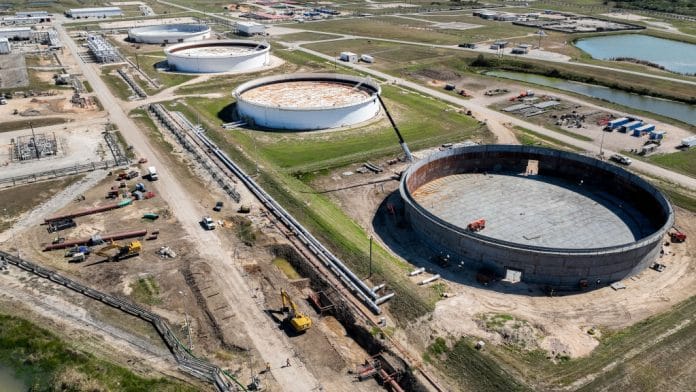


The energy industry’s latest panic is that it’s about to hit “tank bottoms” — the minimum amount of crude in storage required to keep the conveyor belt that goes from oilfields to refineries humming. As with every financial narrative, the story of the impending oil crisis contains a grain of truth — and ample hogwash.
Undeniably, the world has depleted a large chunk of its crude inventories over the last 150-plus days of oscillating war and peace. On average, global stocks, including commercial inventories and strategic petroleum reserves held by governments, dropped at a rate of nearly 3.9 million barrels a day from early March to late May. That’s an enormous quantity, equivalent to the daily demand of Germany and France.
The depletion of inventories lessened in June, as the Strait of Hormuz briefly reopened after the US and Iran signed a memorandum of understanding. But it rebounded in July as the deal collapsed, prompting Tehran to close the waterway again.
All counted, the world has drained 400 million to 600 million barrels from its oil inventories, including barrels kept on tankers that act as floating storage facilities, according to my back-of-the-envelope math. That is, again, an enormous quantity that cannot be ignored. US President Donald Trump himself has expressed alarm, justifying the deal with Tehran in part because of the need to avoid a crunch in stored oil. “We run out of reserves in about four weeks,” he said on June 17. “We would really run out and there’ll be a time when you wouldn’t be able to get it. And do you want to see bedlam?”
Cherry pick a few data points and it’s easy to paint a bleak picture. The US Strategic Petroleum Reserve is, for example, at its lowest level since 1983. Crude stocks in Cushing, an oil-storage hub in Oklahoma, are at a 10-year low. (The drawdown of stocks has been geographically uneven, with the US shouldering a larger share. Asia and, to a lesser extent, Europe have drawn less.)
Listen to the oil bulls — the same group of long-only investors that has been screaming “$200 a barrel is coming!” since late February — and the warnings are everywhere: Global oil inventories are at a record low; the world is running on fumes; tank bottoms are here.
Well, not so fast. For starters, the world’s inventories have fallen by about half of what many anticipated earlier on the conflict. The balance between supply and demand has been looser than expected thanks to the use of bypass pipelines around the Strait of Hormuz, clandestine shuttle oil tankers crossing the waterway in far greater numbers than anticipated, lower imports by China and surging production in the Americas, from Canada to Argentina.
The tank bottoms narrative misjudges two critical factors. First, it glosses over the huge accumulation of oil stocks in China over the last decade that today provides an impressive cushion. Before the war broke out, Beijing had more than 1,400 million barrels in strategic stocks; since then it has drawn, perhaps, about 100 million barrels or so. China still has plenty in reserve to keep its imports below pre-war levels.
What Beijing will do next is unknown. China’s oil imports appear to have bottomed in June, when they plunged more than 40% below a year earlier, and have recovered somewhat in July, particularly in the last 10 days of the month. Despite the increase, imports remain down about 30% to 35% from 2025 levels. I expect China to keep buying less than last year and using its inventory as a buffer.
So yes, global inventories excluding China are low, perhaps approaching concerning levels. But leaving out the world’s biggest oil-importing nation from the calculation of the global stockpile seems a mistake. If the Iran war has taught any lesson to the oil market, it’s just how flexible China can be.
The second problem with the tank bottoms narrative is that it exaggerates the depletion of the strategic reserves held by rich nations. The drop isn’t surprising: it was known back when the release was announced in early March. If anything, the shock is that reserves aren’t somewhat lower. Although the members of the International Energy Agency said they would put 400 million barrels into the market, so far they have released only about 290 million. In Europe, some countries have bought back some of the barrels they released. In any case, rich nations still have another billion barrels or so held in reserve for future disbursement if the disruption continues. Japan and South Korea, in particular, have plentiful inventories.
Zoom out and the picture is more nuanced than the tank bottoms theory suggests. Depleted? Sure. Exhausted? Not even close. The bulls are underestimating the amount of oil that remains in reserve. Where they’re right is that with every day the Iran war continues, the buffer gets thinner. That is, I agree, unsustainable. The only solution is to reopen the Strait of Hormuz, with or without a deal with Iran. The former may be unpalatable for the White House, but it’s certainly preferable to the latter.