





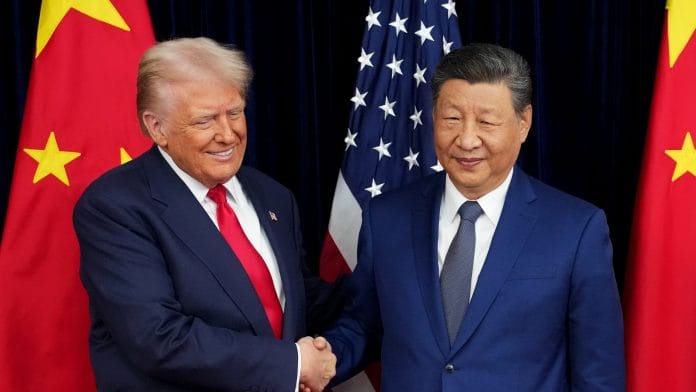


A senior Taiwanese official expressed concern that President Donald Trump might make concessions on the self-governed island in his meeting with Chinese President Xi Jinping, adding Taiwan was working hard to prevent such a scenario.
“What we are the most afraid is to put Taiwan on the menu of the talk between Xi Jinping and President Trump,” Deputy Foreign Minister Francois Wu said Friday in an English-language interview with Bloomberg News. “We worry, and we need to avoid that it happens.”
Trump is set to travel to Beijing May 14-15 for a summit with Xi that’s widely expected to include a variety of business deals and purchasing commitments. It was delayed from late March because of the Iran war and the need for Trump to stay in Washington.
Taiwan — a democratic island claimed as Chinese territory by Beijing — is high on Xi’s list of priorities. At the meeting, Xi is likely to press Trump to agree to change the island’s status by opposing Taiwan independence. A verbal confirmation of that or formal change in US policy would be a major win for Beijing.
Asked if the US has given Taipei any assurances that the language won’t be changed, Wu said: “Nothing is 100% sure.”
But Wu remained optimistic, as Taiwan has been seeking to expand shared interests with the US, particularly through the island’s semiconductor industry and its significant investments in America.
The “more we share a common national interest, more I think we feel comfortable that we will not be put on the menu,” he said. “For now, we feel comfortable.”
A White House official said Trump expects a very positive visit with Xi and that the administration’s stance on relations with Taiwan, known as the One China policy, is unchanged.
Under the policy, the US acknowledges Beijing as China’s sole government without clarifying its position on Taiwan’s legal status. The US has maintained unofficial relations with Taipei under that arrangement.
The Ministry of Foreign Affairs in Beijing didn’t respond to a request for comment outside of normal working hours.
Where Trump routinely talks warmly of Xi, he has a number of advisers who are hawkish on China and who have intervened in the past, including when there was internal debate about whether to allow China to buy Nvidia Corp.’s advanced Blackwell chip, people familiar with the matter said.
Residual Worry
The engagements between Taipei and Washington have been positive, the people said, but they added that it’s impossible to get reassurance from the White House about what exactly will be discussed or agreed to in the Beijing summit.
They also said that Trump’s aides don’t know — and don’t pretend to know — how the meeting will play out.
For Taiwan, the US is an important security and strategic partner, and relations are built on “shared values and a long history of cooperation,” Wu said.
Taiwan also recognizes the need to “strengthen its connections with the international community, particularly by deepening cooperation with like-minded countries such as those in Europe, in order to enhance overall resilience and deterrence,” he added.
US officials have said the Trump-Xi meeting will focus on trade and investment matters. They want to focus the Beijing trip on ensuring better access to critical minerals and rare earths that China last year cut off through sweeping export controls.
While the flow of the metals and minerals has picked up since the two leaders reached an agreement last fall in South Korea, the trade is still not back to the level it was before the controls took effect.
Another key outcome for Beijing would be restraining US arms sales to Taiwan. Trump this year delayed a weapons package to Taipei after pressure from Xi and said he was “talking to him about it,” and that he would be making a determination “pretty soon.”
The comment alarmed some officials in Washington and Taipei, as well as US lawmakers. Still, people familiar with the deliberations believe the pause is temporary and that the package will move ahead after the May summit.
China’s ruling Communist Party considers Taiwan its territory and has vowed to claim it someday, despite never having controlled the democratic island. Officials in Taiwan reject that stance, saying that the island is de-facto independent and has never been governed by Beijing.
Trump told the New York Times earlier this year that it was “up to Xi” what the Chinese leader would do with Taiwan, but that it was unlikely he would move on it while Trump is president and that the US leader would be “very unhappy” if he did.
The US this week seized an Iranian tanker that Trump said contained a “gift from China” — possibly rocket fuel and other inputs. It came after Trump said he’d received written commitments from Xi that China wouldn’t send arms to Iran.
“I was a little surprised but – because I have a very good relationship and I thought I had an understanding with President Xi,” Trump said on CNBC’s Squawk Box this week. “But that’s all right. That’s the way war goes, right?”
–With assistance from Colum Murphy and Eric Martin.
Disclaimer: This report is auto generated from the Bloomberg news service. ThePrint holds no responsibility for its content.